Friday, November 30, 2007


Port Moresby’s Garden of Eden

Port Moresby - Papua New Guinea's capital city – is fast becoming a rapidly growing urban jungle.

Many children who grow up in the city do not know, or perhaps never will know, of that flora and fauna that is so prolific all over our beautiful country.

But there is a temporary reprieve.

The National Capital Botanical Gardens can rightly be called Port Moresby’s “Garden of Eden”.

The gardens, since being taken over by the National Capital District Commission in 1993, have become one of the prime tourist attractions in the city.

Moreover, for caged-in city residents, they offer an oasis of peace and beauty amidst all the pressures.

The gardens also play a very important role in nature and conservation education as well as distribution of trees and flowers in the capital city.

Situated within the University of Papua New Guinea (UPNG) campus in Port Moresby, the gardens were established in 1971 by renowned gardener Andre Millar.

They were initially established as a teaching garden for the UPNG Biology Department and also as a nursery to supply plants for the university grounds.

When Mrs Millar left in the late 1970s, the gardens experienced problems with management and funding and eventually declined from a beautiful garden to a desolate piece of bush land.

When the NCDC took over the assets of the gardens in 1993 through the new curator Justin Tkatchenko, it established a major redevelopment programme.

Another expatriate Wolfgang Bandisch ran the gardens until his departure from the country last year.

The gardens today - under current acting general manager Judith Raka - have a huge collection of plants from all over PNG as well as other parts of the world.

These include palm species, bamboos, heliconias, cordyline, pandanus, native trees and shrubs.

The gardens are well known for their extensive collection of PNG orchid species housed in large greenhouses.

They have large orchid houses for orchid hybrids producing cut flowers for the flower shop.

There are a number of animals on display, like tree climbing kangaroos, gouria pigeons, birds of paradise, cockatoos, lorikeets, parrots and many other birds.

One of the new tenants is a strange looking tree kangaroo, hailing from the Sepik, which has a very long tail.

An orchid research centre was established some years ago.

It includes a small herbarium and a fully equipped ochid tissue culture laboratory where thousands of orchid plants are produced annually from seed and tissue cuIture.

Thee gardens' collection of flora and fauna is the only place in the city that offers educational attractions and an -depth view and appreciation of what PNG has to offer.

They provide valuable scientific and environmental education for school children.

Tours are offered to school children and cover a variety of subjects

A typical guided tour begins with the snake house, the palm collection, birds and animal collection, the mini rainforest, the timber tree collection, the vanilla collection, the orchid nursery and its collection and finally to the insect collection.

The tours help instill in children a responsible attitude towards the environment and help them learn and appreciate the remarkable natural beauty of PNG.

"It's good for parents to bring their children here, especially those who don't go back to their villages," says scientific and education officer Linda Pohai.

"The school children can really learn a lot."

One of the exciting projects the garden has embarked on with the Forest Industry Association, Rotary Club and the Department of Environment and Conservation is a school nursery project.

“It’s about a national school nursery project,” Ms Pohai explains.

“It’s mainly about planting trees.

“What we do is we have a nursery here funded by all these organisations.

“We facilitate workshops for teachers on how to grow trees and build a nursery.

“Once they build a nursery, they can come and pick up trees.

“We’ve done it for the whole year last year, with a lot of schools from NCD attending.

“There are two schools that have already collected their trees - that’s Ward Strip and St Therese Primary School at Badili.

“The trees that we grow are mainly useful trees like medicinal trees, fruit trees and trees that can provide shade or firewood to the community.

“We also try to get the community involved, such as teaching a group of boys from Koki how to grow trees, build nurseries and then giving them free trees.”

Apart from flora and fauna, there are recreational areas where barbeques, weddings and other functions can be held.


Missionaries, Cannibals and Colonial Officers

James Chalmers was the so-called “Livingstone of New Guinea”.

He was a star in the London Missionary Society’s firmament.

For 34 years from the 1860s onwards he preached the Gospel in the South Seas.

He also loved whisky, enjoyed exploring the unknown territory and had a genuine rapport with the Papuan people.

But not even this charisma and courage could save him when late in his career he and his party were lured into an ambush on Goaribari Island.

They were beheaded and eaten by the natives.

It is the Goaribari incident that lies at the heart of Peter Maiden’s extraordinary history of what was then British New Guinea.

This is a history that proves that fact is indeed stranger than fiction.

Sorcery, magic, head-hunting and cannibalism were rife.

To possess a skull collection was to enhance one’s standing in the spirit world.

In 1901, on Goaribari Island alone, a missionary, Harry Dauncey, found about 10,000 skulls in the island’s Long Houses.

The second half of Maiden’s history focuses on the career and tragic end of the very first Australian-born governor of British New Guinea, the Brisbane solicitor Christopher Robinson.

He arrived in BNG in May 1903 and soon afterwards witnessed a savage conflict between the native constabulary and Papuan warriors.

In March 1904, Governor Robinson committed a catastrophic error in the Goaribari Affray.

June 9th, 1903, was a proud day for Queenslanders in general, but most particularly for the people of Brisbane, for that day the Australian Prime Minister, Edmund Barton, had appointed a local man, 30-year-old Christopher Robinson, as acting-governor of British New Guinea (BNG).

Robinson spent practically all his life in Brisbane, settling here as a five-year-old boy, after his father became rector of All Saints, Brisbane in 1878.

Christopher was educated in Brisbane, and then articled to T. W. Daly, a Brisbane solicitor.

A clever student, Robinson graduated top of his year and was admitted as a solicitor in 1895.

He practiced law briefly on the Etheridge and Croydon goldfields, before returning to Brisbane where he took up a private practice in 1898.

He was a handsome and highly presentable bachelor and the first Australian born governor of BNG.

However, it was a difficult assignment and despite his legal skills Robinson was quite inexperienced.

For this shortcoming he was to pay a terrible price.

In 1903, Britain was in the process of passing control of BNG to the Australian government and the colony’s administrators, operating on a shoestring budget, faced fearful difficulties.

Sorcery, cannibalism and headhunting were endemic in Papuan society.

Sorcery was a criminal offence but still it flourished.

Its practitioners “spoke” directly to the Spirit World and could simply frighten a Papuan to death.

A sorcerer had only to tap his victim on the shoulder, tell him he would soon die and within a week the unfortunate native would be in his grave.

And these magicians seemed omnipotent.

In 1903, for instance, a disgruntled sorcerer in eastern New Guinea announced that within three days he was turning every man in the village into a woman, and every woman into a man.

The men were panic stricken, New Guinea being such a male dominated society, but, as the investigating white magistrate observed, “the women viewed the threat with supreme complacency”.

Headhunting was another obsession.

To possess a skull collection was to enhance one’s standing in the spirit world.

In 1901, on Goaribari Island in the Gulf of Papua, a missionary, Harry Dauncey, found 10,000 skulls in the island’s Long Houses.

Even as late as 1957, Australian government officials on one occasion confiscated 78 skulls on Papua’s Casuarina Coast.

Fortunately, cannibalism was not quite as widely practiced.

As one writer, Wilfred Beaver, pointed out, “the population would eventually be reduced to small proportions”, if everybody was a cannibal.

The weakest tribes were most vulnerable.

West of Port Moresby the Mohohai tribe, according to Beaver, was regarded as “a kind of larder” for the predatory Ukiaravi warriors.

Elsewhere, the Scottish missionary, James Chalmers, newly arrived at Suau in 1878, was pleased to be invited to his first tribal feast – before learning that a terrified young boy was on the menu.

Chalmers, the so-called “Livingstone of New Guinea” was a star in the London Missionary Society’s firmament.

For 34 years he served in the South Seas islands as a near-perfect example of “muscular Christianity”.

Chalmers was a physically impressive man with a commanding presence and he possessed a cool head in a dangerous situation.

He liked whisky, loved exploring the magnificent countryside and had a genuine, albeit paternal affection for the Papuan people.

But for a white man, life in New Guinea was anything but a sinecure.

‘If a man escaped dying of fever in the first three weeks he was eaten by cannibals within the fourth week’, wrote Wilfred Beaver.

And if that wasn’t bad enough, even the humble toothache could be a major problem.

With dental help thousands of kilometres away, treatment could be crude: “A red-hot wire jammed into the gum, or a crystal of crude carbolic inserted into the raging stump.”

Murder and massacres were commonplace.

In 1900 a single government patrol led by the ex-Queensland policeman, turned magistrate, William Armit, killed at least 54 natives on the Upper Kumusi River.

In 1901 Alexander Elliot’s constables killed 42

On another patrol, magistrate Allan Walsh’s men disposed of 32 more Papuans in 1902, and in 1903, Whitmore ‘Old Shoot and Loot’ Monckton, a highly regarded magistrate, allowed his constables to kill 18 Paiwa natives.

Of course, the Papuan warriors, too, were aggressive.

Numerous lonely miners and missionaries met with a grisly end, most notably in 1901 when the Reverend Chalmers’ party of 12 was lured into an ambush on Goaribari Island.

There they were beheaded and eaten by natives.

This atrocity demanded revenge and more than 20 Goaribaris were killed in a government reprisal raid.

Soon after arriving in BNG, Christopher Robinson joined a government patrol along the Yodda River and saw at first hand the savage conflict between the native constabulary and Papuan warriors.

This patrol appears to have soured Robinson’s attitude towards the Papuans.

Afterwards, Robinson seemed to show little sympathy to the indigenous population.

He once declared that he had “an intense loathing” for these “inhuman creatures”.

He had no friends among the colourful Port Moresby expatriates and he was overwhelmed by a monumental backlog of work.

Robinson was capable and one local identity described him as ‘one of the most promising officers New Guinea ever possessed’.

Others, though, believed he was arrogant, and even frightened by the very people he was supposed to be protecting.

In March 1904 Robinson led a strongly armed commando to Goaribari, intent on arresting those responsible for the Chalmers’ missionary massacre.

Unfortunately his serious mismanagement of a confrontation with the Goaribaris became the subject of a sensational Royal Commission in Sydney in July.

While the native bowmen fired only a handful of arrows in anger, Robinson’s men replied with a murderous fusillade of 250 rounds.

At least eight natives were shot dead and two European witnesses testified that the governor had shot at least three of the Papuans.

Robinson’s career prospects were in tatters.

The lonely young governor, now afflicted with a severe bout of malaria lost heart and fell into a mood of deep depression that worsened as the date of the Royal commission approached.

Finally, on June 20th, 1904, Robinson took his own life under the flagpole at government house, Port Moresby.

This is a history that makes the clash of the proselytising white colonials with the Papuan warriors come vividly alive.

It is a story of dedication and courage, but also a story of tragic failure. A riveting read.


Missionaries, Cannibals and Colonial Officers
British New Guinea and the Goaribari Affair 1860s-1907
Written by Peter Maiden
Central Queensland University Press RRP $25.95

Downstream processing of peanuts in Papua New Guinea

Peanuts have proved an ideal crop in Papua New Guinea, being easily grown in almost all areas of the country, most famously the great Markham Valley of Morobe Province.

They are excellent nutritionally, being concentrated sources of both protein and fat, which of which tend to be low in the diets of many Papua New Guineans.

The protein content of peanuts, in fact – is higher than that of eggs, dairy products, meat and fish.

They are well liked by children and adults.

Downstream processing of peanuts was the entire buzz in Papua New Guinea in the 1970s and 1980s.

Peanuts were exported out of Lae to many countries in the South Pacific.

In the Markham Valley of Morobe Province, peanut butter was mass-produced by the Atzera Rural Cooperative factory for both the domestic and international market.

Sadly, those exports have ceased and the peanut butter factory has long closed its doors, and the humble but mighty peanut has now taken a backseat.

However, they proved that downstream processing of peanuts was possible in Papua New Guinea, and do to this day.

The challenge is upon us to make that a reality.

Exports

Sum Sum, taken in its Morobe Province original meaning, is sunshine.

Sum Sum, referring to peanuts, meant some of the best grown, processed and exported from Papua New Guinea.

From an unimposing factory in Lae, the home of Nunga Tea and Coffee Company, came a fine variety of top-class peanuts, both salted and roasted, for the domestic and export market.

Growers in the Markham Valley sold to the company either at the factory door or at the roadside.

The factory boasted the biggest roaster machines in the country and the automatic packing machines made for an efficient and effective operation.

The peanuts used in the salted variety were often hulled near where they were grown, and sorted at the factory, roasted, salted and automatically packed.

About 40 workers were employed by the factory at its peak, with exports to many countries in the South Pacific region.

Peanut butter

In September 1976, a year after Papua New Guinea’s independence, the Atzera Rural Cooperative at Kaiapit, in the Morobe Province, embarked on its most ambitious programme yet – the manufacture of peanut butter.

The cooperative built a factory at a cost of K40, 000 and started peanut butter production in September 1976.

It was a unique operation in Papua New Guinea, as all peanut butter until then had been imported.

Atzera Rural Cooperative’s packaged nuts, Markham Peanuts, were sold in Kieta, Rabaul, Lae, Popondetta and throughout the Highlands.

The 2000-odd members of the cooperative came from a wide area – from the Leron River to the Kassam Pass, in the Eastern Highlands.

The factory grew, producing for both the local and export market, however, closed its doors in the early 1980s because of a variety of reasons.

It, however, has made its mark in the history of downstream processing in Papua New Guinea.

The future

A recent study by the National Agriculture Research Institute (NARI) ranked peanuts as the No. 1 reliable income earner for many families.

It was ranked among the country’s top five income generating crops, the others being kaukau (sweet potatoes), taro, banana, and Singapore taro.

Peanuts, like betelnut, are a major income-earner for the people of the vast Markham Valley.

The major customers are people from the Highlanders, who buy peanuts in bulk and in turn sell them at markets when they return home.

This has been an ongoing trend for many years.

Recently, peanut-growing has found new life.

The community is becoming aware that under-nutrition continues to exist widely, and that peanuts are one of the best foods to overcome this.

The major concern with peanuts is the risk of aflotoxin contamination, which is caused by a fungus when peanuts are not properly dried or when they become moist during storage.

Almost all provinces have active programmes to improve nutrition, with peanuts having an important part in these programmes.

The larger-scale Markham industry has also found new life.

Remote Karimui in the Chimbu Province is known to produce arguably the highest quality peanuts in the country – better than the Markham – but the main problem has been transporting it to market as Karimui is only accessible by air.

Lae-based NARI is trialing different varieties for the farmers of PNG.

Trukai Industries is growing large tracts of peanuts in the Markham Valley.

Ramu Sugar is going big time into peanut growing with a view to downstream processing in the not-too-distant future.

The challenge now facing the industry is to generate improvements internally – to grow peanuts more productively, at less cost, and with greater production.

This is clearly the case for the Markham Valley industry which, if it can keep costs down, can tap an enormous export market.

This is also the case for the more important subsistence gardening of peanuts.

People will grow more peanuts only if they get high production for the effort they put into the crop.

To attain an increase in productivity will not be easy, particularly for subsistence growing, but it can be the only basis for a permanent improvement in the industry.


Bina Mene:Connecting the Hebrews

A book – launched by Governor-General Sir Paulias Matane on Thursday, February 1, 2007 – claims the Bine tribe of the Western Province of Papua New Guinea is related to the Hebrew race of Israel.

Author Samuel Were provides no sound anthropological, archaeological, linguistic or academic evidence to support his claim, however, draws on the oral traditions of his people as well as his spiritual experiences as the basis for the book Bine Mene: Connecting the Hebrews.

The book adds to a common belief among Western Province villagers, particularly of the South Fly, that they are related to the Hebrews.

The 28-page book is also an experiment in self-publishing, given that Were wrote and did the page layout himself, with Star Printers printing the cover and Summer Institute of Linguistics printing the inside pages.

Were, a petroleum geoscientist who graduated from the University of Papua New Guinea, also relies greatly on the Bible to support his claim.

He compares the similarities between Bine and Hebrew words for different subjects, people and places.

For example, Adam (mankind) in Hebrew is Ada in Bine; Eve (living community) is Ewe; galeed (father-in-law, son-in-law) is Galiame; Immanuel (God is with us) is Inama; Joseph (may he give me) is yo seba aa; Judah (praise) is alajuta; Manasseh (being present) is Mana agesate; and many others.

The book is a product of cumulative recording and compilation of events, episodes and research by the writer starting in 1972 with the arrival of translators from the Summer Institute of Linguistics to his Western Province village of Kunini.

The translators were assisted by his father, the Reverend Kibani Were, and that led to the completion of the Bine New Testament Bible and Bine Hymn Book.

Were claims he had a divine dream and vision in 1984 while attending Aiyura National High School, regarding what he calls “remnant Hebrew people in PNG”.

He says he acquired a great deal of oral history from his grandparents and his father as a teenager that his Bliutope (Hornbill) Clan were people from the East, great sailors and navigators, who conquered Australia before landing in their present location.

Were claims the history of his people goes as far back as the 1300s, and that he has family members living in Australia to this day.

Whatever critics, including me, may say, he staunchly sticks by what he writes in his book.

I raise this issue of credibility with Were.

“Basically, look at the Bible,” he replies.

“So far, I have used my own information, as well as that from the Bible.

“Because of the comparisons we have in language and prophecies, I’ve gone back to the scriptures to dig out certain messages from the prophets of the Old Testament, regarding people of God who are ‘remnant Hebrews’.

“It (book) originates from the traditional stories of my father and grandfather, about the movement of our people across the sea to our present location.

“…apart from being warriors, traders and sailors, we were also people who feared God.

“According to the story, we were the original people from the beginning.

“This was also true for the language we spoke.

“The other biggest force that made me take this story very seriously was the arrival of the Bible translators from the Summer Institute of Linguistics.

“Another thing prior to this was a stranger who came to my village, Kunini, went to Boze, and he was seen around the Bine tribe, Wipi and Kiwai tribes, and he was also in Daru.

“Nobody actually knew who he was.

“Even though he was locked up by police, he would come out.

“After some time, he vanished and we never saw him again.

“That’s when they started saying that he was an angel of God because we were ‘remnant Hebrews’.

“After this guy left, SIL came in with their Bible translators.

“After all these, I started to develop an interest in finding out if there was a language connection between my Bine language and the Hebrew language, people’s names and place names.

“Being a child of a pastor, this was actually part and parcel of my life, because I always had a Bible with me.

“I went to Aiyura (National High School, in 1984).

“I had a dream in which I was told about the ‘remnant Hebrews’ of this nation.

“I saw a bright light.

“That’s when I knew there were Hebrews here.

“I started doing my own write-ups, especially looking at the names of people, places and cultural comparisons.”

Were says he dug deep into encyclopaedias and the Bible to find similarities between the Bine and Hebrew languages.

Along the way, he found that the Greek language also had similarities to the Bine language.

“One of the main objectives of the book is to tell the truth and to make it known that we are a race of people for God’s service,” Were continues,

“Having that in mind, we believe that even in our present state in terms of social and economic life, we have a treasure of wealth in our land.

“It will be developed according to God’s timetable and plan.

“Many of my tribe people do not know their exact origins, where we come from.

“Only a few of them have records and evidence, in terms of passed-on stories, and some historical artefacts.

“Generally speaking, many of them do not know of our identity, but the language comparison we have between Hebrew language, Greek language, is now telling us that we need to think deep and accepted that if we are connected by language, then we must be related and our origin is one.”

Were says he has also met Israelites who have pointed out to him the similarities between Hebrew and Bine languages.

Some of his writings in the book may seem far-fetched; however, the comparison between Hebrew and Bine words did get my attention.

Were plans to write more books which probe further into the relationship between the Hebrew and Bine languages.

Bine Mene: Connecting the Hebrews. By Samuel Were. Bright Star Morning Corporation. Port Moresby, 2006. 20 pages. K20.


The write stuff now and into the future

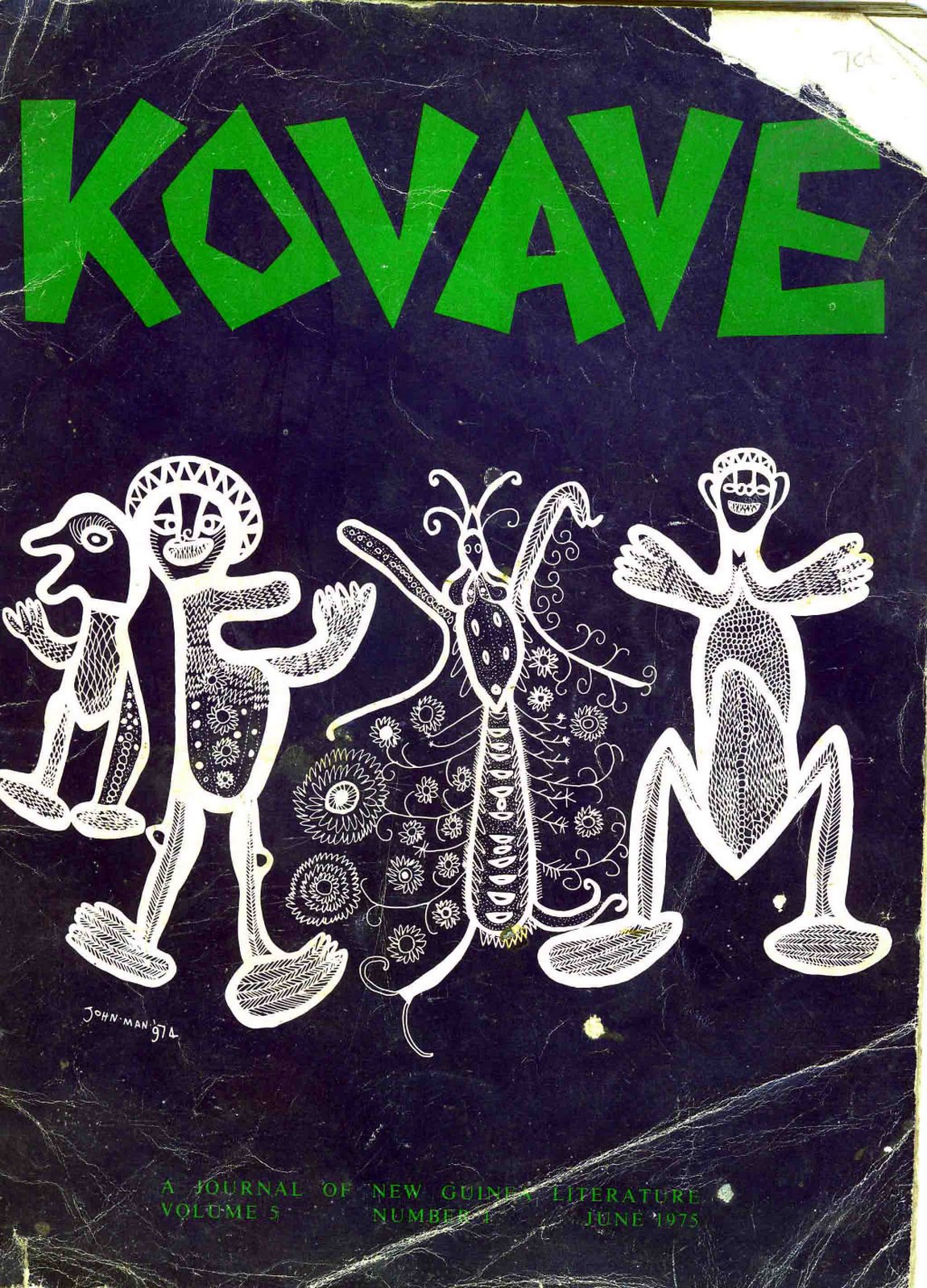
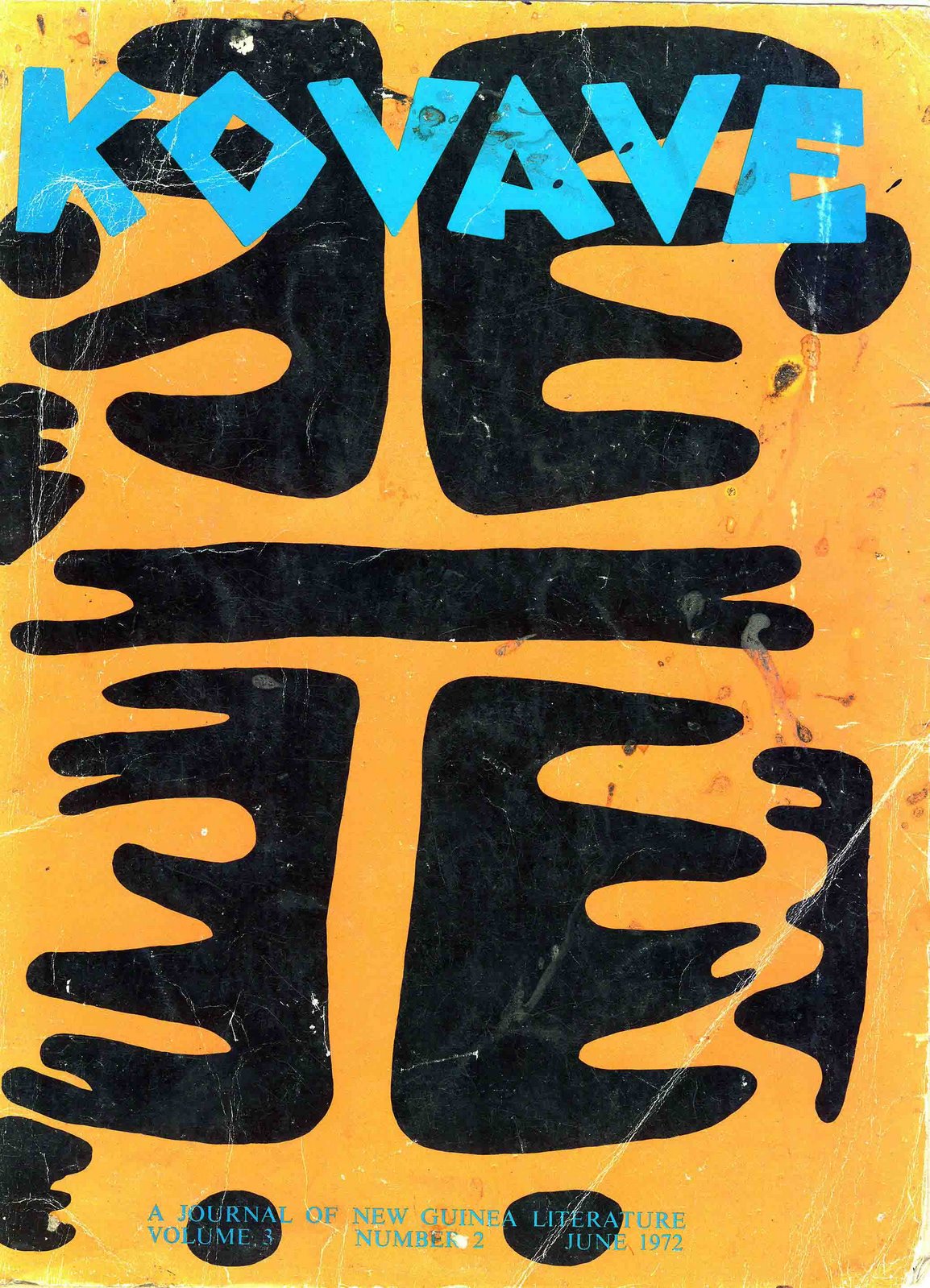
It is while doing my annual end-of-year clean-up over the Christmas/New Year (2006/2007) period that I find a couple of old Kovave magazines from the early 1970s buried under a mountain of paper, novels and assorted paraphernalia.

I flick through the old Kovave magazines, hand-me-downs from my late father, and the memories of another day come to mind.

It is like being transported back to the halcyon days of Papua New Guinea literature in pre-1975.

For those who came in late, Kovave was arguably the best-ever literary publication of the young University of PNG, featuring some of our greatest talent such Vincent Eri, Albert Maori Kiki, Kumulau Tawali, John Kasaipwalova, Leo Hannett, Rabbie Namaliu, Russell Soaba, John Kadiba, John Kaniku, and many others.

Apart from Kovave, their work was also featured on the National Broadcasting Commission’s popular not-to-be missed Sunday night dramas and other literary programmes.

I lay on my mountain of paper and let my mind wander back to those days when such powerful writings so influence my young mind.

My wife wakes me up from my reverie and I fast-forward back to the future just like I am in a time machine.

Coincidentally, I happen to meet senior UPNG literature lecturer and established writer Dr Steven Winduo - who is a good friend of mine and part of the campus literary crowd in the 1980s – at the market that afternoon and we make it a point to meet some time.

Dr Winduo now wears many hats including being director of the Melanesian and Pacific Studies (MAPS) Centre at UPNG, and chairman of the National Literature Board, to name a few.

He believes that PNG literature is undergoing a renaissance after a literary lull between the ‘80s and ‘90s.

“I can see that there is a wave of new voices of PNG literature since last year when we started the National Literature Board,” Dr Winduo says.

“National Literature Board is under the auspices of the National Cultural Commission, so, we began to run the national literature competition

“When it started we had more than 300 entries.

“We had about six novels, a lot of short stories, poems and plays.

“That indicates to me that people are writing.

“But what they need is the support of the government as well as people in places such as UPNG to help them.

“This is very important because over the years, between the ‘70s and ‘90s, there was a literary gap.

“Commentators were saying that literature was dead in PNG, that the ‘80s and ‘90s was almost like ‘death’.

“I came through from that generation of a literary lull.

“People believed Papua New Guineans didn’t have the creative power anymore.

“But 2000 and beyond, individual writers began to publish.

“I think 2000 and onwards, we began to see new writers coming out.

“Some of them are very good.”

Dr Winduo’s MAPS Centre has a publishing programme in place; however, this has been limited because of funding constraints.

This is something that he feels strongly about.

“If we don’t give writers that opportunity (to publish), the work of a lot of people with literary talent will not see the light of day.”

Dr Winduo is also mindful that critical reading of quality works by Papua New Guineans is not done.

“This concerns me as a scholar.

“Otherwise, creativity is there.”

He also acknowledges the work of the Divine Word University in Madang in supporting literature.

“Balanced with scholarly work, fiction and non-fiction, I believe the university should play a central role in fostering and in developing cultural consciousness in PNG,” he adds.

“In some ways, my centre plays a major role and I’m very confident of seeing a lot more writing coming out.

“UPNG still runs Savannah Flames literary journal.

“It’s supposed to come out once a year.

“This is one avenue for writers to submit their works for publication.

“That’s the only journal that encourages creative writing.

“That’s now supported by MAPS Centre.

“Apart from that, I see the future as plentiful, but how do we cultivate it is the question?

“If you think about it, writing is now powerful.

“There are so many things happening in our country, so get the pen and write.”

Dr Winduo also feels that PNG writers are not given ample recognition, as well as financial endowment.

“One of my views is that I really want to see the government recognise our writers.

“Give them a medal or something.

“Maybe have totem poles named after them.

“Look at Russell Soaba, who was given a 30th anniversary independence medal.

“It took the government so many years to recognise this writer.

“Albert Maori Kiki, Vincent Eri and others are recognised all over the world but they are not recognised in their own country.

“The other issue is that the government should look at creating an endowment fund for the arts, which is really a kind of funding mechanism to support all arts, including the literary art.

“The endowment fund can be used to support publishing houses.

“Without the endowment, it’s a bottleneck situation.
“For example, we at MAPS, are working with very limited funding.

“Literature and the arts have been very poor recipients of private sector support.”

Papua New Guinea literature took a giant step forward last May when the first-ever writers’ workshop was held at the Holiday Inn, Port Moresby, organised by the National Literature Board and the National Cultural Commission.

More than 80 aspiring and established writers rubbed shoulders in a long-overdue event.

Dr Winduo was away in New Zealand at that time, however, gave his full support to the event.

“That (workshop) should have been in the ‘80s,” he says.

“The feedback I got is that writing is there.

“It’s the support that the government gives as well as UPNG that is needed.

“I see the future of literature opening up.

“This is a concerted effort by like-minded people and institutions who are saying ‘let’s work together’.

“Literature goes into other activities and feeds its consciousness.

“The ability of Papua New Guineans is there”

Thursday, November 29, 2007


A Dictionary of International Units

Around Papua New Guinea and perhaps in other places around the World you have probably seen road signs with the symbol ‘Km’.

And on some bags and packets of rice, and in some supermarkets you’ve probably seen a metric weight label ‘Kg’.

Both of these symbols are inkorrect.

A small k and not a capital letter must be used.

In Britain you might see ‘Kgs’ on the side of vehicles belonging to a national security company; ‘Kgs’ is another symbol that is inkorrect.

The symbol ‘kg’ does not have a plural form.

In fact a leading American Dictionary (Merriam-Webster) accepts the word ‘inkorrect’ exists!

One person who is keen to promote the correct metric symbols is Philip Bladon.

He worked for many years in PNG as a Chemistry teacher and School administrator.

Between 1982 and 2004 he taught at the following schools: Kaiapit/Markham Valley, Aiyura National High, Hoskins, and Cameron Secondary, Martyrs’ Memorial, and Ela Murray International.

I’m an ex student of Aiyura in 1984 and 1985 and I can remember him.

Mr Bladon, 53, is still keen to ensure that students and colleagues write ‘km’ and ‘kg’ (not ‘Km’ and ‘Kg’).

He also points out to advanced Physics students that the correct symbol for ‘kelvin’ (the unit for thermodynamic temperature) is ‘K’ (not ‘K’); the wrong symbol appears in some science textbooks.

Philip Bladon is now staying in England where he has written a book.

This has recently been published, ‘A Dictionary of International Units’, is full of the official SI (metric) units.

The ‘SI’ refers to the International System of Units (in French: ‘Le Système International d’Unités’), and designated SI in all languages.

This book, not only provides an excellent reference source for science students throughout their careers, it’s also a fascinating book for trivia buffs and a delight for enthusiasts of the board game Scrabble.

With a copy of this book you will soon enrich your vocabulary and discover unusual prefixes.

Schools, colleges, and universities should get at least one copy for their libraries.

An ebook version for IBM and Mac Computers is also available for individuals and institutions to buy.

This dictionary will also help teachers to ensure that their students receive the correct guidance on how to write metric names, symbols and numerical values.

For the non-scientists, like myself, a browse through this paperback can be extremely illuminating (unit: yottalux).

For symbologists and symbolists they can ponder over character sizes for example: ‘Zs’, ‘zs’, ‘ZS’, and ‘zS’.

For Historians they’ll discover the six nationalities of the 19 scientists whose surnames have been used for SI (metric) units.

Most are British.

The first letter of these unit names is not capitalized.

Compared to the large and expensive ISO (International Standards Organisation) documents on SI units available from Geneva, Philip Bladon’s Dictionary of International Units is excellent value and it’s fun.

Those with computers and Internet access can buy online from all the major bookstores, for example www.amazon.com.

It can also be ordered through most bookshops and in Australia the paperback costs approximately $18.

The dictionary will make a good graduation prize for maths, and science students especially those doing Physics.

Schools should order copies and allow plenty of time for them to arrive before the end of the year.

If a bookseller or book distributor in PNG contacts the publisher there are large discounts for bulk purchases.

Philip Bladon is a Fellow of the Institute of Science Technology, a life member of the Federation of Asian Chemical Societies, a member of the International Council of Associations for Science Education, and a member of Australian Mensa.

Mr Bladon’s other interests include outdoor tropical gardening, snake scalation, and the work of the Red Cross Red Crescent movement.


‘A Dictionary of International Units Metric-Matters: Names and Symbols’ Published by www.iuniverse.com . ISBN: 13: 978-0-595 37115-0 (paperback) US $12.95 UK < £8, Australia $18 approx. ISBN: 13: 978-0-595 81515-9 (e-book) US $6.00. Available from online bookstores and can be ordered through leading bookshops.
Helene Holzknecht

Another chapter in the history of Papua New Guinea has come to a close with the death of Helene Holzknecht (nee Schmutterer, pictured above with her beloved husband Karl).

Her death also marked the end of a colourful era in the history of the Evangelical Lutheran Church, Lae, Morobe Province, and PNG as a whole.

Hers is a story of pioneering spirit, love, the horrors of war, and a country and people she grew to regard as her own.

Mrs Holzknecht died on Tuesday, August 26, 2003, after a long illness and was laid to rest at Langmeil Lutheran Church in Tanunda, South Australia onWednesday, September 3, 2003, beside her beloved husband ‘Bingsu’ Karl Holzknecht.

Helene Holzknecht nee Schmutterer was born on February 28, 1917, at Sattelberg Station near Finschhafen.

She was the third child and daughter of Gottfried Schmutterer and his wife Magdalene Pfeiffer, pioneer missionaries of the Neuendettelsau Mission Society in Lae.

Sometime during her first year, one of her older twin sisters, Elfriede, died of suspected meningitis.

A younger brother, Wilhelm, died years later in Germany.

Helene spent her first eight years at the Ampo mission station, now the headquarters of the Evangelical Lutheran Church of PNG, playing with and getting to know the children of Butibam and Kamkumung villages, as well as people from Bukawa, Labu, the south coast and the hills behind Lae.

At eight, Helene was sent back to Germany with another missionary family to attend school while her parents remained in New Guinea.

She lived with other missionary couples at the Neuguinea Heim in Neuendettelsau, attending local schools.

From Neuendettelsau, Helene entered and completed nursing training at Schwaebisch Hall, and then Augsburg, where her father was then stationed as pastor.

During her parents’ periods of furlough in Germany in Neuendettelsau, she had met a young seminarian by the name of Karl Holzknecht who regularly delivered the Mission Society’s magazine, Concordia, to her parents and a friendship developed, followed by an engagement.

Helene’s wish to return to her people in PNG was realised when her then fiancée, Karl Holzknecht, who had been originally slated for mission work Brazil, was sent to New Guinea to meet the manpower needs of a rapidly growing mission field.

She followed Karl to New Guinea and they were married in her father’s old church at Ampo, Lae, on December 17, 1938.

The newly wed couple’s first posting was as support missionaries at Malalo near the then – burgeoning gold mining town of Salamaua, undertaking pastoral visits to villages by outrigger canoe down the coast as far as Sipoma and Paiawa, and by foot into the ranges behind the station to the Hote and Kaidemui people.

Helene accompanied her husband on all but the trips along the Black Cat Trail into the Wau and Bulolo valleys, ministering to village women and helping the sick she found in these areas.

The outbreak of war in Europe in 1939 brought this idyll to an end. Karl – being a German - was taken prisoner as an enemy alien by Australian authorities, leaving a pregnant and heartbroken Helene at Malalo.

Her eldest child and only daughter, Irene, was born at Sattelberg, on February 1, 1940, after Karl’s removal to Australia.

Helene and Irene were returned to Malalo, but were eventually evacuated after Japanese bombers attacked Lae and Salamaua.

Helene often talked of seeing those planes skimming the hills on their way to Salamaua, and the horror of the bombing of Salamaua.

Soon after their evacuation by DC3 to Port Moresby, Japanese aircraft also bombed the Malalo Station, destroying all the family’s possessions.

After long trips by plane to Australia and then by train to South Australia with other missionary wives and families, Helene and Irene were eventually placed with the Pech family in Appila, a sanctuary for which Helene was always grateful, making close friendships with the Pechs and their extended families which were retained all her life.

Helene soon worked with other evacuated wives to obtain permission to join their husbands at the internment camps at Tatura, Victoria.

This was eventually granted and Helene and Irene joined Karl in the family camp at Tatura where more friendships were made especially with a group of Palestinian Templar families.

During their enforced stay at Tatura, Helene and Karl’s two older sons, Gottfried (Fred) and Hartmut were born on January 3, 1940, and May 22, 1945, respectively.
The three children joined the other camp children in school and other activities.

Once hostilities in Europe ceased, many mission families sought release from the Tatura camp, most opting to be repatriated to Germany once their cases had been examined by the local tribunal.

Helene and Karl decided that their families in Germany had few resources to cope with themselves, let alone with another five mouths to feed, and opted to remain in Australia pending approval to return to the mission work in PNG.

The family moved to Queensland, finding initial accommodation with Missionary Lehner and his wife in South Brisbane, where Karl worked and helped on Sundays as a guest preacher.

Eventually approval was given in early 1947 for Karl to return to PNG, as the first German Lutheran missionary to go back.

He was sent to rebuild the mission station at Kaiapit in the Markham Valley, first organising suitable housing so that the family could join him three months later.

Helene soon took on the task of establishing regular health, women’s and baby clinics, looking after the boarding school girls when the school was re-established, and training girls in the household, the way her mother had at Ampo.

Sewing, cooking, ironing, literacy were all things that the future wives of pastors and leaders learned at Kaiapit – in addition to basic hygiene and health.

Helene’s family soon grew with the addition of two more sons, Philip and Erich in 1949 and 1951 respectively.

The older children had started school, first at Sattelberg and then at Katherine Lehman School, Wau, where all five currently went.

Following leave in 1969, Karl and Helene moved back to Ampo, Lae – back to Helene’s roots.

Her friends from Butibam and Kamkumung were now the elders of the community, but the friendships forged in childhood remained strong. Karl’s translation duties with the Jabem Bible and later the Wampar language New Testament also allowed Helene a continued interaction with the people she loved the most.

She was often torn between her remaining family and friends in Germany; her own family in Australia and her loved ones in the villages of Papua New Guinea.

Increasing personal health issues necessitated a move from New Guinea to Australia, where they first settled at Fernvale in Queensland near Philip and his family.

Amongst the many people Helene befriended in Ipswich was the son of one of the Palestinian Templar families who had been at the Tatura camp and Helene and Karl rekindled a friendship with him and his wife.

Every brown face she saw in the streets of Ipswich reminded her of her people in PNG.

At the end of 1989, Helene and Karl moved to Tanunda to be near son Erich and his family, first living in Jane Street.

Deteriorating health forced a moved to the Tanunda Lutheran Home where she saw out the rest of her life.

Helene is remembered by most people she met as ‘Mutti’ – a name which sums up what she was to most people who knew her.

She loved people, loved being with people, helping and being part of what was going on, despite growing frailty.

To her children in Adzera, Jabem, Wampar and Lahe, she was ‘Misi’, a figure of love, honor and respect.

But even there, she became ‘Mutti’ to many of her children’s friends.

‘Mutti’ will be remembered for the wicked sense of humour she inherited from her father, for her ability to use three or four languages in one conversation, for her quaint use of the English language, for the love and pride she held to her father and his achievements, but most of all for the love and pride she held for her children and grandchildren – her insistence on seeking knowledge and understanding it, and the love and unforsaken faith she had in her Saviour.

Helene leaves behind her older system Lydia, younger brothers Gerhard and Friedel and their families, as well as her children Irene, Gottfried, Hartmut, Philip and Erich and their partners Terry, Dawns, Sue, Rhonda and Sonia, 11 grandchildren: Aedin, Richard, Erik, Misha, Martin, Richard, Sara, Heidi and Karin, and nine great grandchildren: Ryan, Emlyn, Indica, Sebastian, Alec, Zak, Peyote, Liam and Acacia, with two more on the way last year.

‘Mutti’ is remembered with love and affection by all who knew her and whose lives were touched by her.

She rests now in the hands of her Saviour, free from all her trials and tribulations.

Ian Downs


Many of those legendary Australian kiaps (patrol officers) who helped develop Papua New Guinea into what it is today were sadly not be around as the country celebrated 30 years of Independence.

Such a man was Ian Downs, who died on Tuesday August 24, 2004, in the Gold Coast, aged 89, one of the greatest and most legendary men who walked this country.

Downs is remembered as the principal facilitator of the contruction of the Highlands Highway – linking the Highlands, Lae and Madang - as well as being a powerful influence in the founding of PNG’s great coffee industry.

He was also a member of the first House of Assembly in 1964, when he collected a record majority of over 100,000 votes – which goes to show the respect he commanded – to win the Seat of the New Guinea Highlands, a constituency in the Central Highlands region with a population of over half a million people.

In the face of an increasingly nationalist style of politics he decided not to stand for re-election in 1968, and retired from parliament to take up private interests.

“He’s the one who got the road (Highlands Highway) through,” pioneer Highlands explorer Mick Leahy once said of Downs.

“He’s a man and a half this Downs.

“A few more like him and New Guinea would really get somewhere.”

A man of intellect and a great strength of character, Downs was also a writer of note.

A former patrol officer who rose to the position of Deputy Administrator in the mid-1950s, Downs was a prominent figure in PNG in the last years of the Australian trusteeship, and possibly the only person who combined the roles of administrator, politician, planter and historian.

Ian Fairley Graham Downs was born in Edinburgh, Scotland, in 1915 and was educated at Brighton and Geelong Grammar Schools between 1926 and 1928.

He entered the Royal Australian Naval College as a midshipman in 1915, and in 1935, joined the New Guinea administration as a cadet patrol officer.

Downs took up his appointment to New Guinea in 1936 and was one of the first patrol officers assigned to the Western Highlands.

He accompanied John Black and Jim Taylor on part of their famous Hagen-Sepik patrol in 1938-39.

From 1942 to 1945, Downs was a Coastwatcher with the Royal Australian Navy in New Guinea waters.

Downs returned to New Guinea after World War II and by 1951 was the youngest District Commissioner in the administration, based in Madang.

Between 1952-56 he held the position of District Commissioner in Goroka, before resigning to take up coffee farming and to enter politics.

Succeeding the late George Greathead as District Commissioner to the then Central Highlands, a huge “middle kingdom” of more than a million people stretching from Kassam in the East to the then Dutch New Guinea border in the West.

Disillusioned with official policy, Downs resigned from his post as District Commissioner in 1956 and in the following year gained election as Member for the New Guinea Mainland in the Legislative Council.

As a parliamentarian he was further elected in 1961 to the Administrator's Advisory Council (later known as the Administrator's Executive Council), a board set up to advise the Administrator on policy issues.

Downs resigned from the Government, where he had long been a member of the Legislative Council, to contest this country’s first national elections.

Downs was elected to the first House of Assembly in 1964 with a record majority of over 100, 000 votes.

For the next four years he held the Seat of the New Guinea Highlands, a constituency in the Central Highlands region with a population of over half a million people.

In the face of an increasingly nationalist style of politics he decided not to stand for re-election in 1968, and retired from parliament to take up private interests.

He involved himself deeply in the infant coffee industry, being instrumental in the creating of the original Coffee Marketing Board in 1964, of the coffee exporting company Coffee International Ltd, of the Highlands Farmers & Settlers Association and its trading arm Farmset Ltd, and was active in many areas of PNG’s early political and social development.

It was during these years that Downs pioneered what became known as Korfena Plantations, a group of coffee plantations centred in the Upper Asaro Valley, as well as one of the first village-based coffee marketing groups known as Upper Asaro Coffee Community Ltd.

His novel The Stolen Land was published in 1970, and he returned to Australian in 1970 after 35 years in the country.

His widely respected publication The Australian Trusteeship: Papua New
Guinea, 1945-75
was published in 1980, followed by his autobiography The Last Mountain in 1986.

Ian Downs’ contribution to the founding of modern-day Papua New Guinea was immense, and thousands who knew him well have mourned his passing.

Zia Writers of Waria

From July 10-15, 2000, in the beginning of the new millennium, a novel development took place in Unu village, along the great Waria River of Morobe Province.

Unu hosted the first writers’ workshop of the new millennium, attracting mostly villagers who started writing two years earlier when a conference on Zia language, culture and traditional knowledge systems was organised in Dona village.

Workshop participants included husbands, wives and children, medical officers, village court magistrates, non-government organisation workers, teachers, village elders and youths.

Their lowest educational standard was grade two and the eldest was about 64.

They all wrote creatively their life stories, histories, biographies and the Zia culture during the week-long workshop, which was coordinated by Zia language speaker and University of Papua New Guinea lecturer Sakarepe Kamene, assisted by his colleague Dr Steven Winduo.

The stories talk about Waria people and how their life style is fused into nature, and how it is nurtured in the rich alluvial plain of the Waria River.

They talk about the river that in ordinary times remains tame and harmless, but in the wet season runs wild like a raging boar, causing destruction and misery to people and the surrounding areas.

Some of these stories capture and exhibit the strong sense of moral lessons.

Other stories show a much bigger picture of how nature is closely linked with society and its people.

There are also stories that recount new and sometimes strange experiences when people relocate themselves into new places or situations.

From the workshop has come an 80-page book titled Raitim Stori Bilong Laip (Writing Stories about Life): Zia Writers of Waria, which was first published in 2004 by UPNG’s Melanesian and Pacific Studies (MAPS) Centre, however, is a publication that very little people know about.

In fact I had never seen or heard of the book until Dr Winduo recently gave me a copy as an example of recent MAPS publications.

The collection of writings by the Waria writers is the first of its kind in Papua New Guinea and could serve as a benchmark for future projects in literacy and awareness throughout the country.

“Even though it has taken a long time for this publication to come out, we hope the end product of this publication will benefit others who will read this book,” Mr Kamene and Dr Winduo wrote in the book’s preface.

“It is a publication we feel confident will stand on its own.

“The stories are written in the Zia language, Tokpisin and English.

“The use of all languages in creativity is encouraged.

“In editing this book for publication, we tried to make sure the way in which the writers expressed themselves was maintained, except for basic production issues.

“Through the initial project, we knew we had moved on from basic literacy to literacy that involves people writing their stories and lives down on paper.

“We wanted to make sure those who received literacy training used the skills acquired to transform their lives.

“In the Zia writers’ workshop, this was accomplished.

“The experience we had in running the Zia writers’ workshop and in the production of this book convince us that literacy programmes and awareness programmes must go beyond basic literacy skills.

“Literacy skills and development of these skills must be encouraged.

“Inclusion of literature and various techniques of reading and writing is a must in literacy and awareness programmes.

“This publication proves that anyone can write and have their books published.”

The Zia experience greatly touched Dr Winduo, senior UPNG literature lecture, established writer, director of MAPS, and chairman of the National Literature Board.

“In a week of enthusiasm and nerves to see that our objectives to facilitate the knowledge and skills already present in the participants’ lives accomplished our goals, we were excited that the workshop was a success,” he observed.

“The participants had begun to write their stories.

“Most of them felt that they had achieved what was impossible.
“They can now write their lives down with confidence.

“The Zia people can write their history, culture and lives in books without having to go to university to study literature or how to write books.

“In my view, these students were the most-serious ones and were able to prove to me that writing is not only for those in schools or those studying literature at the university.

“Writing was always with them!

“All they needed was a catalyst to take them one step further.”

Dr Winduo feels that what has happened to the Zia people is also applicable to other villages in Papua New Guinea.

“They village people, especially youths and women, need new kinds of training that involves skills and knowledge already present in their societies,” he says.

“Indigenous forms of learning need to be encouraged.

“Developing new ways of documenting cultural and traditional knowledge systems was the way forward.

“This is one way to renew and revive the skills of reading and writing.

“People are presented with skills of reading and writing everyday, but are never given the opportunity to use the skills to empower themselves in their way of life.”

Dr Winduo has strong words.

“In a book fair in Port Moresby, a lot of views were expressed about the right to read and write, but many people consider writing as a process that empowers individuals and people.

“Writing has the power to transform a nation’s consciousness!

“If a nation can develop its own works of literature consistently, it can continuously evaluate itself and reinvent its consciousness.”

Raitim Stori Bilong Laip: Zia Writers of Waria. Edited by Sakarepe Kamene and Steven Edmund Winduo. Melanesia and Pacific Studies (MAPS), University of Papua New Guinea. Port Moresby, 2004. 80 pages. ISBN 9980-9962-0-X

Storm Boy brings back memories of another day

It was while searching a second-hand shop in Port Moresby for books recently that I found a real gem.

That book was Storm Boy, written by Australian Colin Theile, and which was later made into a classic Australian film of the same name in 1976.

I immediately pounced on the book as Storm Boy was a movie that touched my heart – and those of so many other children - so many years ago as a child in Lae.

And, indeed, my children enjoyed every minute of me reading the book to them, which just goes to show the timelessness of Storm Boy.

It also brought back so many memories of another day, particularly of the now-extinct movie theatres, which once abounded all over Papua New Guinea.

A whole generation in Papua New Guinea has sadly grown up without knowing the experience of watching movies in a cinema.

In the “happy days” of the 1950s, 1960s, and 1970s, cinemas were commonplace all over the country.

Those of us who grew up in the roaring that memorable period will know the joy of watching films on the big screen.

These days, with the advance of television, video, VCDs, and the Internet, the movie projector has become as antiquated as the time-honored typewriter.

Anyway, it was in 1978, when I was 10, that my father brought my elder brother David and I to the Huon Theatre in Lae one rainy night to watch Storm Boy.

I remember sitting with my eyes glued to the big screen, following Storm Boy’s every move, until I broke down and wept with him when his pet pelican Mr Percival was shot by hunters along a lonely, windswept Australian shore.

Every once in a while there is a special film, a film that appeals to all ages, a classic family entertainment that celebrates life and joyfully touches the heart.

Storm Boy is that film.

Storm Boy (Mike) lives with his recluse father, Hide-Away Tom, on South Australia's lonely and beautiful coast.

Years before, when Storm Boy’s mother had died, Hide-Away Tom had left Adelaide and gone to live like a hermit by the sea

Here his Storm Boy’s spirit roams with his pet pelican, Mr Percival, and his secret Aboriginal friend, Fingerbone Bill.

He knows no other world.

Suddenly there are intruders, the local school teacher who wants him to take lessons, a resentful wildlife ranger, duck shooters, hooligans with loud music.

Storm Boy, growing up, is forced to choose between a life of continued isolation and the challenges of the outside world.

One time the hunters are in the area, Mr Percival is shot down and Mike does a mad search through the long grass to find him.

The search is unsuccessful and Mike cries as he walks along the beach remembering times they spent together.

Fingerbone eventually finds Mr. Percival and buries him.

He shows Storm Boy the grave he dug, and there are a few moments of sadness, but this is turned to hope when Fingerbone shows Storm Boy a nest with a freshly hatched pelican in it: "Mr. Percival all over again, a bird like him never dies."

The film was one of the first Australian feature films made for children to become well-known and both the book and film are still widely used in school English programmes.

Wednesday, November 28, 2007


Young entrepreneur talks about the future of IT in Papua New Guinea

The establishment of digital posters is one of the biggest breaks for young IT entrepreneur, Emmanuel Narakobi, since setting up his company Masalai Communications in 2001.

The 29-year-old, (pictured left discussing digital posters with business associates in Malaysia) who turned his back on a lucrative legal career to get into IT, is, however, confident that IT has a big future in Papua New Guinea.

Narakobi, of mixed East Sepik and Morobe parentage, is a graduate lawyer of the University of PNG who was bitten by the IT bug.

He wears many other hats apart from Masalai Communications such as being general manager of Narakobi Lawyers, president of the University rugby union club, and president of the Port Moresby Rugby Football Union.

He is adamant IT can contribute to business efficiency, and contribute greatly to dissemination of information to and from villages.

Digital posters are a new, dynamic and captivating medium in PNG for products and services to be advertised to consumers, which Masalai is running in major Port Moresby supermarkets such as SVS, Stop N Shop, Boroko Foodworld and Andersons Foodland,

Other major projects Masalai has undertaken are data/voice cabling for the four-storey Post Haus in Boroko; data/voice cabling for the National Fisheries Authority in Deloitte Tower; SMS voting for Ice Discovered on EMTV; and the concept of email to SMS for Australian mobile phones which never really took off.

Right now the company is working on touch screens for customer feedback for ANZ Bank and looking at a number of e-commerce initiatives.

“I started Masalai in 2001 and I used to work from my bedroom with a dial up connection,” Narakobi remembers.

“My interest in IT and initially websites first came from seeing the Trading Post newspaper in Australia in 1999, so I thought to myself, ‘what if we had a website like that newspaper in PNG?’.

“I started the http://www.pngtradepost.com.pg/ website and then set about teaching myself how to design websites from a HTML for Dummies book.

“The Trading Post website, due a lot to my lack of attention, has not developed as much as it could have but this was what led me into website development.

“I met a friend called Phillip Korare who worked in Datec at that time and he taught me a lot of the basic HTML programming to get started.

“Masalai itself then came about from meeting two like-minded friends; we thought that we knew something about IT so we decided to give it a go.

“I was actually still in Legal Training Institute after law school and I decided that I wanted to do something different which could make a difference.

“I know that sounds really cliché but my friends and I really believed that.

“They both have since gone their own ways: one is in London now and the other is Brown Omotosho of Nichtosh.

“Brown and I are still very close and we still do a lot of projects together.

“He specialises in electrical and data/voice networks.

“And just so you know, we have started on redeveloping the Trading Post website.”

Masalai’s progress over the years has been like the proverbial tortoise; however, with the great support of his family and friends, Narakobi is proving that “slow and steady oftens wins the race”.

Masalai’s bread and butter is website development, its Content Management System for updating websites without any need for programming skills, and website analytics with Google.

Its major clients include Coca-Cola Amatil, PNG Ports Authority, National Maritime Safety Authority, Internal Revenue Commission, PNG Events Council, National Fisheries Authority, NASFUND, PNG Gas Project, Autonomous Region of Bouganville, Independent Public Business Corporation, Pryde Furniture, Ela Beach Hotel, Supreme and National Courts of PNG, Pacific Assurance Group and many more medium to small clients.

Masalai has done over 30 websites since 2001 and this year has already picked up about 20 jobs.

“I think you go through a lot of different feelings,” Narakobi says about being a young Papua New Guinean with his own IT company.

“I feel a lot of freedom in what I think and can do; I think that would be the big benefit.

“I guess I’m only restricted by my cash flows and dreams really, so it feels good knowing that.

“Of course, with that freedom comes the responsibility I feel of doing something that changes the country, hopefully, and doing it right.

“I also do feel a lot of pressure to get things right and it does hurt when I fail at anything or I fail clients.

“I currently have six staff with me: three of them are freelance contractors.

“Freelancers help keep down my costs and also allow me to source from a wider pool of talent, so I’m not stuck with one creative type of model.

“It helps me to source the best talent for any given project.

“But I am now looking at increasing my staff numbers this year so I could end up with about 10 by the end of this year.

“I feel fortunate to have met the people in my team, they have been a great support in getting us where we are today and obviously we still have more to do in improving ourselves and our skills and services.”

Narakobi feels strongly that more people in PNG must have to have access to IT.

“IT is a broad area and if you separate it into offline usage and online usage, then you can understand better where we are at in PNG.

“IT’s aim is to share information which means that an online PC or a networked PC in an office will have more usage and demands from the user.

“So in PNG, the most-networked PC’s and the most PC’s hooked onto the Internet are the ones in businesses.

“Papua New Guineans today are a lot more familiar with IT and what it can do for them.

“More people now through Internet at work have email addresses now as opposed to back in 1999.

“But IT usage now is primarily in the business world so the social and personal aspect of IT has not been developed enough yet in PNG.

“The only way for people to personally interact on the net is in their work time.

“Why?

“Because the total costs for accessing the Internet at home or personally through, say your mobile phone or a PDA is prohibitive or non-existent, and that is a direct consequence of the pricing hurdles set by ISP’s and Telikom’s Tiare Gateway.

“Businesses bear a lot of costs for IT now and they can afford to, even though it is expensive, but until the cost for personal access and overall access of Internet is lowered, we will continue to lag by 5-10 years behind the rest of the world.

“So two things need to be done.

“Firstly, Internet prices need to drop so Internet penetration rates can be increased; and secondly, entrepreneurs and businesses need to show consumers how their daily lives can be improved and be more efficient with IT initiatives, and I mean initiatives that can touch everyone in PNG from the cities to the villages.

“The future is bright and since we still have a long way to go, the only way is up so to speak.

“Internet prices will drop and the different forms of accessing the Internet will increase, whether it be from a PC at home, a PDA at a restaurant, your laptop at a hotel lobby or your mobile phone in your hand.

“This is inevitable with the way the rest of the world has gone, but for us it is only a question of how quickly that happens?”

For further information, visit the website http://www.masalai.net/ or call Emmanuel Narakobi on telephone (675) 323 6266, mobile (675) 683 6231, or email emmanuel@masalai.net.

Melissa Aigilo is Papua New Guinea's leading woman writer

Melissa Aigilo does not hide the fact that she is passionate about writing and its role in shaping Papua New Guinea.

At only 24, Aigilo is currently the country’s leading woman writer, with a book of poetry, Falling Foliage, published in 2005.

A collection of short stories and another anthology of poetry await publication.

This immensely-talented and intelligent young woman has a big following, especially among high school students, and her work is even being studied in the USA and Australia.

Her mentors, especially University of Papua New Guinea literature lecturers Dr Steven Winduo and Russel Soaba, extol the virtues of their protégé.

Soaba compares her writing to that of the great English woman writer Emily Dickenson.

However, as I found out, Aigilo is a quietly-spoken young woman who shuns the limelight to dwell on writing.

“My one book is called Falling Foliage,” she tells me.

“I also have my poems which are recorded on CD and tape in the International Library of Poetry in America.

Falling Foliage was published in 2005.

“I’ve written two books so far which haven’t gone in for publication.

“One is a collection of short stories and the other is an anthology of poetry.

“ABC has a website where my poems have been aired.

“The University of Melbourne analyses some of my poems in their literature classes.

“Since my book was published, a lot of high schools and international schools have been ordering a lot.

“I think they’ve run out of copies at the university bookshop.

“I can see the support there.”

In saying this, Aigilo empathises with the women of Papua New Guinea, saying that they are not given enough support to air their voices.

“If only other women writers were given that same support, we could change the face of Papua New Guinea because writing is a very powerful political tool.

“Women have as much to offer as men and their views and opinions need to be expressed.

“Some important issues (concerning women) are still not addressed by today’s government and need to be looked at seriously.

“It is my very strong belief that women are the backbone of society.

“So I’m calling on people in authority to give women a chance to voice their concerns, politically, and socially, through writing.

“We have a lot of women writers, but the problem is not identifying them and assisting them to bring out their work.”

Aigilo graduated from the University of Papua New Guinea in 2006 with a Bachelor of Arts in Literature degree.

She was at university from 2001 to 2005, including a year studying law; however, she found that she preferred the solitude of writing to noisy courtroom antics.

Before campus, Aigilo attended St Joseph’s International Primary School, Marianville Girls Catholic High School, and then Port Moresby National High School.

She is the eldest in a family of two sisters and two brothers.

Her father, former Police Commissioner and graduate lawyer Peter Aigilo, played a significant role in her opting for a life of writing.

One of her poems The Guardian, published in a recent issue of the literary publication Savannah Flames, is dedicated to her father.

“My dad is my mentor,” she says.

“He’s my strength.

“As a woman, I can say that.

“I like writing anything to do with prose, poetry, short stories, drama, plays.

“I think when I began to learnt how to write, I came up with ideas.

“Basically, because my dad is a lawyer, he emphasised reading and he is a reader himself.

“He used to read to me when I was younger, and that opened up my avenues for creating, so when I learnt to write, I put that creativity on paper.

“Writing is a form of liberation for me because I guess I’m a quite person.

“What I think and feel is expressed on paper.

“…some people keep journals.

“I find that poetry is like my journal.

“I am able to hide behind my words, and the style of poetry that I write is abstract.

“It’s a form of release for me.

“My saving grace!”

Aigilo could be described as a true Papua New Guinean, seeing her family connections.

“I’m from four provinces,” she elaborates.

“My mother’s part East New Britain and Morobe, and my father’s part West New Britain and East Sepik.”

Her future?

“I’ve always wanted to pass on my skills of writing to students, so while writing remains my No.1 passion, my second goal in life is to teach creative writing and literature.

“I look forward to writing more books, with the kind of assistance I’m getting from my lecturers and you in the media.”

Aigilo is blunt about her belief that writing is one of the most-important things in any society.

“I would say that, as I said, writing is a very powerful political tool.

“There are two forms of literature.

“The one that is oral is spoken and forgotten about.

“But the one which is written is preserved, and can be looked at to pave the way for the future in any aspect, whether it be social, political, religious.

“I believe that writing can change the way in which people think.

“The mind is a very complex thing.

“When you change someone’s mind, you are capable of changing a whole democracy.”

SCRIPTWRITERS

Imprinted
Letters so brashly written
Bidding attention
That's what you already have.
Words
They are hard to speak
So they come out as inscriptions.

You and I
Have something in common
You flaunt your inner self
On bus stop seats
And engrave your thoughts
On walls and dust engased shop windows
Scoring for yourself.

What would you like the world to imagine
When it reads your markings?
I create the images of a dramatist
In my mind and I envision you.
Would you remember my concealed scripts?
The way I know yours by heart
If you read them
Would you be able to fashion my personna
The way I mould your form

The words I read
Haunt me at night
Are you really out there

- MELISSA AIGILO

Florence Jaukae makes the world her stage

Everyone under the perennial-springtime climate of Goroka seems to know Florence Jaukae.

She has time for everyone, her smiles are contagious, and she is heavily involved in community affairs and charity work.

I know, because I spent almost five years working in Goroka for the Coffee Industry Corporation, and often passed her on her way to work at Frameworks Architects.

Such is the popularity of this 34-year-old woman that, in a male-dominated society such as that of the Eastern Highlands, Jaukae is a Ward 4 councillor in the Goroka Rural Local Level Government.

And she is known for her no-nonsense approach during council sessions!

However, it is with the seemingly-ubiquitous bilum, that she is making a name for herself, Goroka, and Papua New Guinea.

Florence Jaukae hit the world stage in Melbourne last March when the Papua New Guinea team wore her products at the Commonwealth Games.

The mean wore bilum ties and the women bilum dresses supplied by her Goroka-based company Jaukae Bilumwear.

It was a proud moment for her, more so, when Ryan Pini won gold for Papua New Guinea in that moment forever etched in time.

Another big break for Jaukae came in September 2006 when the Small Business Development Corporation arranged for her to travel to Hanoi, Vietnam, to attend an APEC seminar on supporting and enhancing capacity for women exporters.

Entrants in the Miss Papua New Guinea quest wore her dresses at crowing night last December.

Now, in a seemingly never-ending story, the Investment Promotion Authority arranged for her to attend an expo in Australia.

Indeed, Jaukae has made the world her stage, from very humble beginnings at her Kama village in Goroka about five years ago.

It was then that she started making and wearing dresses made like bilums.

The fad caught on in Goroka, the rest of Papua New Guinea, and the world is now Jaukae’s stage.

“We’re doing very well,” Jaukae says.

“SBDC has been very supportive and this has enabled us to get a loan from the Rural Development Bank.

“We’re got overseas customers, however, that I will not disclose because of increasing competition from other bilum dress makers.

“All I can say is that we’ve got a lot of interest from people overseas, mainly Australians.”

Jaukae Bilumwear involves about 50 women who spin and weave the wool to make dresses and other items of clothing at Kama.

“I buy the wool, give it to them, and they weave the dresses,” Jaukae says.

“They give the dresses to me and I find the customers.

“It is a labour-intensive industry.

“It can take up to two months to make a dress.

“That’s why the average cost per dress is about K300.

“The reality of it is that I don’t benefit.

“It is the women who make bilum dresses who benefit.

“About two-thirds of income goes to them while one-third comes to me, mainly to cover telephone and other administrative costs.

“We’ve come a long way over the last five to six years.”

Jaukae, however, feels that the women weavers need a lot more government assistance, especially in marketing.

She also feels that women must have readily-available access to credit, training in business, and knowledge of computers in this day and age.

“Every woman can make a bilum,” she says.

“It comes to us naturally as Papua New Guinean women.

“The government must help us find a market because the benefits trickle right down to the unemployed mothers.

“It will also fight against poverty.

“This is a new industry we’ve created in the country.

“We don’t want flattering remarks.

“We want your help.

“Marketing is the problem.

“We are looking at the government to help us find markets outside of the country.”

The future?

“I want to see this become a big industry in the country, because it is an industry for the grassroots,” Jaukae replies.

“The government should also look at creating a national dress for the country, and of course, I’m putting my hand up for bilum wear!”

People who wish to purchase genuine Jaukae bilum products can contact Florence Jaukae on mobile (675) 6868994 or email jaukaebilumwear@hotmail.com.

Flower pot man is a university graduate

Chris Dally is familiar sight outside Gerehu Stop N Shop Supermarket, Rainbow Village, and other parts of Gerehu in Port Moresby.

The tall, dreadlocked Dally, 42, from Busamang village in the south coast of Morobe Province, ekes out a living by selling beautifully-crafted flower pots made from old tyres.

Many a house in Gerehu and Rainbow Village is decorated with trademark Chris Dally flower pots.

He fashions them himself at his Gerehu Stage 5 home and then takes them to Gerehu Stop N Shop, and Rainbow Village, where his biggest clientele is.

Dally averages K300 weekly, which is enough to put food on the table for his young family, pay the bills, and put his two children to school.

He is adamant Papua New Guinea would not have such a huge unemployment problem if people eat humble pie and go into such small business.

He is also proud that he is quietly contributing to the fight against pollution and global warming by discouraging people from throwing away and burning old tyres – something for which Papua New Guineans are notorious.

But, unknown to may people, Dally isn’t just a simple flower pot peddler.

The pithy saying, “never judge a book by the cover”, rings true for him.

Chris Dally is a graduate in Building Technology from the University of Technology in Lae and, before that, completed secondary education at Sogeri National High School.

It is with disbelief that former schoolmates of university and Sogeri, friends, and wantoks pass Dally under the shady neem trees outside Gerehu Stop N Shop.

He worked with a number of firms as a building designer before, literally, being run over by old tyres.

It was quite by accident, about two years ago, that Dally took up making flower pots from old tyres.

“I learned through trial and error,” he recalls.

“I had two old types, which I sold to some men from Pindiu (Morobe province).
“They found some faults with the tyres and came back to me demanding their money back.”

Dally fashioned the two tyres into flower pots and, lo and behold, “my neighbours said that they would buy the flower pots”.

“I saw that I could make good money so I continued.

“I make small pots, large pots, and hanging ones.

“Sales are very good.

“Everything I produce is sold.

“I can make up to K300 a week.

“I pick up old tyres all over the place.

“A lot of old tyres end up being burned.

“I try to stop people from burning tyres.

“At Gerehu Stage 5, where I live, I find a lot of tyres in the main drain which runs into the swamps behind Gerehu.

“I collect the tyres, dry them, mark them with chalk, and cut them out.

“I then make holes in the tyres, wire them up, thoroughly clean them up, and paint them.

“I can make six flower pots from an average-sized tyre, which I sell for K10 each.

“So you are looking at K60 from an old tyre!

“I can make K60 per tyre, and in one week, I can work on five tyres, which add up to K300.”

Dally is a crusader for self-employment and believes that there should be no such thing as unemployment in Papua New Guinea.

“I’ve passed on some of my skills to boys on the street and they are making their own money,” he says.

“There are a lot of ways for unemployed people to make money, rather than resorting to crime.

“I think people are just too lazy.
“A lot of people are also too proud to get into such small activities.

“For example, I have brought in some young boys, but they feel embarrassed standing out on the streets selling flower pots.

“Some of my ex schoolmates (from university and Sogeri) see me and they wonder what I’m doing out there, selling flower pots, but I don’t feel embarrassed.

“The problem with Papua New Guinea is that people don’t want to work hard.

“They just want to sit back and wait for handouts.”

Dally does get the occasional building job; however, he plans to stay on in the flower pot-making business.

“At the beginning of this year, I registered a business name,” he says.

“I’m just waiting for the certificate.”

People who wish to purchase genuine Chris Dally flower pots can contact him on mobile (675) 6952966.