Sunday, January 27, 2013

Enterprise Energy Resources acquires interest in oil and gas assets in Papua New Guinea


Enterprise Energy Resources has announced that in conjunction with an arm's length third party, the company has acquired a 31.5% interest in Telemu No. 18 Ltd, a Papua New Guinea based subsidiary of LNG Energy for aggregate consideration of US$4,000,000.

About Telemu
Telemu is the holder of four petroleum prospecting licenses ('PPL') in Papua New Guinea, PPL 319, PPL 320, PPL 321 and PPL 322, comprising a total of over 5.5 million acres and covering highly prospective territory for oil and gas exploration. PPL 319 lies in the lowland area of the Papuan fold and thrust belt in which a number of substantial oil and gas fields have been discovered and is on-trend with the Kutubu and Gobe producing oil fields owned by Oil Search Limited. LNG has identified a number of structural leads on PPL 319 through the use of recently acquired and processed 2D seismic.

Transaction Details
Prior to the Ttansaction, the company reorganised its formerly wholly owned British Virgin Island subsidiaries with the result that EERL (BVI) Holdings is now 50% owned by EERL (BVI) Ltd. (a wholly owned subsidiary of the Company) and 50% owned by the third Party. pach party contributed US$2,000,000 of equity capital to EERL Holdings.
In connection with the transaction, EERL Holdings entered into an investment agreement with Telemu and LNG under which EERL Holdings paid Telemu US$3,800,000, part of which was the subscription price for certain Telemu common shares and the balance of which was a non-interest bearing shareholder loan to Telemu. EERL Holdings also paid LNG US$200,000 as consideration for the transfer to EERL Holdings of certain outstanding Telemu shares owned by LNG.
After giving effect to the investment, EERL Holdings acquired an aggregate of 31.5% of the outstanding shares of Telemu. Enterprise owns 50% of the shares of EERL Holdings, and therefore effectively holds a 15.75% interest in Telemu. Concurrent with the closing of the Transaction, LNG, EERL Holdings and Telemu entered into a shareholders' agreement to govern the operations of Telemu.
The Invested funds will be used by Telemu to fund a 22km 2D seismic acquisition programme on PPL 319 and for general operating expenses. The seismic programme is expected to be completed in April, 2013.
Enterprise is a Canadian exploration and development company with oil and gas properties in Montana, USA and Papua New Guinea. 

Source: Enterprise Energy Resources

Saturday, January 26, 2013

Curse or blessing of natural resources in Papua New Guinea

By Patrick Nicholson
Caritas

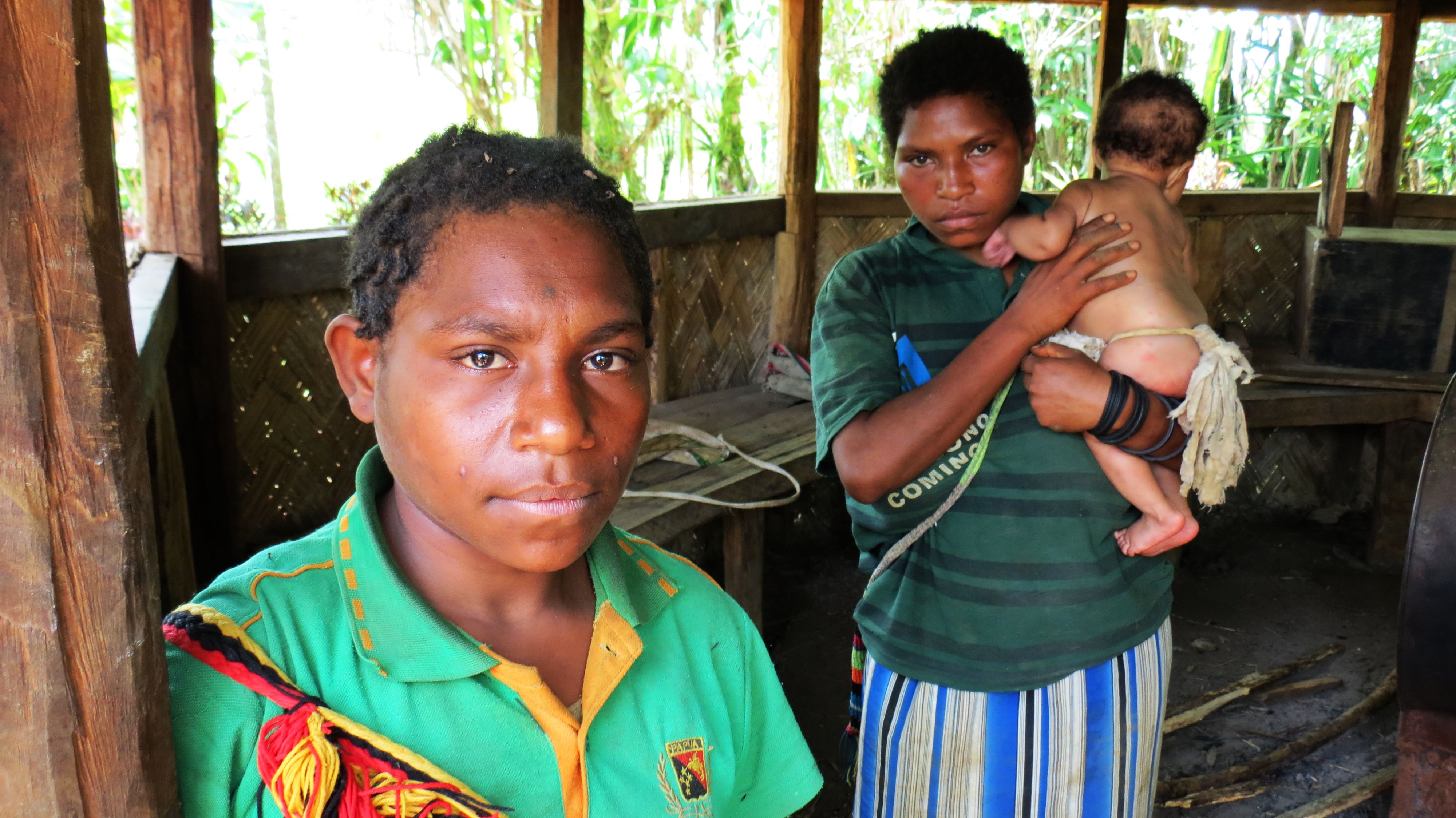
“After washing in the stream, our faces became swollen and we developed a rash,” said Veronica Pili. She shows the red marks down her arms. The same spots cover the children.
Veronica Pili, 15, and Mary David, 20 years, with baby. Both have suffered skin problems after mining construction began in their area. Photo by Patrick Nicholson/Caritas
Her village in the Highlands of Papua New Guinea sits high up a mountain, covered in thick forest and jungle. “We went to the local clinic, but they just told us we needed to go to the hospital. It’s a couple of hours away and we can’t afford the transport or the treatment even if we could reach there,” she said.
Caritas Papua New Guinea’s Director Raymond Ton leads the way to the stream that villagers say is polluted. It’s very murky, but what concerns him the most are the tiny bubbles he says are not normal.
Skin rashes aren’t the only problem facing Veronica’s village in Heights 1 in Hela.  She shows the stunted Popo fruit (a kind of Papaya) hanging limply off the branches. Their trees don’t produce any fruit anymore, their potatoes don’t grow and recent deadly landslides scar the mountainside. The villagers say that these problems began with the start of a project to extract natural gas from the mountain.
Exxon Mobil is leading a $19 billion project extracting natural gas from the Southern Highlands.

Heights 1 sits on top of a multi-billion dollar gas deposit. The Liquefied Natural Gas Project (LNGP) is a joint venture that began in 2010 to explore extracting that gas and exporting to overseas markets. The initial investment phase is estimated to be US$19 billion. It is expected that over nine trillion cubic feet of gas will be produced and sold, generating over US$200 billion in its 30 years lifespan.
The Liquefied Natural Gas Project (LNGP) promises to transform the lives of the local with investment in infrastructure, jobs and services. Landowners will receive cash benefits once the gas starts to flow in 2014, such as royalties and equities. It will double the GDP of Papua New Guinea, improving the development prospects of not just the residents of Hela but the whole country where 4 out of 10 people live in poverty.
“We see the helicopters, the workmen and the construction but we don’t see any of the promised development,” said Beth.  Her village is typical of the Hela region, where only 40 percent of children go to school and under 40 percent of adults can read and write. The local midwife says most of the babies are delivered at home.  Child mortality is 15 percent higher in Hela than the national average.
People were expecting schools, hospitals, the dust roads to be covered with tarmac, electricity and clean water. “We were promised everything except a highway to the moon,” says one landowner.
Peter Don Topi is a clan leader. He has been negotiating on behalf of his clan with the LNGP company. He’s also works in construction and is a Catholic Catechist (he built the local church).  “At first people were filled with high expectations,” he said. “The discovery of oil and gas was a good thing. People were promised a much better way of life. Three years later, many of the good things haven’t happened.”
Instead of visible development, the locals are left just with their complaints about the environmental and social impact. “The teachers have all left for higher wages in the gas company,” said Peter Don Topi. “Because there are no teachers, the children have given up going to school. Wages have increased, but because the nearest bank is 5 hours drive away, people tend to spend it quickly. Even though alcohol is prohibited, they buy it illegally.”
A frequent complaint is that there has been little community awareness and relations in the villages. This has led to feelings of exclusion and frustration. When six young men from the village protested about the pollution in the water, they were arrested by police.
A coalition of aid agencies including Caritas Australia warned last year of continuing major concerns that need to be addressed around the LNPG. In their joint report The Community Good – Examining the Influence of the PNG LNG Project in the Hela Region of Papua New Guinea, the aid agencies recommended proper transparent landowner recognition, community outreach, livelihoods and skills training for residents,  education to be made a priority and the establishment of community planning committees
The report says LNGP should help take people out of the poverty they currently face. Whether it does so still remains to be seen. Papua New Guinea has a long and painful history of seeing its abundant natural resources exploited by the mining industry with little significant benefit to the majority of the population.
Many in Hela believe they will see their traditional way of life gone forever but will not receive their fair share of the profits. Suspicion that others are getting a better deal is rife. People fear corruption or favouritism. Tension is high, optimism low. “It’s a great blessing from God,” said a local priest. “It’s the people who are turning the blessing into a curse.”

Concern over unsafe abortions in Papua New Guinea

Irin

BANGKOK, 25 January 2013 (IRIN) - Health experts are concerned about the number of unsafe abortions taking place in Papua New Guinea (PNG).
“Nobody knows the actual numbers, but it’s clear the number of school-age girls [having unsafe abortions] is unacceptably high,” says Lisa Vallely, head of the maternal and child health section of the PNG Institute of Medical Research (IMR) and principal investigator of a new study on the issue.


Maternal health is a key challenge

“These are the figures at the hospital level only. We still don’t know what is happening outside in the community,” she told IRIN on the sidelines of the Second International Congress on Women’s Health and Unsafe Abortion in Bangkok.
The six-month study (not online) looked at all admissions of spontaneous and induced abortions in Eastern Highlands Provincial Hospital in Goroka. Of 120 reported miscarriages admitted to the hospital over the period, 23 percent (28 women) were induced abortions, with more than half taking place 12-26 weeks into the pregnancy.

Most were young girls, attending school or higher education, and most of these induced abortions took place using prescription-only tablets purchased through healthcare workers or at a pharmacy. Others reported using traditional herbs and physical means, including strenuous exercise, inserting a stick into the vagina and tying a rope around the abdomen.

Many women resorted to abortions for fear of shaming their family; so they could continue their education; or because they were still breastfeeding another child, the study found.

A recent
study of the situation in Goroka highlighted sepsis due to unsafe abortion as a leading cause of maternal mortality.
According to the World Health Organization, unsafe abortions - almost all in developing countries - cause an estimated 47,000 deaths annually. Unsafe abortion is one of the main contributors (
13 percent) to maternal mortality worldwide, and encompasses procedures outside hospitals, clinics and surgeries, or without qualified medical supervision.
Maternal health
remains a key challenge in PNG. According to an inter-agency review based on 2008 data, some 250 mothers die per 100,000 live births.
Abortion is illegal in PNG unless two doctors agree a woman’s life may be at risk. However, the practice of induced abortions is widely practised, health workers say.

Barry Blyth Holloway championed PNG independence


OBITUARY Sir Barry Blyth Holloway. Patrol officer and Papua New Guinea politician. Born Kimberley, Tasmania, September 26, 1934. Died Brisbane, January 16, aged 78. 

THE generation of Australians who grew up in the 1940s and 50s heard much from their older brothers and fathers about war.
The best of them volunteered for their own challenge. At an astonishingly young age, they travelled to the remotest corners of their country's big tropical colony to administer vast areas and populations of Papua New Guinea.
They were magistrates, police chiefs, road and bridge builders, health and education supervisors, all roles wrapped in one, that of the patrol officer or "kiap" - a word derived from the old days of German New Guinea.
This afternoon, appropriately Australia Day, the best of those best is being buried at St Michael and All Angels Anglican Church in the tiny north Tasmanian township of Kimberley, alongside his parents.
He is Barry Holloway, the most prominent Australian to stay on in independent PNG and the best-known of a generation of patrol officers who effectively ran the country until independence in 1975 and maintained a key role afterwards. He was still playing a central role in PNG life until recent days, almost succeeding in recapturing his Eastern Highlands constituency at last year's election, aged 78.
Sir Barry Blyth Holloway

Prime Minister Peter O'Neill said in a tribute to the man his country knighted: "At independence, he was one of the first to take out citizenship.
"He had no hesitation in embracing the new nation of Papua New Guinea."
Sir Barry, a hard-living, empathetic intellectual, typical of the best of the kiaps, arrived in the then Australian territory in 1953, aged just 18, following a six-week orientation course.
He told ABC radio: "We were given basic, multi-functional activities to do, such as learning how to map, how to handle government stores, and all sorts of clerical work, which really dampened our spirits somewhat, because we were coming up for high adventure."
Which he certainly found.
He was one of about 1000 kiaps who each ruled and helped develop vast areas of the country during the 25 years leading to independence.
He described an early assignment to settle a tribal conflict involving hundreds of fighters. He was accompanied by a handful of PNG police armed with .303 rifles, which he said appeared to the combatants to be mere sticks.
"We demonstrated the power of the rifle by lining up about five shields, and showing how the bullet would come out causing a great gap at the other side."
Sir Barry established himself as a political systems reformer, so impressing Paul Hasluck, as minister for territories on a visit to his Kainantu district in the Eastern Highlands, that Hasluck put him on his aircraft and flew him to headquarters to brief senior officials.
He was also a founder, with Michael Somare, of the Pangu Party that pressed strongest for independence.
Tony Voutas, a fellow patrol officer and then a fellow MP, and also a founder of Pangu, described Sir Barry as "a combination of a political mastermind and an exceptionally generous person".
"He made a substantial personal and financial contribution in 1966 and onwards to a nascent 'Left Bank salon' in the new Port Moresby suburb of Hohola, built for Papua New Guineans recruited into the public service."
The political salon was centred on the basic fibro houses of the then union activist Albert Maori Kiki and of Sir Barry, about 150m apart. Voutas said: "The Information and Broadcasting Department's new recruit, Michael Somare, had an identical house about 400m away."
To push for independence before the 1968 elections was an especially brave move by Sir Barry, Voutas said, "as his electorate was in the Highlands, where many people were as frightened of self-government as if it were an apocalypse".
But Sir Barry won his seat, and later became Speaker, from 1972 to 1975.
He was appointed to the cabinet at independence, and held a series of senior portfolios during his 20 years as an MP.
These included education and finance - thus effectively making him the country's treasurer.
He eventually fell out with Sir Michael and formed a new party, with the late Anthony Siaguru.
Sir Barry had three wives, Liz from Australia, and Ikini and Fua from PNG, 12 children and numerous grandchildren and great-grandchildren.

Friday, January 25, 2013

InterOil completes logging of the Antelope-3 Well and provides an update on its LNG partnering in PNG

InterOil

InterOil Corporation today announced that it has completed the logging program at the Antelope-3 well in Papua New Guinea

 As in the previous wells, conventional wireline logs (porosity, resistivity and sonic) were acquired in addition to formation imaging (FMI), vertical well bore seismic (VSP) and rotary sidewall coring conducted while under pressure. 

The formation evaluation by Schlumberger indicates an average porosity in the pay interval of 10.2 percent and a net to gross ratio of 66 percent. 

This compares favourably with the results from the Antelope-1 and Antelope-2 wells with average porosities of 8.8 and 13.1 percent respectively (see the table below). 

We believe these results indicate that the reservoir quality at the Antelope-3 location is of similar quality to the Antelope-1 and -2 wells, and fully support our reservoir model.

Well Name
Hydrocarbon
Column
Height
Feet
Of
Net Pay
Net
To
Gross
Average
Porosity
Elk-4
620
166
0.28
0.039
Antelope-1
2,220
2,088
0.67
0.088
Antelope-2
1,771
1,465
0.70
0.131
Antelope-3
2,301
1,810
0.66
0.102

The forward programme is to complete a final drill stem test (DST) over the open hole interval combined with production logging instrumentation to provide further dynamic reservoir characteristics and flow capacity.
Separately, InterOil announced that it has advised bidders with which the company has been in discussions that the final binding bid solicitation period for the partnering process currently being undertaken will close on February 28, 2013.
The InterOil board of directors intends to meet the company's advisors during the first week of March 2013 for the purpose of evaluating bids received and selecting our partner(s) for the development of the Gulf LNG Project utilising gas from the Elk and Antelope fields in Papua New Guinea.
Phil Mulacek, chief executive officer of InterOil stated, "We are pleased to have the continued support of the PNG Government during the conclusion of our partnering process.
"The interest demonstrated by major oil, national oil and global utility companies remains strong, and bodes well for the conclusion of our sell down of interest in the Elk and Antelope fields and partnering in the Gulf LNG Project."

Triple Plate Junction's JV partner ends PNG gold/copper search

StockMarketWire.com 

Triple Plate Junction said joint-venture partner Newmont Ventures, is terminating its search for large bulk tonnage of gold/copper porphyry stems at their project property in Papua New Guinea.
Newmont, which is a unit of Newmont Mining Corp, is in the process of exploring its options in consultation with Triple Plate Junction.
In December last year, Newmont said it would not be allocating a development budget to the joint venture's Morobe project for 2013.
Meantime, Triple Plate Junction said there was a significant amount of related data that it was evaluating in order to determine whether there were areas within the JV territory that may be appropriate and suitable for it.
"Of particular interest are areas containing high grade targets that Newmont have discounted as too small for their requirements but which could be of great interest to the Company to develop," Triple Plate Junction said in a statement.
"Whilst recognising that the costs of exploring in Papua New Guinea are very high, Triple Plate Junction has engaged the services of an experienced team of geologists to commence the process of reviewing the project data," it said.
"The anticipated report is expected to be delivered by the end of February 2013, and a further announcement will then follow."
Triple Plate Junction also said it was in talks with Barrick Gold about their future intentions for the joint venture at Wamum, where exploration work over the past two years has been limited.
The company was also awaiting the results of Newcrest Mining's drill holes at Arie which have now been due for a month.

Miners tie up government, villagers


The National

 Wafi-Golu joint venture participants Newcrest and Harmony continue to engage with the PNG government and landowner representatives to ensure alignment on the planned project development and key elements of the next phase of work, according to Newcrest Mining Ltd’s quarterly report released yesterday
“Capital costs continue to be reviewed and potential key contractors assessed,” the report said.
“Activities have been focused on the initial camp construction, exploration drilling, and refinement of the technical development plan.”
The report said since the ore reserve update in August 2012, a total of 11 holes had been drilled to completion into the Golpu porphyry deposit.

Hidden Valley records ‘very disappointing Q4'


The National

Hidden Valley’s December 2012 quarter performance was a “very disappointing” 20,649 ounces of gold and 235,312 ounces of silver at a production cash cost of A$1,584 per ounce of gold, according to Newcrest Mining Ltd’s quarterly report released yesterday.
This compares with the September 2012 quarter performance of 22,137 ounces of gold and 223,936 ounces of silver at a cash cost of A$1,355 per ounce of gold.
“Hidden Valley’s production and cost performance continues to be very disappointing,” the report said.
“Significant effort is being applied to improve productivity and reduce costs.
“With the later commissioning of the crusher, production is expected to come in below guidance for the full financial year at around 90,000 ounces.
“Newcrest will carefully review the performance of the asset after the crusher is commissioned in April 2013.”
The report said material movements and gold grades were marginally higher in the December quarter.
“Lower gold production resulted from reduced mill throughput due to lower plant availability during the quarter,” it said,
“Silver production increased as a result of higher grades and recovery rates.”
The report said crusher installation at the start of the overland conveyor was progressing and would be commissioned in April, approximately two months later than forecast.
“After the crusher is commissioned, operating costs are expected to fall with the removal of higher cost trucking of ore to the mill,” it said,
“Higher unit cash costs in the December 2012 quarter resulted from lower gold production and increased site costs.
“Cost increases were primarily driven by higher energy costs associated with increased reliance on-site power generation, and higher levels of training and community expenditure.”

Lihir hikes gold output


The National

Lihir gold mine’s December 2012 quarter performance was 147,126 ounces of gold at a production cash cost of A$649 per ounce, according to Newcrest Mining Ltd’s quarterly report released yesterday.
 This compares with the September 2012 quarter performance of 129,311 ounces of gold at a cash cost of A$632 per ounce. 
The new semi-autogenous grinding (SAG) and ball mills at the Lihir mine which are in the final stage of commissioning.

“Gold production was 14% higher than the September 2012 quarter, associated with a 37% increase in mill throughput partially offset by lower grade and recoveries,” the report said.
“The previous quarter was primarily impacted by a production interruption due to an electrical fault in the main oxygen plant.
“Lower feed grade in the December quarter resulted from a planned transition from Stage 11 of the Lienetz pit into ore from Stage 12 of the Minifie pit.
“Total material movement was 20% higher in the December quarter, comprising both increased ore mined and additional waste stripping in Stage 12 and Stage 9 of the Minifie pit to access future ore sources.”
The report said site costs were higher than the previous quarter as both mining and milling rates increased.
“Unit cash costs were 3% higher than the previous quarter primarily as a result of milling lower grade ore,” it said.
“The progressive increase in production volumes associated with the Million Ounce Plant Upgrade (MOPU) ramp-up is expected to contribute to a reduction in unit costs in the second half of the financial year.
“Refurbishment projects are progressing to plan to improve the older sections of the plant.
“Projects include upgrading the electrical and control systems and replacing the neutralisation cyanidation adsorption (NCA) circuit.
“The expansion project of increasing the flotation capacity is proceeding on schedule to a July 2013 delivery.”
Newcrest is currently undertaking a major expansion of the Lihir process plant, known as the MOPU.
The US$1.4 billion MOPU project, which will be completed by the end of this month,  includes installation of a new crushing facility, upgrades to the ore processing plant, and additional power generation capacity and water supply.
This expansion of the processing plant will better match processing rates to mining rates and will increase throughput.
It will provide increased operational flexibility, reduce the exposure to single pieces of equipment and lower fixed costs per tonne, with the medium term objective being to lift annual gold production output to 1.2 million ounces.

Man sails from PNG to Australia island on raft made of twigs

AFP

A POLISH man was lucky to be alive today (Friday) after sailing from Papua New Guinea to a north Australian island on a raft made of twigs and sticks, through crocodile and shark-infested waters, during a cyclone.
The man was found washed up in mangroves on Saibai Island in the Torres Strait, a treacherous stretch of water that lies between the two countries.
What made his survival even more miraculous was that he attempted the trip in the aftermath of Cyclone Oswald, with 1.5 metre swells and 40 knot winds, rescue authorities said.
"It's the first time I've heard of someone trying to cross the Torres Strait in a raft in the middle of a cyclone," Australian Maritime Safety Authority (AMSA) spokeswoman Jo Meehan told AFP, adding that the raft was held together with string.
"It's not something we'd recommend. Navigation in the area is challenging for normal vessels, it's quite treacherous with reefs and rocks, and he did it in high winds and high seas.
"He's very lucky to have made it."
AMSA was alerted when residents of Saibai, which is part of Australia but only four kilometres (2.48 miles) from Papua New Guinea, spotted the man offshore on Thursday.
They sent a helicopter and a customs ship but failed to find him, so they called in local police who discovered the exhausted man in the mangroves.
Australian media reports said the Pole, who has not been named, set off from Sigabadura village in Papua New Guinea on Wednesday and that locals tried talking him out of the voyage, to no avail.
Australian immigration authorities said they were waiting to interview the man.
"He has been transferred to Thursday Island where he has been detained," a spokesman said, adding that he was being medically assessed before being interviewed to find out why he made the trip. -AFP