By SINCLAIRE SOLOMON
AN Airlines PNG Dash 8 aircraft crashed in bad weather near Madang killing up to 28 people in the country's worst air disaster, The National reports.
There were four survivors – three crew members and a passenger.
Prime Minister Peter O'Neill immediately conveyed his condolences while Public Enterprises Minister Sir Mekere Morauta suspended all talks in relation to the proposed Air Niugini and Airlines PNG merger.
The Accident Investigation Commission (AIC) said last night there were 32 people on board the plane which went down about 6pm in the Raicoast area on a normal flight from Lae to Madang.
Unconfirmed reports suggested that the passengers were mainly parents on their way to attend the thanksgiving of their children attending the Divine Word University in Madang.On a normal domestic flight, a Dash 8 aircraft carries a crew of four – a pilot, a first officer and two flight attendants.
Villagers and Madang residents said the weather was bad, with thunderstorm in the area in the afternoon.
AIC had not officially confirmed how many had survived the crash, however, investigator Sid O'Toole said the plane went down over land about 20km south of Madang.
"There were reports of fire and there have been some fatalities," he said.
O'Toole said police and ambulances had reached the crash site and investigators will be travelling there today.
The billion-kina Ramu nickel mine developer Ramu NiCo, which has projects in the area, said last night it had a rescue team on site.
As of 7pm, Madang provincial police commander Anthony Wagambie Jr and his officers, emergency official Norman Philemon and provincial administrator Ben Lange were making preparations to send a rescue team to Raicoast.
In Port Moresby, consular officials at the Australian High Commission were trying to determine if there were any Australians on board. It was believed the pilots were Australians.
Australia also scrambled four Black Hawk helicopters, here for the past week for a joint defence force exercise, to help in the search and rescue effort.
Sir Mekere expressed deep sympathy for the families and relatives of those who had lost their lives in the crash.
"This is a terrible accident, and many people have died," he said.
"I offer my condolences to the families of the victims of this disaster," he said.
Friday, October 14, 2011

Tuesday, October 11, 2011
Goroka Secondary School needs your help
By
MALUM NALU
Former students of Goroka Secondary School, one of
the leading secondary educational institutions in the country, are putting
their money where their heart is.
They will be holding a fundraising dinner at Dynasty
Seafood Restaurant, Vision City, on Saturday, October 22, to help the school
raise funds to rebuild its science laboratory, which was razed by fire in June
this year.
The school, formerly known as Goroka High School,
has produced some of Papua New Guinea’s leading personalities such as Prime
Minister Peter O’Neill, Chief Secretary Manasupe Zurenuoc, National Court judge
Panuel Mogish, Airbus A380 pilot Capt Locklyn Sabumei, and many more from all
over PNG.
 |
| Captain Locklyn Sabumei at the "front office" of the Airbus A380 |
They have all been asked to help the school at this
time of need.
A fundraising committee known as Asu Amiti
Fundraising Committee has been set up in Goroka and Port Moresby since the
burning down of the laboratory, and has already conducted several fundraising
activities, which will culminate with the dinner.
It is made up of former students and staff of the
school.
Tickets are on sale in three categories – gold for
K10, 000, silver for K5, 000 and bronze for K3, 000 – while individual tickets
can be purchased for K150.
Committee member and businessman Jeno Aeno, owner of
Oxford Medical Supplies and a former student, urged all former students to
attend the dinner.
“We’re having ex-students from places like Alotau,
Kokopo, Tabubil, Lae and Madang calling us to purchase tickets,” he said.
“These people are going to spend their own money to
fly in just for the dinner.
“It’s also becoming like a big reunion for the
school.”
Aeno said they were already assured of support from
National Gaming Control Board, Post PNG, JDA Wokman, Eyechen and National
Maritime Safety Authority.
He is already putting his money where his mouth is,
with Oxford paying for four tables at a cost of K19, 000.
Former students and supporters of the school who
wish to attend the dinner can call Oxford Medical Supplies on telephone
3254874.
Expert: Australia banks a haven for Papua New Guinea fat cats
AUSTRALIA may be sheltering hundreds of millions of black dollars funnelled out of South Pacific countries, including Papua New Guinea, by corrupt politicians and public officials, a conference in Brisbane on law and order and good governance in Australia and the Pacific region has been told, The National reports.
This money laundering was being tolerated by a disinterested Australian federal government, the Sydney Morning Herald (SMH) reported, quoting a good governance expert Prof Jason Sharman of the University of Griffith.
The newspaper quoted Sharman as saying that PNG, in particular, was believed to suffer from the avarice of some of its officials and politicians.
He added that a senior police officer recently claimed the country lost as much as 50% of its budget – about A$1.9 billion – every year through fraud and corruption.
Sharman called on the Australian government to drop its "nonchalant attitude" towards the problem, which, he said, hamstringed regional aid, governance and security policies.
"Recent research on grand corruption has emphasised the importance of following the money trail to determine where corrupt senior officials hide their stolen assets," he said.
"The answer is often that wealth looted from poor countries is held in rich countries with large, stable financial centres and which share historical ties with the victim country."
But, he said, Canberra had displayed a lack of interest in pursuing foreign corruption in Australia. An example of this, he said, was the bribery scandal enveloping the Reserve Bank in relation to foreign bribes allegedly paid by employees of its part-owned subsidiaries, Note Printing Australia and Securency.
The government has ignored that case and has three times blocked a move in the Senate to launch a parliamentary inquiry.
"The government doesn't care about Australia playing host to the proceeds of foreign corruption," Sharman said.
He said he first became concerned about the role of Australia in embezzlement and corruption in the South Pacific while undertaking research for the World Bank about the problem in Africa.
"If you're a corrupt leader and you're stealing millions ... through embezzlement or taking bribes, then you don't want to keep it at home, you want to put it somewhere international."
He said his research showed that money tended to flow to the former coloniser, or the nearest thing. Given that many South Pacific politicians and officials study in Australia and have family and friends here, Australia would be the closest thing to a coloniser.
The SMH said evidence gathered by several international organisations had made particular claims about politicians from Papua New Guinea – which had undergone a minerals boom in recent years – buying property in Queensland with their corrupt profits.
This money laundering was being tolerated by a disinterested Australian federal government, the Sydney Morning Herald (SMH) reported, quoting a good governance expert Prof Jason Sharman of the University of Griffith.
The newspaper quoted Sharman as saying that PNG, in particular, was believed to suffer from the avarice of some of its officials and politicians.
He added that a senior police officer recently claimed the country lost as much as 50% of its budget – about A$1.9 billion – every year through fraud and corruption.
Sharman called on the Australian government to drop its "nonchalant attitude" towards the problem, which, he said, hamstringed regional aid, governance and security policies.
"Recent research on grand corruption has emphasised the importance of following the money trail to determine where corrupt senior officials hide their stolen assets," he said.
"The answer is often that wealth looted from poor countries is held in rich countries with large, stable financial centres and which share historical ties with the victim country."
But, he said, Canberra had displayed a lack of interest in pursuing foreign corruption in Australia. An example of this, he said, was the bribery scandal enveloping the Reserve Bank in relation to foreign bribes allegedly paid by employees of its part-owned subsidiaries, Note Printing Australia and Securency.
The government has ignored that case and has three times blocked a move in the Senate to launch a parliamentary inquiry.
"The government doesn't care about Australia playing host to the proceeds of foreign corruption," Sharman said.
He said he first became concerned about the role of Australia in embezzlement and corruption in the South Pacific while undertaking research for the World Bank about the problem in Africa.
"If you're a corrupt leader and you're stealing millions ... through embezzlement or taking bribes, then you don't want to keep it at home, you want to put it somewhere international."
He said his research showed that money tended to flow to the former coloniser, or the nearest thing. Given that many South Pacific politicians and officials study in Australia and have family and friends here, Australia would be the closest thing to a coloniser.
The SMH said evidence gathered by several international organisations had made particular claims about politicians from Papua New Guinea – which had undergone a minerals boom in recent years – buying property in Queensland with their corrupt profits.
Monday, October 10, 2011
Utula Samana walked the talk
By ADAM VAI DELANEY
 |
| The late Utula Samana (right) with Adam Vai Delaney (centre) and another PNG staffer at the United Nations |
It was year 1996, and we had just ended the final session of the Asian
Group Ministerial Meeting of the United Nations Conference on Trade and
Development. Samana was about a year into his term as PNG’s Permanent
Representative (Ambassador) to the United Nations (UN). In Jordan, he was Head
of Delegation and I was his sole Adviser, as PNG had decided not to send
delegates from Port Moresby to the Conference. With no other Pacific delegates
in attendance, we ‘flew the flag’ on behalf of PNG and for the Pacific region
amongst our more influential, and large Asian partners.
The security personal assigned to us was a very senior ranked Jordanian
soldier. After short discussion about our plan, he was more than happy to drive
us to the Jordan River and then to the city of Eilat in Al Aqaba, near the Gulf of Aqaba, where Jordan shares an
active border with the State of Israel and Egypt. It is about 50km from the
border with the Kingdom of Saudi Arabia.
When we arrived at the riverbank, Samana stared in awe. Enthusiasm.
Finally, he was at the banks of the Jordan River, seeing the sacred water that
he had heard about in childhood stories at ‘Sunday School.’ He photographed the
river and the banana plants and said to me that he wanted pictures to show ‘our
people’ that here, in this land, unlike PNG’s fertile soils, people grew
bananas. They made good use out of so little. As a grand believer in the power
of agriculture, Samana was in Heaven recording his evidence.
The ‘Star of David’ fluttered from a visible security-post across the
opposite side of the river. With our security-guide close-by, we walked onto
the King Hussein Bridge and headed
towards the middle of the structure facing the occupied area of Jericho. As
Samana and I took more photos from the bridge, a female soldier of the Israeli
Defence Force, fully armed, approached us. She spoke in Arabic, waving her
hands asking that Samana to stop taking pictures of the river. She seemed
unhappy and we were bemused. Our Jordanian Guide then explained to her who we
were, and what our interest was in the area. It was a rapid moment of
uncertainty and must have been odd for the IDF soldier to see two men in suits
taking ‘touristy’ photographs at a common border and that Samana, looking like
a Nigerian with his clean, shaved face, and dark skin complexion, and I passing
as a Palestinian, with my light brown complexion and a face covered with hair!
Appreciating the sensitivity of the area, our security asked that we stop
somewhere close to the middle of the bridge and put our cameras away. Another
step and we would have been in Israeli side of the river. The two soldiers
exchanged a few words and I said to Samana that the IDF was sensitive to anyone
taking pictures near their border. She came closer waving frantically as we put
our cameras away. We then observed the friendly dialogue in Arabic. With
respect, we agreed and returned to our car. Seeking more reassurance, Samana
asked our guide again if we were standing above the Jordan River. The guide
nodded, but didn’t say a word. The IDF solider returned back to her post.
Back in the car, Samana gave a short laugh and shook his head as we
talked in Tok Pisin. I asked him if
he had realised why our security hadn’t replied to him in words about being at
the Jordan River. Samana said he hadn’t noticed. I then said that, in this part
of the world, names of places, including Rivers, can differ, depending on which
side of geo-politics you sit on. Hence, our Jordanian soldier felt that a nod
and silence, was perhaps a good answer to his question, in the presence of an
IDF soldier.
Samana had his pictures. We drove off towards the Dead Sea then to Petra
and Eilat. Sadly, it was to our last trip together.
I was deeply saddened to hear of Samana’s passing. Most Papua New
Guineans will identify with him as a ‘fire-brand politician” – a cliché
description I guess that comes from his colleagues and the media describing his
way of campaigning and addressing national issues. The other side of Samana,
far removed from politics and fighting injustice, was a hospitable, friendly statesman,
a superb debater and a wonderful listener. I remember well the many dinners
that he and Fungke hosted at the official residence in Scarsdale, New York,
where his children, friends and close guests could freely express their views
on current affairs and recall stories. It was a remarkable ‘family’ discussion
marked by civility and maturity. Samana would often prod and play the Devil’s Advocate.
He loved deep, intellectual challenges but never shied away from new ideas.
When he arrived
at the United Nations, as PNG’s Permanent Representative, Samana quickly
applied his reputation and a unique style to take on international politics. He
built strong friendships with the solid foundation that had earlier been laid
by his predecessor, the late Renagi Renagi Lohia. Samana carried forward the
mantle that Renagi had carried, including causes for the Kanaks of New
Caledonia, Tokelau, Falklands and East Timor as Chairman of the UN Committee
responsible for the remaining remnants of ‘colonialism’- known as the ‘C24.’
Samana also headed the PNG delegation to the ground-breaking Conference on
Population and Development in Cairo, Egypt. In this role, he chaired the
Pacific Islands Forum Group and helped that caucus weave through the global,
political labyrinth to get the Pacific’s voice heard. Samana’s exceptional,
political intuition also played an active role in the hand-over of the
Chairmanship of the Alliance of Small Island States from Trinidad and Tobago to
Samoa.
Much of his time
though was occupied explaining PNG’s position and developments to members of
the UN Security Council (UNSC) on the sensitive issue of the Bougainville Peace
Process. I recall several, impressive high-level meetings that we had with the
Russian Federation at the Russian Mission to the UN when it held the rotating
Chairmanship of the UNSC. It was his ability to articulate PNG’s position that
enhanced his relationships with key allies from both the developed and the
developing countries, including the Permanent Five of the UNSC. Samana was a
master deal-maker.
He was an
inspirational leader and stood his ground when it mattered for PNG. He loved to
see young PNGeans take on challenges and true to his confidence in his team, he
would often delegate tasks. He wasn’t a glory hunter. I recall his decision to
send me to support then Minister for Foreign Affairs, Kilroy Genia, at the
United Nations Commission on Human Rights in Geneva, Switzerland. Our
participation at that meeting was a watershed moment in the UN’s disposition of
the issue on Bougainville
Samana was great
at stepping into an opportunity. One of his coy, yet clever achievements, which
he would fondly tell afterwards, was participating at the once-in-a-lifetime
photographic event of all the Heads of Governments during the UN’s 50th
Anniversary celebrations. As the PNG Head of Delegation, and unbeknown to the
organisers, he was ushered in to stand in the spot reserved for the PNG Prime
Minister. At that time, the PNG Prime Minister or the Governor General, had not
made it to the event. When the organisers discovered that it was an Ambassador
and not a Head of Government that was standing in the spot, it was too late.
Samana now stood amongst many of the world’s greatest, including Nelson
Mandela, and he had the photograph to prove it!
Despite him
seemingly enjoying the glitz and stress of international politics, diplomacy
was not his calling. He wanted something more tangible; less talk, more action.
Cutting short his UN term, he and his family then returned to PNG. It was a
very rare moment to see Samana with tears in is eyes.
Back at home, he
was much happier being closer to his people in Morobe Province and, as doing
best at what he loved doing - walking the talk. His personal goal was to
re-enter National Parliament and it must have been a dire, spiritual battle
when he didn’t get his people’s blessing for this at the last elections.
I know that my
colleagues that also served him at the PNG Mission to the UN during his term,
including Ambassador Max Rai and Kappa Yarka, would agree with me that it was
truly a blessing and an honour to work with Samana. PNG has lost a great
nationalist and we will miss him. May he Rest in Peace. He now goes to see the
Christ that was baptised in the Jordan River.
Adam Vai Delaney
was First Secretary to the PNG Mission to the UN. He now works as a Consultant.
Pictures of the launching of Sir Puka Temu's new 'Our Development Party'
 |
| Sir Puka Temu (second from left) and New Generation Party leader Bart Philemon with supporters at the launch of Our Development Party at Sir John Guise indoor stadium, Saturday, October 8, 2011.-Pictures by MALUM NALU |
 |
| Maopa village dancers |
 |
| Huli wigmen dancers |
 |
| Bougainville bamboo band |
 |
| Huge crowd at the Sir John Guise Stadium indoor complex |
 |
| Viriolo village dancers |
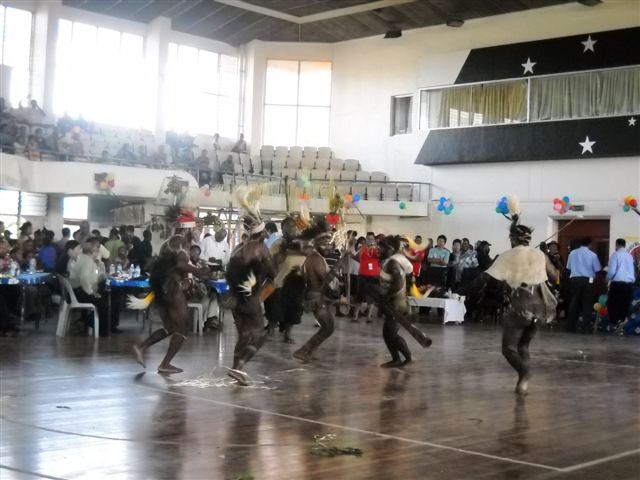 |
| Telefomin dancers with their famous penis gourds |
 |
| A touch of Pacific from Viriolo village girls |
 |
| Maopa village dancers |
Cabinet affirms partnership policy
THE National Executive Council has agreed to continue the public-private partnership policy to assist the country's infrastructure projects, The National reports.
Minister for Works and Transport Francis Awesa said the government had accepted the policy to implement its key infrastructure projects.
He said the government saw the partnership procurement methods as best for the Department of Transport, Works and the National Road Authority.
He said the Lae and Highlands highways, Gulf-Southern Highlands Highway and the Paia wharf would be among the first projects to be implemented.
He said the first part of the Lae-Highlands highway project from Lae wharf to Nadzab would proceed with a four-lane road construction costing about K4 billion.
In addition, the K2 billion Gulf-Southern Highlands Highway and the Kikori seaport development would come under the project.
He said infrastructures such as roads, airports and seaports were important catalyst to the economic growth of any country.
Minister for Works and Transport Francis Awesa said the government had accepted the policy to implement its key infrastructure projects.
He said the government saw the partnership procurement methods as best for the Department of Transport, Works and the National Road Authority.
He said the Lae and Highlands highways, Gulf-Southern Highlands Highway and the Paia wharf would be among the first projects to be implemented.
He said the first part of the Lae-Highlands highway project from Lae wharf to Nadzab would proceed with a four-lane road construction costing about K4 billion.
In addition, the K2 billion Gulf-Southern Highlands Highway and the Kikori seaport development would come under the project.
He said infrastructures such as roads, airports and seaports were important catalyst to the economic growth of any country.
Kapris tells critic to run for election next year
MAPRIK MP Gabriel Kapris has called on public servants wishing to contest the next general election to resign from their jobs instead of issuing misleading media statements against politicians, The National reports.
Kapris said this in response to Simon Kwingu, of Lae, who was critical of Kapris and his People's Action Party's move to join government and his involvement in controversial projects like the casino hotel in NCD and the PMIZ project in Madang.
Kapris said Kwingu was a teacher at the Balob Teachers College who had contested the Maprik seat in 2002 and lost.
"I challenge him to leave his comfort zone and return to Maprik and challenge me in the 2012 general election," he said.
Kapris called on people who did not know about the marine industrial zone in Madang to shut up.
He said the PMIZ project had so much benefit compared to the LNG project.
He said the PMIZ would make the country the world's major tuna exporter, create 40,000 jobs, help other maritime provinces and create many business opportunities.
"There are issues like landowner benefits and environment issues that the government is managing very well," Kapris said.
Kapris said PAP's move to government was not a mistake.
Kapris said this in response to Simon Kwingu, of Lae, who was critical of Kapris and his People's Action Party's move to join government and his involvement in controversial projects like the casino hotel in NCD and the PMIZ project in Madang.
Kapris said Kwingu was a teacher at the Balob Teachers College who had contested the Maprik seat in 2002 and lost.
"I challenge him to leave his comfort zone and return to Maprik and challenge me in the 2012 general election," he said.
Kapris called on people who did not know about the marine industrial zone in Madang to shut up.
He said the PMIZ project had so much benefit compared to the LNG project.
He said the PMIZ would make the country the world's major tuna exporter, create 40,000 jobs, help other maritime provinces and create many business opportunities.
"There are issues like landowner benefits and environment issues that the government is managing very well," Kapris said.
Kapris said PAP's move to government was not a mistake.
Subscribe to:
Posts (Atom)