Friday, July 06, 2012

Way out west in Vanimo

By MALUM NALU
 
Evening at Dali Beach, Vanimo, West Sepik province, on Friday, June 22, 2012.

Panorama of Vanimo.-Nationalpics by MALUM NALU
I am lying on the beachfront of the Vanimo Beach Hotel, waves lapping up to my feet, watching the hermit crabs scurrying along the white sand, and smelling the freshness of the turquoise waters.
To my right, the sandy stretch runs all the way to Aitape and on to Wewak in East Sepik, while to my left, it does all the way to Wutung along the border with Indonesia, and on to Jayapura.

Beachfront scene as seen from Vanimo Beach Hotel
As the waves rush up to my feet, I can’t help but think about the future of this country, especially with this being the season of elections.
The footprints in the sand remind me of one of my favorite poems, Footprints, of a man dreaming of walking along the beach with the Lord.
I spent three days in Vanimo recently, from June 22-24, enjoying this beautiful frontier town way out west to the border with Indonesia.


Endless white beaches along East Coast Road
The two-hour Air Niugini Q400 flight from Port Moresby takes in spectacular sunrise scenes and the breathtaking grandeur of the Gulf of Papua, Highlands and Sepik River before we descend into Vanimo.
After checking in and having breakfast at the Vanimo Beach Hotel, we drive up to Vanimo Hill – the Beverly Hills of the West Sepik capital – to catch million dollar views of the town.
Early morning at Dali Beach, Vanimo, on Sunday, June 24, 2012

On top of the hill, where local MP Belden Namah is building a plush new residence, a big crowd is gathered to hear their leader address them.
After that, we take a scenic drive along the West Coast Road to Wutung Border Post, on the border with Indonesia.

Start of the West Coast Road from Vanimo to Wutung
I have travelled hither and thither in the country; however, none matches the natural beauty of the road from Vanimo to Wutung.

Natural forest camouflage along the drive to Wutung
Mountains, natural unspoilt forests, streams and ocean meet along this drive to the border.
One thing I notice in Vanimo and all the way to Wutung, is the number of election banners, a costly exercise elsewhere in the country, but very cheap here because they are done up by Indonesians at the border.

Wutung in the background as seen along the drive from Vanimo
At Wutung, we check with PNG Customs at the border, and are given the green lights to walk through the 1km long “no man’s land” to the Indonesian side of the border, on to the Indonesian side of the border and through to Batas Market.

Wutung mountain grandeur
The original plan was to have travelled all the way to Jayapura; however, this was not to be.

Wutung Border Post
One of the perks and priviledges of Vanimo is that you can travel from here by road to Jayapura, starting at Wutung, where you hire a vehicle.

The Indonesian side of the border
A visa can be easily acquired at the Indonesian consulate in Vanimo.
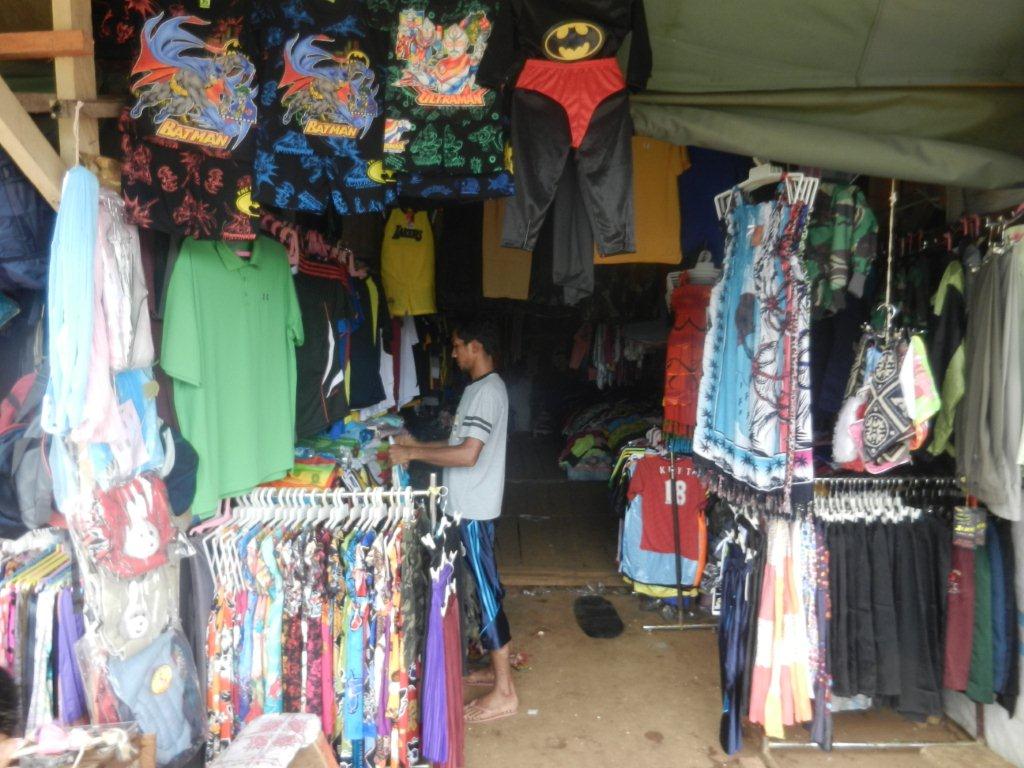
Batas has, over the years, become a mecca for shoppers from all over PNG to buy cheap Indonesia food, clothing, electronic goods and other items, however, in recent times, it has become the hub for trade of illicit goods into PNG.

Clothes on sale at Batas Market
Clothes, food items, cigarettes, alcohol, electronic goods and all manner of goods are sold here.
The Indonesian sellers are very aggressive and approach you with their sales pitch, “papa, papa”, as they ply their trade.

PNG customer checking out electronic goods at Batas Market
One of the hottest-selling items here are male sprays, which the salesmen say will, “keep you hard all night and make her very happy”.
I’m man enough to say that I don’t need one right now!
Pornographic movies, sold in SIM cards, sell like hot cakes to PNG customers as well as sexual toys for both men and women.
The clothes and toys are cheaper and of better quality than that sold in other Asian shops in PNG, and I end up spending some K300 on clothes and toys, both for my kids and myself.
After that, my escort and I walk back across the border, stopping for a chat with Indonesian border guards, who we find are just as good salesmen as their countrymen and women at Batas Market.

Goodbye Indonesia
The next day, Saturday, we take a drive around Vanimo town and see that there is not much by way of market as the place is inundated with Indonesian goods from the border.
We take a drive along part of the East Coast Road, which leads on to Aitape and then Wewak, before turning back to town for lunch.


 Along the East Coast Road towards Aitape
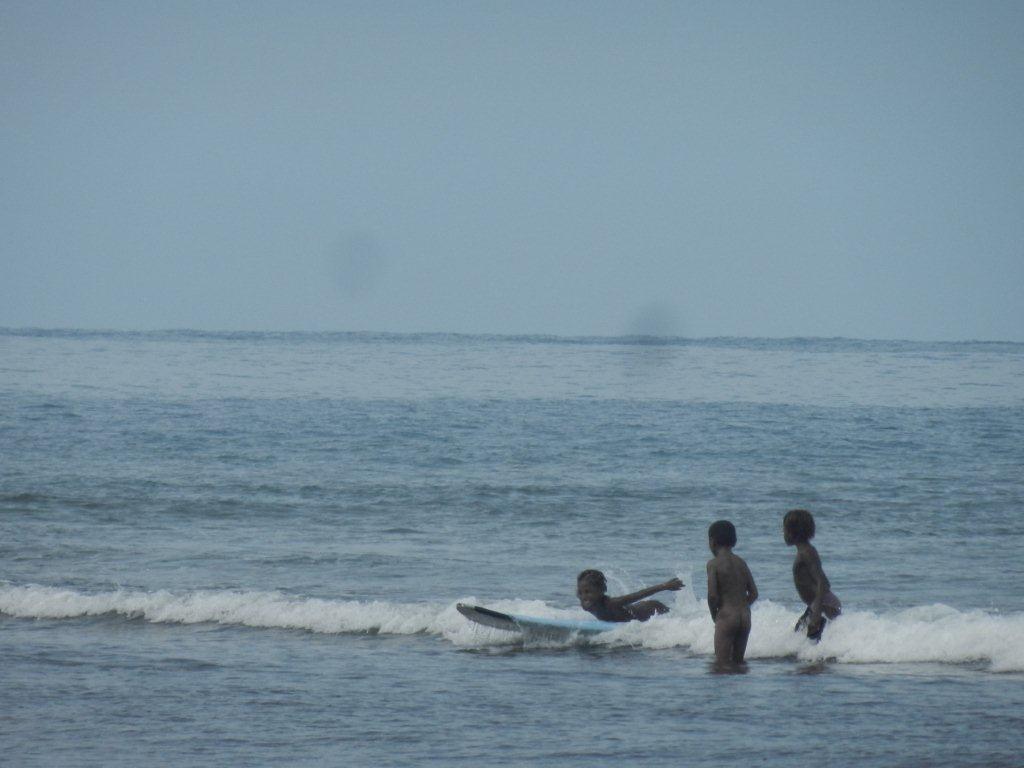
After lunch, we take another drive to Wutung, stopping along the way at picturesque Lido village, home of some of the best surf in PNG, which draws in surfers from all over the world here in search of that fabled “perfect wave”.

Children surfing at Lido village
 Lido is a neat, well-kept village, and children are swimming and riding the waves, elderly women fishing, oblivious to all the politics that has divided their village as well as Vanimo.
Splinters is the first feature-length documentary film about the evolution of indigenous surfing in PNG.
In the 1980s an intrepid Australian pilot left behind a surfboard in the seaside village of Lido.

Picture-perfect beach scene at Lido village
Twenty years on, surfing is not only a pillar of village life but also a means to prestige.
Next year, Lido will host an international surfing tournament, which surfers from all over the world will attend.
After Lido, we drive on to Wutung, where we leave our vehicle at the border post and walk across the border to Batas Market to do some more shopping.


Motorcycles loaded with goods from Batas Market on the PNG side of the border
Loaded with bags, we walk back across the border, and take the drive back to Vanimo. Evening in Vanimo is absolutely spectacular, pretty as a picture, as the sun sets.
That’s why West Sepik is called Sandaun (Sunset) province.
And the sun sets on one of the most-beautiful places in PNG.

Wutung lighthouse along the border


Thursday, July 05, 2012

Ramu Agri Industries Ltd builds two satellite towns

By MALUM NALU

RAMU Agri Investments Ltd (RAIL) is building two  satellite towns – “estate villages” – at Surinam and Dumpu in the Usino-Bundi area of Madang province, past its sugar town of Gusap, The National reports.
 Quality housing is being built for staff, complete with trade stores, community centres and sporting facilities.
New employee housing being built at Dumpu.-Nationalpics by MALUM NALU

This is all part of the multi-million kina expansion of oil palm in Ramu Valley of Madang province and adjoining Markham Valley of Morobe province after having its product rated as among the best in the world.
These projects include the biggest-ever 440km-long irrigation project in Papua New Guinea using water from the Gusap River, a second mill at Dumpu, and getting more outgrowers from Ramu and Markham valleys.
Management housing at Surinam

Dumpu estate mana­ger, Lama Kuri, told The National during a recent site visit that palm oil planting in Dumpu started in 2006 and 2007 on the site of the cattle ranch of well-known former Madang politician, the late Sir Bruce Jephcott.
Signboard at Dumpu

“This used to be a cattle area that was run by the late Sir Bruce Jephcott,” he said.
“When palm oil development started, we started moving all the cattle out to Leron Plains Cattle Ranch in the Markham Valley of Morobe province.
“We’ve got a total of 2,157ha here.
“We’ve already got 27 new houses on site, with 16 new ones coming up,” Kuri said.
New houses going up at Dumpu

“We’ve got two divisional managers, four field supervisors, one estate clerk and one junior clerk.”
He said they have a total of 360 employees on the estate.
“Most of our emplo­yees are from the local area, with others from Madang, Eastern Highlands, Chimbu, Enga, Southern Highlands, Morobe and other pro­vinces.
“We give priority for employment to locals from around the area.”
Children of all employees at Dumpu are transported to and from school at Gusap every day by 25-seater buses owned by RAIL.
Kuri is excited about all the developments ta­king place in what used to be grassland and cattle paddocks in the past.
“It’s like a town here,” he said.
“It used to be grassland and cattle country before.
“When I first came here, there was only one house, which is my house.
“I see a lot of houses coming up now.
“Many people are making positive comments about the place.
“We will have trade stores, community hall, clinic, street lights. It will be a town of its own.
“Our employees are very happy to live on site.”
RAIL general mana­ger Jamie Graham told The National that a new oil palm mill was also planned for Dumpu.
Signboard at Surinam

“We’re also planning a new mill to be located near Dumpu,” he said.
“We would hope to start by the end of 2013.
“We would hope to have that in operation by the end of 2015.”

Cell phone opens new opportunities

By MALUM NALU

TECHNOLOGICAL innovations are opening access to new business opportunities in Papua New Guinea, according to the World Bank, The National reports.
In its  latest PNG Economic Briefing, The Challenge of Transforming Today’s Boom into Better Living Standards for Tomorrow, the bank said the private sector is generating new opportunities, through innovative business structures and technological changes that fit PNG’s conditions well.
“As many as two and a half million Papua New Guineans had mobile phone handsets by early this year, compared with only thousands four years previously,” the report said.
“This employs large number directly, for example, Digicel has a network of around 30,000 distributors of pre-paid credit vouchers either new to informal retail business or enjoying increased turnover.
“The benefits of mobile phone technology are particularly great for a country constrained by PNG’s geography and often remote population, for example, on access to finance.
“Bank of PNG issued Digicel with the country’s first mobile banking licence last February.”
The report said major retail banks were trialling new mobile banking platforms designed to enable access to financial services, particularly savings accounts.
Nationwide Microbank staff assisting a Porebada village woman to access her bank account on the mobile phone.-Picture courtesy of NATIONWIDE MICROBANK

“These services include mobile agents using low-cost computers connected with mobile phone networks to open bank accounts for individuals.
“Individuals and small businesses are then able to transfer funds by mobile phones and deposit and withdraw funds from local agents, located in trade stores, for example.
“This reduces the costs of dealing in cash – for example, of theft or in handling cash, which can be scarce in remote areas.”
The report said Bank South Pacific was targeting 200,000 holders of such accounts by 2014.
“These innovations have the potential to dramatically deepen many Papua New Guineans’ engagement with the cash economy,” it said.
“They can allow small farmers to shift from relying on opportunistic production of cash crops when cash is needed to more strategic production, so raising incomes and allowing savings to be built to buffer against shocks or to support investments in productive capacity.”
A “Financial Inclusion Day” is planned for later this year following a 2008 World Bank report which found out that only 8% of the population in PNG has access to financial services while a whopping 90% are “financially excluded”.
The Consultative Implementation and Monitoring Council’s informal economy committee, realising the seriousness of the problem, held a meeting on Tuesday to start planning for the day.
According to a CIMC concept paper presented at the committee meeting on Tuesday, PNG ranked at the bottom of the table among Asia-Pacific countries, when it came to “financial inclusion”.
“Some degree of financial exclusion exists in all countries, even wealthy ones, but PNG is at the bottom of the league table among countries in the Asia-Pacific region,” it said.
“Even allowing for the relatively low population densities and rugged topography that make the provision of any services difficult in PNG, the country has performed very poorly in providing access to formal financial services for its people.
“Only about 8% of its population is ‘financially included’, or 92% excluded.”

Wednesday, July 04, 2012

ANZ to open branch in gas-rich Hides

A NEW ANZ branch will be opened in gas-rich Hides area of Hela province to provide banking services to local people and employees of the LNG project, The National reports.
 ANZ PNG chief executive Vishnu Mohan, Hides Gas Development Company (HGDC) chairman Tuguyawini Libe Parindali and Esso Highlands Ltd (EHL) senior project manager Mark Hackney signed a joint agreement last Thursday to construct a new bank branch which will provide access to banking services for people living in and around the Hides area.
From left: Hackney, Parindali and Mohan at the signing ceremony in Port Moresby

At the signing ceremony, Mohan said: “ANZ is committed to further investment in our business in Papua New Guinea and we are pleased to be partnering with HGDC and be supported by EHL to provide the local business community and residents of the Hides area with better access to banking services.
“With a number of international companies based in the Hides area, we’re now able to provide critical banking services and connect customers to our main branch in Port Moresby and to expertise across our regional network in Asia Pacific, Australia and New Zealand.”
Parindali said: “Greater Hides Area is a critical resources hub in PNG and with the Highlands’ unique geographic location, we need a developed banking solution which will provide the area with a full service branch that is easily accessible.
 “ANZ is providing our community with a critical banking service which we previously haven’t had access to before.”
Hackney said: “This branch of ANZ will provide an important benefit to the people of the region and a convenient way to begin to save for the future.
“EHL constantly looks for ways to bring value and improve the lives of the people of the communities in which we operate, and we’re proud to be part of providing access to savings opportunities.”
The ANZ Hides area branch will be housed in a converted shipping container.
ANZ opened its first “banktainer” branch last March in Lihir for employees of Lihir gold mine in New Ireland province.
ANZ began operations in PNG in 1910 and has 15 branches, more than 55 ATMs, nearly 1,000 Eftpos terminals and 600 staff

PNG coffee firms invited to China trade fair

By AUGUSTINE DOMINIC

COFFEE companies in PNG have been invited to attend the 10th China Agriculture Trade Fair organised by the Ministry of Agriculture of China, The National reports.
 Coffee Industry Corporation Ltd extended the invitation this week to more than 10 coffee companies to attend the fair in Beijing from the Sept 27-30.
The invitation was channelled through the Investment Promotion Authority (IPA) from its networking partner, the Pacific Islands Forum Trade Office (PIFTO) based in Beijing, China.
The invitation said  the event was expected to attract over 2,000 exhibitors from more than 20 countries and more than 3,000 varieties of agriculture products would be exhibited and an estimated 30,000 visitors from 30 countries are expected to come.
Lae-based coffee inspector Warap Era preparing a coffee cupping session during the last PNG Coffee Festival in Goroka in 2010.

Products to be exhibited include agro-products (grains, cash crops, fruit and vegetables, seeds, edible oil, edible fungus, dried fruits and nuts), food and beverages (conventional foods, instant foods, snacks, healthy foods, frozen foods, canned foods, condiment, fruit juices), agro-technology (embryo, breeder, meat products, poultry products, dairy products, fishery products, seafoods, aquaculture products), animal husbandry and aquatic products and agro input products (agrochemical, fertiliser and seeds).
Under the auspices of PIFTO, the organisers will be providing free accommodation (three rooms) to Pacific Island participants/companies for the duration of the event and a free booth for exhibition.
All other costs are to be borne by participants which include airfares, transit accommodation, freight and customs clearance and living allowances.
This offer would be accorded on a first-come-first-serve basis.
Further information can be obtained from IPA officers Julienne Leka-Maliaki or Nestalyn Krewanty on telephone 321 7311, fax 320 2237 or email jleka@ipa.gov.pg or nestalynk@ipa.gov.pg
A similar event in 2011 was described as a success in terms of business and market development

PNG economy to grow strongly over medium-term

By MALUM NALU

THE PNG economy is expected to grow strongly over the medium term, according to Treasury acting assistant secretary – forecasting branch Nancy Lelang, The National reports.
 She told the monthly economic and public sector programme seminar at the Holiday Inn last Friday that in putting together PNG’s fiscal outlook, Department of Treasury formulated projections for government’s total revenue, grants, total expenditures, recurrent expenditures and development budget expenditures.
“Over the medium term 2013 to 2016, government revenue is expected to remain fairly stable, largely because of stable non mineral revenue offsetting the variations in mineral revenue over the medium term,” Lelang said.
Fresh vegetables on sale at Leron in the Markham Valley of Morobe province last month.-Nationalpic by MALUM NALU

“Government’s expenditure is expected to stabilise over the medium term in line with the projected revenue outlook
“Expenditure will be focused on government’s medium term development plan (MTPD) priority areas of health, education, law and order, and transport infrastructure.”
She predicted:
  • The PNG economy is expected to grow strongly over the medium term;
  • The outlook for government’s total revenue is to remain stable over the medium term;
  • In contrast, mining revenues are varying over the medium term. Mining revenue is likely to decline reflective of the closure of Ok Tedi mine in 2015;
  • The first lot of the PNG LNG project dividends is expected in 2015. These are sufficient to replace the Ok Tedi mine and the depleted oil field revenues to support government expenditure;
  • Government expenditure is expected to be stable in line with projected revenue over the medium term;
  • Government debt is expected to be in line with the medium term debt strategy of 30% of gross domestic product;
  • The new medium term fiscal strategy (MTFS) will be framed in light of expected low mineral revenues; and
  • Over the medium term, the mechanisms to be used to promote PNG’s development is through macroeconomic policies, Industry reviews and reforms,  prudent public debt management, and through the usual annual budgetary allocations

90% deprived of financial services

By GYNNIE KERRO

A “FINANCIAL inclusion day” is planned for later this year, following a 2008 World Bank report which found out that only 8% of the population of PNG has access to financial services while a whopping 90% are “financially excluded”, The National reports.
 The Consultative Implementation and Monitoring Council’s informal economy committee, realising the seriousness of the problem, held a meeting yesterday to start planning for the day.
According to a CIMC concept paper presented at the committee meeting yesterday, PNG ranked at the bottom of the table among Asia-Pacific countries, when it came to “financial inclusion”.
“Some degree of financial exclusion exists in all countries, even wealthy ones, but PNG is at the bottom of the league table among countries in the Asia-Pacific region,” it said.
“Even allowing for the relatively low population densities and rugged topography that make the provision of any services difficult in PNG, the country has performed very poorly in providing access to formal financial services for its people.
“Only about 8% of its population is ‘financially included’, or 92% excluded.
“This compares unfavourably with other Pacific countries, for example, the Solomon Islands (15%), Samoa (19%) and Fiji (39%).
“In Asia, levels of inclusion range from 98% (Singapore) to 1.2% (Pakistan).
“PNG’s level of financial inclusion was actually higher in the 1980s, when there were many more bank branches and agencies than it is today.”
The paper said the National Informal Economy Policy 2011-15 aimed to have the informal economy grow in size and in the diversity and quality of the goods and services it produced.
“The policy nominates two ‘arms’ for action to achieve these goals: the first is ‘financial inclusion’, or giving people access to formal financial services,” it said.
“Only 8% of its people are ‘financially included’ at present, making PNG one of the worst-performing countries in this important indicator of development.
“The policy identifies six ‘roads to financial inclusion’ for PNG.
“Most of these rely on private sector investment in the financial and telecommunications systems.
“This investment will be forthcoming over time if government can provide the enabling policy and regulatory environment for it to occur.”
The paper noted that there had been a big improvement in this area, given the reforms undertaken within the telecommunications industry.
“Competition was introduced in the form of the arrival of Digicel PNG and the rollout of their services of innovative products in partnership with existing service providers such as PNG Power (EasiPay), commercial banks and financial entities (mobile and SMS banking), Eda Ranu (water vending system) and Post PNG (Salim Moni Kwik).
“Nevertheless, the knowledge gap is an ongoing problem that is preventing ordinary Papua New Guineans to have access to these products that are provided.”
“This is an area that service providers and the government will need to work in partnership through providing financial literacy training, introducing financial literacy curriculum into the schools, and through regular awareness.”

Tuesday, July 03, 2012

Grow non-mineral sector, PNG urged

By MALUM NALU

THE key challenge associated with PNG’s economic outlook is to grow the non-mineral sectors of the PNG economy, according to Treasury acting assistant secretary – forecasting branch Nancy Lelang, The National reports.
 She said looking ahead over the horizon, prices of PNG’s major export commodities would continue to be volatile, with the world economy still suffering from the impact of the uncertainty in global growth and stability.
Lelang...PNG economy to grow strongly...

Because of this, it may take time for a global economic recovery to gain a foothold and stabilise conditions over the medium term.
Lelang said for the medium term (2013 to 2016), the PNG economy was expected to grow strongly.
She told the monthly economic and public sector programme seminar at the Holiday Inn last Friday that these non-mineralsectors included agriculture, forestry and fishing sectors;  electricity, gas and water sectors;  transport, storage and communication sectors; wholesale and retail sectors; construction sector; finance, real estate and business services  sectors;  and the community, social and personal services sectors.
Lelang said the growing of these sectors could be accomplished through policies such as:
  • Enhancing competition;
  • Developing more effective and efficient markets;
  • Reducing impediments to businesses and investments;
  • Supporting of microfinance;
  • Pursuing reforms to secured lending arrangements;
  • Continuing the National Land Development Programme;  and
  • Accomplishing the housing policy.
“The growing of the non-mineral sectors can also be accomplished through reviews of industries,” she said.
“Such industries that need to be reviewed regularly include Companies Act 1997, sugar prices, PMV and taxi fares, agriculture commodity pricing, as well as pricing reviews for services offered by state-owned enterprises such as electricity, water, postal and ports prices and for specific regulated products like petroleum by Independent Consumer and Competition Commission (ICCC).
“Equally important are the agriculture, forestry and fishing sectors which comprise a vast majority of our people.
“These can be supported with the government continually maintaining basic infrastructure like roads, bridges and ports, as well as, providing microfinance.
“The onus is also on the private sector and all stakeholders engaged in these no-mineral sectors to operate effectively and efficiently to grow these non-mineral sectors of the economy.
“The benefit of growing the non-mineral sectors of the PNG economy is ultimately to improve the quality of life of all Papua New Guineans, as well as to grow the PNG economy.”

Sir Rabbie joins InterOil board

Interoil Corporation yesterday announced that its board of directors has approved the addition of two members, The National reports.
 Sir Rabbie Namaliu and Samuel Delcamp, former executive director and chief investment officer of the Fuller Foundation, have both joined the board.
Sir Rabbie Namaliu
In keeping with good corporate governance practices, the board also decided to separate the roles of chairman and chief executive officer.
Dr Gaylen Byker was appointed chairman of the board.
Phil Mulacek will continue as chief executive.
In addition to serving as PNG prime minister from 1988 to 1992, Sir Rabbie served as Speaker of the National Parliament between 1994 and 1997.
Prior to this, Sir Rabbie was minister for foreign affairs and Trade from 1982 until 1984 and has held several other senior government posts since his first election to parliament in 1982.
Sir Rabbie has chaired InterOil’s PNG advisory committee since last August.
Delcamp has more than 40 years of investment experience.
He served as executive director and chief investment officer of The Fuller Foundation, a public charity, for 24 years.
Delcamp was instrumental in founding the organisation and overseeing the growth in its assets under management from US$4 million to more than US$600 million.
Byker has additionally served as director and president of MBM Partners Inc, an unregistered investment adviser.
During his tenure as a director since 1997, Byker held roles as lead independent director and  chair of the board’s compensation, among others. Nominating and governance committees and membership of its audit and reserves committees

Kongo Coffee to get K10 million loan funding

INTERNATIONAL Finance Corporation, a member of the World Bank Group, will set up a risk-sharing facility with Bank South Pacific to enable the bank to provide K10 million in loans to Kongo Coffee Ltd, the largest locally-owned coffee exporter in Papua New Guinea, The National reports.
 The financing will help the company buy more coffee from farmers, meet market demand and create more jobs.
“IFC’s guarantee means Bank South Pacific will now be able to lend us the money we need to triple our coffee processing capacity to six tonness per hour from two tonnes,” Jerry Kapka, Kongo Coffee’s managing director, said.
“This improvement will allow us to purchase more coffee beans from local farmers, satisfy our customers’ demands, and increase our coffee exports.”
The company largely buys its coffee from remote communities in Chimbu province, where more than 100,000 people rely on the coffee industry for jobs and income.
Most of its suppliers are small growers who own less than two-and-a half hectares of land.
In addition, IFC will provide advice to Kongo Coffee to improve its corporate governance, internal systems, and management skills.
“By helping Kongo increase its exports and sustainability, we are giving small-scale coffee farmers an assured buyer who will want more of their product,” Carolyn Blacklock, IFC’s resident representative in PNG, said.
“More demand means younger farmers have a future and are given the opportunity to expand their businesses, increase profits, and create jobs.” 
A key priority for IFC in the PNG is to provide investment and advisory services to financial institutions to better serve micro, small, and medium enterprises and expand access to finance in rural areas to improve living standards and create economic opportunities.  
IFC is the largest global development institution focused exclusively on the private sector.
It helps developing countries achieve sustainable growth by financing investment, providing advisory services to businesses and governments, and mobilising capital in the international financial markets.
In fiscal 2011, amid economic uncertainty across the globe, IFC helped its clients create jobs, strengthen environmental performance, and contribute to their local communities  – all while driving its investments to an all-time high of nearly US$19 billion

Monday, July 02, 2012

Goroka Show gets K20,000 boost

By MALUM NALU

THE popular Goroka Show, PNG’s biggest tourist-pulling event, will get even bigger and better this year, according to Eastern Highlands Farmers and Settlers Association (EHFSA) president Wilson Thompson.
He said this last Thursday during the presentation of K20,000 from Bank South Pacific to Eastern Highlands Agriculture Society for the 2012 Goroka Show.
BSP Goroka branch manager Ruben Elizah and rural banking regional manager Joe Waim handed over the money to EHFSA and show executives.
Thompson (left) receives the K20,000 from Elizah as Goroka Show chairman Gideon Samuel looks on.-Picture by THOMAS SOLEPA

Elizah said BSP was committed to community activities such as the show, and construction of a mess as Mesauka Secondary School, while Waim said rural branches and small business facilities would be opened in Okapa, Aiyura and Yonki,
“All accommodation have already been booked out by tourists and others are even booking for 2013,” Thompson said.
“I challenge Tourism Promotion Authority and National Cultural Commission to also assist in this premier event.
“We will soon be asking them to remove Goroka Show from their brochures and publications as we have not had any support from them, apart from the Institute of PNG Studies.”
Thompson said the first day of the show would be committed to agriculture and rural development, hence, it was fitting that BSP was now placing more emphasis on rural banking and financial services.
Goroka Show chairman Gideon Samuel said National Gaming Control Board had sponsorship rights for the show, with BSP being the second major sponsor.

Peter O'Neill set to win Ialibu/Pangia seat back

Peter O'Neill is set to win his Ialibu/Pangia seat back.
He has primary votes of more that 50% plus one.
He is set to be the first candidate to win in the 2012 national elections.
O'Neill, at last count, had more than 16,000 votes so it should just be a mere formality for him in the remaining ballot boxes.
At last count today, O'Neill had 16, 583 votes and his closest rival was Raphael Noipo (2,930), while Eke Lama was third on 2, 767 votes.

More details to be posted.

World Bank: PNG must spend better

By MALUM NALU

THE passing of the boom in PNG government revenues will challenge authorities in the coming years, according to the World Bank, The National reports.
 This is according to its latest PNG Economic Briefing The Challenge of Transforming Today’s Boom Into Better Living Standards for Tomorrow,  which was presented by World Bank country economist Tim Bulman at the monthly economic and public sector programme seminar at the Holiday Inn last Friday.
Tim Bulman


The report said meeting the community’s expectations of improving services would require “spending better as much as spending more.
Important policy steps are being taken in this direction, but the pressures to meet short-term demands, and PNG’s social needs, are great”.
“Before the revenues from the LNG and the potential additional projects start flowing late this decade, government revenues are expected to stagnate, especially relative to rising costs of skilled employees, and of materials and the demands of a population growing by around 2% each year,” it said.
“At the same time, the community will continue to expect the government to provide more and better services, towards benefitting from the boom occurring in parts of the economy.”
The report said to manage these opposing pressures, it would be essential for the government to better ensure that spending from the government was translated into education, health and other services delivered to the end user with fewer leakages en route, or that investments in infrastructure were appropriately maintained.
“This will require both better planning and implementation,” it said.
“The establishment of the sovereign wealth fund and the government’s move towards multi-year budgets for capital projects are steps in this direction.
“More effective, especially in the short term, will be reducing leakages.
“Strong institutions of governance, throughout the public sector, and developing a pervasive culture of accountability can help achieve this.”
The report said translating economic wealth of the scale enjoyed by PNG into better living conditions for all citizens was a great challenge.
“Some countries have successfully managed the challenge of the ‘resource curse’,” it added.
“Already, PNG has created a climate that attracts investment in its resource production, and it is developing the institutions to ensure that this wealth supports a stable macro-economy.
“For long-term development and prosperity, it will be essential to design PNG institutions that ensure political leaders have the incentives to turn the nation’s wealth into long-term, broad-based development, rather than maximising the potential for it to generate short-term private rents.
“Failure to do this may undermine the gains of the past decade and the potential ongoing boom, working its way through the project planning and preparation pipeline.”
The report said Standard & Poor’s warned of this risk in February this year when it shifted the outlook for the country’s long-term sovereign debt from stable to negative.
“The challenge will be for the leadership that emerges from the mid-year elections to replicate these efforts in the public realm,” it said.

InterOil extends LNG deal with Mitsui

INTEROIL announced at the weekend that it has entered into agreements with Mitsui & Co Ltd to extend the dates by which certain conditions are to be met and final investment decisions (FID) made in LNG project agreements with Mitsui until Dec 31, 2012, The National reports.
 On March 30, 2012, InterOil indicated additional amendments to extend the joint venture operating agreement (JVOA) for the company’s proposed condensate stripping plant (CSP) with Mitsui, and associated agreements to December 31, 2012, were being contemplated.
“The JVOA for the company’s proposed CSP with Mitsui and associated agreements, have been amended so that the time allowed for FID has been extended until December 31, 2012,” InterOil said in a press statement.
“The JVOA sets out the rights and obligations of the participants of the joint venture to develop a CSP at InterOil’s Elk and Antelope field site in Gulf province, Papua New Guinea.”