Thursday, July 29, 2010

PDM 4 yoyos back to government

FOUR People’s Democratic Movement (PDM) members of parliament, who jumped ship to the opposition during the recent political horse-trading amid a looming vote of no-confidence on the prime minister, have returned to the government fold, The National reports.

The four included deputy party leader and Obura-Wonenara MP John Boito, member for Telefomin Peter Iwei, Jimmy Miringtoro (Central Bouginville) and Jack Cameroon (Kiriwina-Goodenough).

However, Cameroon was away in his electorate and could not confirm if he had also returned to government.

PDM parliamentary leader and Higher Education Minister Michael Ogio told reporters yesterday that the four were neither terminated nor were they part of the opposition.

He said what transpired resulted from a National Alliance party split that caused them to move with the splintered group to the March Girls Resort camp.

The move by the PDM four brings to 10 the total number of “rebel” MPs who have moved back to rejoin the National Alliance-led coalition. Six Southern region NA MPs, who had defected to the opposition, also rejoined government early this week.

The NA rebellious six included David Arore (Ijivitari), Andrew Mald (Moresby Northeast), Alphonse Moroi (Central Governor), Mathew Poia (Goilala) and Pitom Bombom (Gulf Governor). South Fly MP Sali Subam was named but had not confirmed.

“We want to tell the government and the prime minister that the four MPs are still part of the coalition according to the Warangoi Accord,” Ogio said.

“I will stand and PDM will still remain with the grand chief for stability.

“I want him to leave with dignity when he retires from politics.”

Boito claimed that the four of them were misled by the NA faction and would apologise to the prime minister for what had happened.

He also attributed their move to the opposition to the slowness of certain vital issues not being addressed, citing the disbursement of public investment programme funds as an example.


Tuna cannery suspends 400

ABOUT 400 workers of fish processing company, RD Tuna Cannery in Madang have been suspended by the company, The National reports.

The action by the company followed a strike on July 22 over the minimum wage rate of K2.29 an hour which, the workers claimed, the company had not honoured.

RD Tuna Cannery’s failure to apply the minimum wage, which came into effect this year, did not go down well with the disputing members of the workforce who opted for industrial action.

Yesterday, the company confirmed that 400 production workers had been placed on preventive suspension.

It said that on July 22 the production workers on night shift just sat down and refused to work despite explanation and pleas of the management to report to work.

“As a result of their mass action, we sustained losses,” RD Tuna Cannery said in a statement, adding the reason of the mass action was the delayed implementation of the new K2.29 an hour minimum wage rate. 

“In compliance with the Minimum Wages Board Determination, RD Tuna Cannery has implemented the rate of K1.14 per hour and 26 weeks later, RD implemented the mandated rate of K1.72 per hour. 

“However, on the implementation of the K2.29, RD opted to exercise a provision in the determination given to sector/employers with provision for partial wage payment to include payments for housing,   transport assistance etc.”

RD Tuna Cannery said that on Oct 12 last year, it filed a position paper with the director of the National Tripartite Consultative Council seeking, among others, a consideration as “cash wage” the cost of transportation which RD spends to pick up and drop off the workers which was about K120,000 a fortnight or K3 million a year and the cost of meals which RD  provides  the workers at K3 a head a meal.

It said that although the NTCC acknowledged receiving the position paper, it failed to notify the cannery about the status of its claim within 26 weeks as required in the determination.

“As a result of this delay the workers resorted to this industrial action,” RD Tuna Cannery said.

“Just like the implementation of K1.14 and the K1.72, RD has committed to comply with whatever the decision of NTCC on our petition.”

In a meeting between the RD Tuna Cannery management and the Labour Department, the labour provincial officer in Madang declared that the workers did not comply with the requirements of conducting a legal strike under the PNG labour laws and regulations and considered their strike action to be illegal.

 RD currently employs about 1,000 workers in the production area.  With the suspension of a portion of its workforce, RD is taking alternative measures to ensure that operations were not hampered.


SWF best kept offshore: Yauieb

ONE of the main objectives of a sovereign wealth fund (SWF) is to create a broad-based economy, The National reports.

“This will present adverse affects that are usually present in booming oil and gas economies,” Anthony Yauieb, chairman of the SWF working group at Port Moresby’s National Research Institute, said yesterday.

The working group’s recommended model of the SWF was to be a consolidation of three offshore funds:

  • Stabilisation fund;
  •  Infrastructure fund; and
  • Future or savings fund.

One of the reasons of having the SWF kept off-shore is to prevent exchange rate appreciation and the effect which is often called “Dutch disease”.

Dutch disease, in economics, refers to the decline in manufacturing sector due to increase in exploitation of natural resources.

The theory is that the increase in revenue from natural resources affects the country by raising its exchange rate and which will make the manufacturing and agriculture sectors less competitive.

Yauieb said the SWF would be kept offshore because past onshore funds like the Mineral Resources Stabilisation Fund and the trust accounts, were depleted due to inefficient management arrangements. 

Central Bank deputy governor Benny Popoitai, who is the working group deputy chairman, said the idea of the SWF was important with the LNG project promising significant economic growth as well as improving the living standards of people.

Popoitai stressed the importance of properly managing the flow of proceeds from the LNG project.

“Managing the flow from the LNG project is very important.

“If this flow is not sterilised and quarantined then it will lead to high liquidity,” he said, adding that the government in its wisdom had set up his group to work towards creating arrangements that would “assist in insulating and sterilising” the flow of money from the  LNG project.

Wednesday, July 28, 2010

Handout of DSIP cheques by PM shows arrogance and blatant disregard for the law

By Bulolo MP SAM BASIL


The Leadership Tribunal decision in the Hagoria case upheld the legal position that all electoral funds (in that case, the District Support Grant) should be paid into the district treasuries and NOT to any individual MPs.

DSG and the District Support Improvement Program (DSIP) funds are required under Section 95A of the Organic Law on Provincial and Local-Level Governments to be paid directly to the District Treasuries.

The prime minister was dishing out DSIP cheques to individual MPs after the ‘questionable’  election of the governor general in Parliament on Friday 25.06. 10. The PM’s action is in breach of the guidelines and the law governing the disbursements of these funds and sends a clear message of his blatant disregard for the laws of this land.

This is not the only instance of the PM demonstrating his arrogance and total disrespect of the law. The PM has openly defied the laws of this land time and time again. The recent open advertisement by the leader of the opposition, Sir Mekere Morauta raises serious questions about the integrity of the PM in relation to the illegal re-appointment of the GG. Section 187(5) of the Constitution is in no uncertain terms. The vote taken on Sir Paulias Matane was a qualification for eligibility to nominate as a candidate for the post of GG. It is not the election proper. There is nothing complicated about this, yet the PM is not willing to adhere to the law by taking a position that is legally correct to preserve the integrity of Parliament and of government in PNG.

Whether this is sheer arrogance or serious incompetency, the PM must be held accountable to the people of this nation.

The PM is also one of those leaders whose integrity has been brought into question by a leadership tribunal referral by the Ombudsman Commission for alleged misconduct in office. His misconduct relates to the failure to submit annual statements to the Ombudsman Commission as required under Section 4 of the Organic Law on the Duties and Responsibilities of Leadership. This is a very serious misconduct because it shows a lack of interest to the fundamental principles of accountability. He is a prime minister who has demonstrated that he is above the law and will not be accountable to the 6.5 million people of this country, either legally through constitutional accountability mechanisms like the Leadership Code or personally by being indifferent and evasive to questions and calls by the people of this country for accountability.

His government is full of leaders who have been referred by the Ombudsman Commission for misconduct in office, whose cases are pending before the Courts, yet they continue to hold on to very key public offices and continue to carry on the business of this country with his blessings despite serious questions surrounding their personal and official integrity. Still overshadowed by serious questions of integrity and breaches of the Leadership Code, his government blatantly orchestrate amendments to the Leadership Code that clearly demonstrate their vehement desire to be free from  accountability and have these bills pushed through Parliament without consultation with the people of this nation.

The amendment to the Ombudsman laws shows no intention of strengthening accountability and good governance; instead it reveals a clear will to water down the Leadership Code and to avoid the principles of ethical and moral responsibility that the Leadership Code seeks to instill and uphold for leaders.

The Petromin issue is also one that has been cleverly swept under the carpet with no accountability to the People of Papua New Guinea. The LNG was illegally moved to IPBC from Petromin and now interestingly to another company called Kroton No.2 Limited to avoid accountability by an independent Board.

The insanity continues with the bulldozing through of laws like the Environment Act in parliament, that totally disregards the basic rights of resource holders, stakeholders and the people of Papua New Guinea to express their views on matters that concern their livelihood. There is no freedom of expression when the PM calls his people ‘sadangs’ or ‘demons’ and ‘longlongs’ or imbeciles. His tactics of evading accountability is well known by us all by now.

The PM has time and again, demonstrated that he is not interested in nurturing a culture of open democratic government. He openly flouts the laws of this land and makes no apology for it. His actions must NOW be questioned.  It is time he accepts responsibility for his negligent disregard for the law and relinquishes the leadership of this nation to a more honest and accountable leader that can uphold the law and respond to the needs of the People it represents. PNG needs a PM that is honest and transparent and accountable and one who serves the best interest of his people.

The people of PNG are not blind, deaf or mute. They are already talking and rising up. Its now up to individual MP’s to wake up from their slumber and be true to the election promises of accountability and good governance by making a change to this selfish and corrupt government.

Government is fragmented: Basil

There are strong signs that the Government is fragmented and there are cracks appearing in the coalition despite the prime minister’s efforts to hold his government together, says outspoken Bulolo MP, Sam Basil.

Mr Basil said yesterday that the confusion surrounding the appointments of new Ministers to the Somare-Polye Cabinet is frustrating to the public and especially to foreign investors. He said in the last three days, senior cabinet ministers have been making conflicting public statements and bickering among themselves over ministerial portfolios.

Mr Basil said, “It is obvious that the Grand Chief Sir Michael Somare is not in charge of his Cabinet as young aspiring Turks are lobbying intensively among themselves to curry favor and also aspire for the top job.

“This is not good and shows a lack of leadership and contrary to what Sir Michael is saying to raise public confidence, he has totally lost control of his cabinet and needs to move aside and hand over the day to day running of the government to a strong and decisive leader like his deputy, Don Polye.

“The Opposition will support a strong leader like Don Polye as he is willing to make tough decisions and not back away as was the case when he was acting prime minister last week. The time is right for this country to see a young, articulate and vibrant leader take the helms of the political leadership of our country and I will back him to the hilt as I believe this it is time for us to change the old guard.

“The people of Papua New Guinea demand change and they will get it. I strongly urge young leaders from both sides of the house to throw their party allegiance aside and work together to build a grand coalition government that represents the interests of all Papua New Guineans and not just certain ethnic or regional groups in the country as is the case with the current government.”

Mr Basil says Mr Polye is a well-educated and articulate leader and is able to represent the country well on bilateral, multilateral and global issues that are of significant interest to PNG’s national interest.

“For instance, the prime minister’s latest junket to Fiji is farcical and his close association to Fiji and the so-called ‘Melanesian Brotherhood’ is outdated and has no relevance for a modern and globalised Papua New Guinea. And Don Polye will not stand up to these parochial Melanesian grandstanding tactics.

“The Fiji Government is run by a military dictator. We should not be dealing with military dictators one way or another. PNG is a signatory to various bilateral and multilateral organisations that promote democracy and good governance and we should adhere to these international protocols. Therefore, the Prime Minister should not use the shroud of ‘Melanesian Brotherhood’ to confuse our diplomatic relations in the region and on the global arena.

“The days of ‘Sulu diplomacy’ are over and the Prime Minister should not use PNG for his own private grandstanding ‘big-man’ type ruse.

“The deputy prime minister has all the credentials to lead our country and I am sure he will not confuse his own political agenda with that of our national interest. I will support him in his ambition to become Prime Minister.”

Democracy- Does it exist in Papua New Guinea?

From PAUL OATES

 (The following quotes in Italics are taken from the Wikipedia site.)

Having just returned from the original birth place of democracy, in the light of a fellow commentator's postulations, it seemed appropriate to reflect on whether true democracy does or did ever exit in Papua New Guinea. So firstly, what is democracy?

'Democracy is a political form of government where governing power is derived from the people, either by direct referendum (direct democracy) or by means of elected representatives of the people (representative democracy). The term comes from the Greek: δημοκρατία - (dēmokratía) "rule of the people", which was coined from δμος (dêmos) "people" and κράτος (krátos) "power", in the middle of the fifth-fourth century BC to denote the political systems then existing in some Greek city-states, notably Athens following a popular uprising in 508 BC. Even though there is no specific, universally accepted definition of 'democracy', equality and freedom have been identified as important characteristics of democracy since ancient times. These principles are reflected in all citizens being equal before the law and having equal access to power. For example, in a representative democracy, every vote has equal weight, no restrictions can apply to anyone wanting to become a representative, and the freedom of its citizens is secured by legitimized rights and liberties which are generally protected by a constitution.'

Well that seems fairly clear. Democracy exists when:

  1. all citizens are equal before the law and their votes are of equal value, and
  2. legitimized rights and liberties are protected by a constitution.

However George Orwell in his book, 'Animal Farm', highlighted the concept that when some of the animals took over the farm, "some were more equal then others". So are all PNG citizens 'equal before the law' one is given to ask? In many so called modern democracies, it seems the way law is applied depends on a citizen's relative wealth. Given the opportunity, wealth seems to affect the way the law can be applied as expensive legal assistance can often affect the outcome of a court case. Yet even expensive legal assistance can still only be a factor IF a case goes to court. In PNG these days it seems like any legal action involving PNG politicians ever actually gets to court. If the case doesn't get to court, how can there be any justice decided? So it seems not all PNG citizens are 'equal before the law'.

Wikipedia goes on:

'There are several varieties of democracy, some of which provide better representation and more freedoms for their citizens than others. However, if any democracy is not carefully legislated – through the use of balances – to avoid an uneven distribution of political power, such as the separation of powers, then a branch of the system of rule could accumulate power and become harmful to the democracy itself.'

So has a 'branch of the PNG system of government' achieved an 'uneven distribution of power'? Given the performance of the current Somare government where Parliamentary government has effectively been sidelined, the answer would appear to be a resounding "Yes!" It therefore seems that some in the PNG political system have 'accumulated power and become harmful to democracy itself.'

'The "majority rule" is often described as a characteristic feature of democracy, but without responsible government or constitutional protections of individual liberties from democratic power, it is possible for dissenting individuals to be oppressed by the "tyranny of the majority". An essential process in representative democracies is competitive elections that are fair both substantively and procedurally. Furthermore, freedom of political expression, freedom of speech, and freedom of the press are essential so that citizens are informed and able to vote in their personal interests.'

So are 'dissenting individuals' being oppressed in PNG? Given the recent arrangements the Somare government has made concerning local mining and timber industries, many would say 'You bet!'

Are PNG elections 'fair both substantially and procedurally'? Well with the extra financial resources from foreign sources claimed by the Opposition and available to the Somare government and the ability to use all government facilities including publically funded aircraft, it would seem PNG elections are anything but 'fair'.

So has democracy ever existed in PNG? Well that is in the eye of the beholder. What is clear however is that under the definitions listed in Wikipedia, PNG is not currently a democracy and hasn't been for some time.

Why then is Australia still supporting the current PNG government? Elsewhere in the world including Melanesia, leaders of countries who have deposed Parliamentary rule and effectively instituted a dictatorship are sidelined and denounced.

Why then hasn't this happened with the current Somare regime?


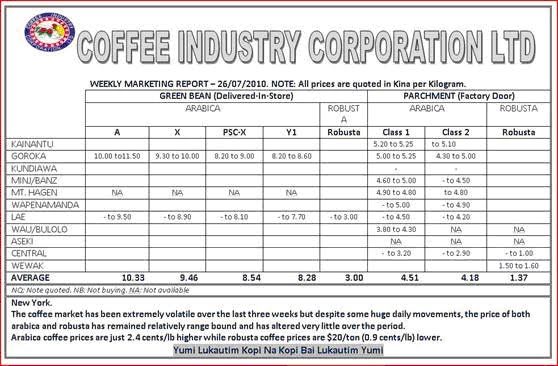
Weekly coffee price

Please click to enlarge