By MALUM NALU
A coffee industry expert has accused architects of the controversial National Agriculture Development Plan (NADP) of living in “fantasy” with their unrealistic projections for the industry.
Well-known coffee personality, David Rumbarumba, has joined cocoa, copra and palm oil in rubbishing unrealistic projections contained in the “realigned” NADP, which were provided to the Department of National Planning and Monitoring’s (DNPM) national development strategic plan 2030 (DSP 2030).
The NADP expects coffee to reach 500,000 metric tonnes in 2030 from 73, 868mt this year – a massive 700% increase.
This projection will also be part of the much-vaunted Vision 2050.
“Five hundred metric tonnes is 8, 333, 333 bags of green bean (exportable coffee),” said Rumbarumba, who is general manager of Awute Coffee Producers.
“This is more than 700% increase from current average of 73, 868mt (1, 231,133 bags).
“Correct current average volume is around 54,000mt, or 900, 000 bags – not even a million bags!
“Basing on this target, 500,000mt will be more than 900% achieved in 19 years!
“Wow!
“This target is ridiculously ambiguous and an unrealistic dream, or shall I say ‘fantasy’, by the government and its agents.
“Where does the DNPM and DAL get their data from?
“I can gurantee that such a volumetric target will not be achieved in 19 years or even 100 years, and I can certainly bet my life on that.”
Rumbarumba said only once in coffee’s 60-year history, in 1998 after the 1997 drought, did coffee achieve its biggest-ever production of 1.23 million bags, and it had since slumped
He said coffee was competing with other subsistence crops for land space, due to population growth, and there was no gurantee that there would be more plantings.Rumbarumba said compounded by all the problems, the government had not even invested in coffee over the years, even leaving stakeholders to fund research and extension industry levy.
“A reasonable target for coffee in the next 20 years would be to double the volume from current 54,000mt (900,000 bags) to 110,00mt, or a target of two million bags,” he said.
“This was the industry’s target in its two five-year strategic plans 10 years ago, but it was not achieved, because the government failed to support the plan with funding of its programmes.
“We in the coffee industry believe two million bags can be achievable with right and consistent financial and policy support from the national government.”
Rumbarumba called on government to:
• Directly fund the Coffee Industry Corporation with K30-K40 million a year to reactivate research and extension programmes, industry regulations, farmer training and marketing programmes, coffee nursery developments, and coffee rehabilitation;
• Create a government ministry for commodities, separate from agriculture and livestock; and
• Create a commodities bank with open and soft lending policie
Sunday, April 10, 2011

Department of Agriculture and Livestock turns ‘logger’
By MALUM NALU
Department of Agriculture and Livestock has turned forester, venturing into the forests of Papua New Guinea with forest clearance authority (FCA) projects, saying that it is part of “wealth creation under Vision 2050”.
These cover “oil palm” and “cocoa” projects, among others, however, skeptical landowners and people of Papua New Guinea now see it as a front for logging.
According to a department FCA update, obtained by media, “one of its responsibilities is to provide leadership in overseeing coordination, assessment and approval of integrated agriculture agro-forestry projects (defined as Forest Clearance Authority) of the government”.
“The FCA agro-forestry projects are essential interventions that support the medium-term objectives of the National Agriculture Development Plan (NADP) as these projects have profound impact on the PNG economy and bring in immediate benefit to the resource owners in the rural communities,” it said.
“The production targets across all agricultural commodities set by the National Development Strategic Plan (NDSP) 2010-2030 can only be realised by increasing rehabilitation of existing croplands and new development of virgin land.
“The integrated agro-forestry projects provide an appropriate strategic intervention as poverty and economic corridor projects with ‘far-reaching’ contribution towards achieving these outcomes and targets.
“However, it is also imperative for increased awareness as planning based on environmental sustainability, climate adaption and compatible development come to fore.”
The update says to date, 32 projects have been registered and 17 have received DAL approval.
“Fourteen of these approved projects have been issued FCA by PNG Forest Authority (PNGFA) and have progressed with initial project development activities,” it says.
“Sixteen projects are in the process of being assessed and listed as pending projects.
“By land use, there are 20 oil palm projects, seven have been approved and have commenced development.
“There are eight cocoa projects, seven have commenced development.”
Department of Agriculture and Livestock has turned forester, venturing into the forests of Papua New Guinea with forest clearance authority (FCA) projects, saying that it is part of “wealth creation under Vision 2050”.
These cover “oil palm” and “cocoa” projects, among others, however, skeptical landowners and people of Papua New Guinea now see it as a front for logging.
According to a department FCA update, obtained by media, “one of its responsibilities is to provide leadership in overseeing coordination, assessment and approval of integrated agriculture agro-forestry projects (defined as Forest Clearance Authority) of the government”.
“The FCA agro-forestry projects are essential interventions that support the medium-term objectives of the National Agriculture Development Plan (NADP) as these projects have profound impact on the PNG economy and bring in immediate benefit to the resource owners in the rural communities,” it said.
“The production targets across all agricultural commodities set by the National Development Strategic Plan (NDSP) 2010-2030 can only be realised by increasing rehabilitation of existing croplands and new development of virgin land.
“The integrated agro-forestry projects provide an appropriate strategic intervention as poverty and economic corridor projects with ‘far-reaching’ contribution towards achieving these outcomes and targets.
“However, it is also imperative for increased awareness as planning based on environmental sustainability, climate adaption and compatible development come to fore.”
The update says to date, 32 projects have been registered and 17 have received DAL approval.
“Fourteen of these approved projects have been issued FCA by PNG Forest Authority (PNGFA) and have progressed with initial project development activities,” it says.
“Sixteen projects are in the process of being assessed and listed as pending projects.
“By land use, there are 20 oil palm projects, seven have been approved and have commenced development.
“There are eight cocoa projects, seven have commenced development.”
Friday, April 08, 2011
Abal promises feedback on business summit proposals
ACTING Prime Minister Sam Abal has assured the newly-formed PNG Indigenous Business Council that within three months, the national government will put forward its position on recommendations from the indigenous business summit in Kokopo, The National reports.
Summit patron Sir Rabbie Namaliu presented the joint communiqué, called the Kokopo Declaration, to Abal yesterday at the Vunapope Hall where hundreds of national business people cheered and clapped in unison.
The Kokopo summit also ended yesterday.
The acting prime minister, when accepting the Kokopo Declaration containing 10 recommendations, said the creation of a national business council was the greatest thing ever done in PNG.
Abal said he had initially considered to take a year to work on the recommendations but, with the elections just around the corner, it would take about three months as a practical quest to make them part of legislation and form structural policies.
“This government will make it work and take up the issue of national partnership and go as far as we can until the elections,” the Wabag MP said.
“We will not be complacent about it, we will walk the talk.”
However, Abal stressed this should now not be taken as an anti-foreigners’ lobby campaign.
He said national business people had made a stand to move forward and must cut out regionalism in conducting businesses as this could lead to disaster.
The 10 points in the Kokopo Declaration were:
*Creation of a ministry for indigenous business sector;
*Creation of a PNG Indigenous Business Council;
*Establish a foreign investment and review board;
*Provision of seed capital and tax incentives;
*Capacity building and entrepreneur training;
*Creation of an indigenous land mobilisation authority;
*Establish a national context monitoring authority;
*Determination of national equity;
*Control on major basket of commodities; and
*Work permits and visas.
Also in attendance yesterday were governors Luther Wenge of Morobe and Western Highlands’ Tom Olga, Deputy Speaker of Parliament and Talasea MP Francis Marus, Internal Security Minister Bob Dadae, Attorney-General Sir Arnold Amet and government chief secretary Margaret Elias.
Ramu needs support for more sugar
RAMU Sugar’s parent company, Ramu Agri Industries Ltd (RAIL), has welcomed the expression of support for sugar production in Ramu Valley made by Morobe Governor Luther Wenge following his statements made in the media regarding RAIL’s involvement in oil palm and the increasing cost of sugar prices experienced lately, The National reports.
The company said they looked forward to the Morobe government’s assistance in protecting the production of domestic sugar in the years to come, without needing to phase out sugar production.
Responding to recent media reports, RAIL has stated that the company has invested heavily in the sugar enterprise at Ramu since the acquisition by New Britain Palm Oil Ltd (NBPOL) in late 2008.
It said that during 2009-10, nearly K18 million had been spent on improvements in the sugar factory and refitting the plant and field machinery in the sugar cane production operation.
RAIL said another K7 million had been budgeted for capital improvements to the sugar enterprise for this year and also the land under sugar cane production had remained stable but planting of new canes in the field has increased in an effort to increase production.
The management also refuted claims by Wenge that the company was not giving priority to sugar production, stating that the government had detailed plans to remove protection from domestic sugar production and expose the people of PNG to the wildly fluctuating prices in recent weeks.
RAIL said the Treasury department was informed of the high level of investment that was being undertaken to secure sugar production.
The statement said the company invested in planting thousands of hectares of oil palm on land that was previously used for rough cattle grazing at Gusap.
The acquisition of additional land near Umi, for an expansion of oil palm, had allowed for oil palm development without reducing land committed for sugar production.
NBPOL has invested heavily in sugar, beef and oil palm which had increased employment at a rate never before seen in the Ramu Valley during the past two years and invited Treasury and Finance Minister Peter O’Neill and Wenge to visit and see the company’s commitment for sustainable, agricultural development in PNG.
The company said they looked forward to the Morobe government’s assistance in protecting the production of domestic sugar in the years to come, without needing to phase out sugar production.
Responding to recent media reports, RAIL has stated that the company has invested heavily in the sugar enterprise at Ramu since the acquisition by New Britain Palm Oil Ltd (NBPOL) in late 2008.
It said that during 2009-10, nearly K18 million had been spent on improvements in the sugar factory and refitting the plant and field machinery in the sugar cane production operation.
RAIL said another K7 million had been budgeted for capital improvements to the sugar enterprise for this year and also the land under sugar cane production had remained stable but planting of new canes in the field has increased in an effort to increase production.
The management also refuted claims by Wenge that the company was not giving priority to sugar production, stating that the government had detailed plans to remove protection from domestic sugar production and expose the people of PNG to the wildly fluctuating prices in recent weeks.
RAIL said the Treasury department was informed of the high level of investment that was being undertaken to secure sugar production.
The statement said the company invested in planting thousands of hectares of oil palm on land that was previously used for rough cattle grazing at Gusap.
The acquisition of additional land near Umi, for an expansion of oil palm, had allowed for oil palm development without reducing land committed for sugar production.
NBPOL has invested heavily in sugar, beef and oil palm which had increased employment at a rate never before seen in the Ramu Valley during the past two years and invited Treasury and Finance Minister Peter O’Neill and Wenge to visit and see the company’s commitment for sustainable, agricultural development in PNG.
Thursday, April 07, 2011
Young Papua New Guinea scientist uncovers huge untapped potential for kaukau
By MALUM NALU
Joel Waramboi from Kubalia, East Sepik province, is one of Papua New Guinea’s most highly-qualified experts in food science, post-harvest technology, starch, processing and quality management of food and alternative food and cash crops.
He also has experience in agricultural production and farming systems.
Waramboi is now breaking new ground with his research into kaukau (sweet potato), PNG’s most widely-grown food crop, while undergoing further studies in Australia.
“Although production data on our food crops remain sketchy, available information shows that, PNG produces about 2.9 million tonnes of sweet potato, 700,000 tonnes of banana, 300,000 tonnes of yams, 350,000 tonnes of taro and 80,000 tonnes of cassava annually,” he says.
“Globally, sweet potato is one of the most-important root crops, with more than 133 million tonnes produced annually.
“It is a staple food for millions of people and the seventh most-abundant crop after wheat, rice, maize, potato, barley and cassava.
“In PNG, of the large volume produced, less than 1% is sold in domestic markets and hardly any quantity is either processed or exported.
“So where does the 99% of the crop go to?
“It simply ends up in the cooking pot”
Waramboi has a bachelor of science degree (with merit) from University of Technology (Unitech) in Lae specialising in food technology, and a master of science degree (with merit) in post-harvest technology from the University of Greenwich, United Kingdom.
The 37-year-old will be completing his doctor of philosophy (PhD) degree in 2012 at the University of Queensland (UQ), Australia.
Waramboi is a senior scientist with the National Agricultural Research Institute (NARI), and conducts applied and adaptive research on post-harvest and processing aspects of food crops, alternative and emerging food and cash crops and natural resource management issues.
Currently he is with the Queensland Alliance for Agriculture & Food Innovation, a leading research organisation within the UQ researching on food and nutrition issues.
Waramboi has vast experience in implementing research and development projects.
He has conducted research, training and outreach activities with farmers and organisations around PNG.
In 2005, he implemented a project funded by the Agriculture Innovations Grant Scheme (AIGS) of the Australian government and trained national and provincial agriculture staff on proper vanilla curing and quality management aspects in West Sepik, East Sepik and Milne Bay provinces.
One of his notable contributions to PNG is the development and release of four improved rice varieties.
Besides his input on rice production research, he implemented a project on evaluation of the eating qualities of rice varieties in several locations around PNG.
“Based on these studies, four rice varieties, namely NR1, NR9, NR15 and NR16 were released by NARI to the PNG farming community in May 2004,” Waramboi recalls.
“These varieties are now grown by farmers around the country.”
Waramboi has also worked on processing and value-addition of PNG staple foods like kaukau and taro by processing them into products like flour, chips, crisps and ice cream.
He has also done some product development work on coconut and fruit (pineapple, pawpaw, carambola) jam, peanut butter, roasted peanuts, imitation milk (peanut, soy bean) and starch extraction (cassava and sago). Some of these technologies have been tested with farmers, and all have the potential to be adopted and up-scaled by individuals or cottage industries in PNG.
Waramboi has the ability to put good project ideas and proposals for donor funding.
Some of his contributions have won major funding support from organisations like the Autralian Centre for International Agricultural Research (ACIAR) and the public investment programme (PIP) of the PNG national government.
His profession has taken him abroad to several countries.
In 2002, he attended an international training course on seed storage and germplasm conservation in Beijing, China.
In 2007, he attended another course in Changchun, China on corn and starch processing technology looking at starch extraction, modification and processing into food and industrial products like plastics, pharmaceuticals, chemicals, cosmetics and textiles.
Later that year, he was part of the PNG government delegation to Malaysia on the sago commercialisation project for PNG.
Waramboi has published papers both locally and internationally.
Within NARI, he has published six Toktoks or extension leaflets on rice post-harvest technologies.
In 2003, he published a technical bulletin on the physico-chemical and eating qualities of rice.
In 2005, he published a paper in the Journal of Agriculture, Foresty and Fisheries with DAL followed by an article in the Rice Relay with Trukai Industries Ltd.
From his current PhD studies on kaukau, he has published several papers.
In 2009, his first research paper on flour and starch properties of PNG and Australian varieties was presented at the International Potato Centre in Lima, Peru.
Early this year, he published a paper in the journal Food Chemistry, a high-impact journal of Elsevier Publishers, England.
He has submitted another paper on starch digestion in kaukau to Carbohydrate Polymers which should be available for public consumption by mid 2011.
In February this year, he also presented two papers at the Australian Institute of Food Science and Technology conference in Brisbane.
In his current research, he has extensively studied 25 varieties of kaukau for their flour and starch properties, nutritional value, processing parameters (temperature, moisture, heat transfer etc), granule structure, pasting, gelatinisation, and digestibility behaviours of these varieties.
In the digestion studies, his research will be the first to develop an in-vitro (test tube) technique to model digestion behaviours in these varieties.
“The study is also the first to identify and report resistant starch (RS) in several PNG sweet potato varieties like L3 and L135 which are beneficial for human health.” Waramboi says.
“When sweet potato is consumed, the RS basically escapes digestion in the small intestine, and gets fermented into fatty acids in the colon (large intestine) to help reduce lifestyle diseases like diabetes, high blood pressure and obesity, which are now becoming so common in PNG.”
Waramboi is also researching into carotene (the yellow/orange pigments that give colour to fruits and vegetables) in kaukau.
“Carotenoids are pro-vitamins, and when converted in vitamin A, they have beneficial health effects like prevention of night blindness” he explains.
“In Africa, the Bill & Melinda Gates Foundation has funded several projects to promote coloured flesh sweet potato varieties in schools and villages, and similar projects can be done in PNG to promote coloured flesh sweet potato, for example, kerot, for their natural goodness and health properties.”
He has also successfully developed extruded snack foods from flours of white and orange fleshed varieties using extrusion processing technology.
“This research has enabled me to optimise process control parameters like moisture contents, screw speed, temperature, heat flow and expansion properties to get high quality and ready-to-eat snack foods from sweet potato,” Waramboi adds.
“Low-cost extrusion technologies are available, and can be introduced to villages in PNG.
“My research is also looking at nutrient retention in processed products because some nutrients like protein, minerals and carotene can be lost during processing, especially at high temperatures.”
Waramboi continues to work hard, and is satisfied, both personally and professionally with his achievements and contributions to PNG.
He would like to see more young people making a career in science because most countries now are prospering through innovations and interventions and science and technology.
Waramboi was born on Feb 5, 1974, to illiterate and subsistence parents from Paparom village, Kubalia, East Sepik.
He did his grades one to six from 1982-1987 at Sassoya Primary School, grades seven to 10 from 1988-1991 at Brandi High School in East Sepik Province, and grades 11 to 12 at Aiyura National High School in Eastern Highlands from 1992-1993.
From 1994-1997, Waramboi studied for his bachelor of science degree at Unitech.
After graduation, he was employed as a trainee manager with Andersons Foodland, eventually managing its wholesale department.
He resigned in October 1999.
In February 2000, he joined the first batch of NARI cadet scientists and eventually became a permanent staff in late 2002 with the institute.
From 2003-2004 he did his masters degree in England and in 2009, started his PhD in Australia.
Interested persons can contact him on j.waramboi@uq.edu.au
Joel Waramboi from Kubalia, East Sepik province, is one of Papua New Guinea’s most highly-qualified experts in food science, post-harvest technology, starch, processing and quality management of food and alternative food and cash crops.
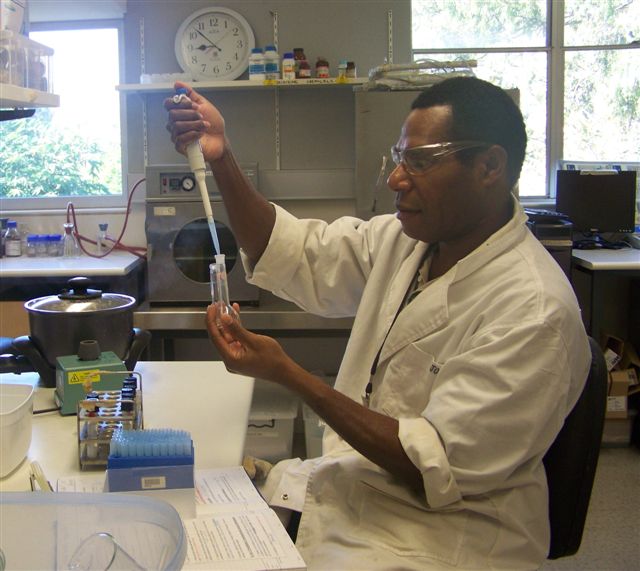 |
Joel Waramboi working in the laboratory
|
Waramboi is now breaking new ground with his research into kaukau (sweet potato), PNG’s most widely-grown food crop, while undergoing further studies in Australia.
“Although production data on our food crops remain sketchy, available information shows that, PNG produces about 2.9 million tonnes of sweet potato, 700,000 tonnes of banana, 300,000 tonnes of yams, 350,000 tonnes of taro and 80,000 tonnes of cassava annually,” he says.
“Globally, sweet potato is one of the most-important root crops, with more than 133 million tonnes produced annually.
“It is a staple food for millions of people and the seventh most-abundant crop after wheat, rice, maize, potato, barley and cassava.
 |
Kaukau flour
|
“So where does the 99% of the crop go to?
“It simply ends up in the cooking pot”
 |
Kaukau variety Beauregard
|
The 37-year-old will be completing his doctor of philosophy (PhD) degree in 2012 at the University of Queensland (UQ), Australia.
Waramboi is a senior scientist with the National Agricultural Research Institute (NARI), and conducts applied and adaptive research on post-harvest and processing aspects of food crops, alternative and emerging food and cash crops and natural resource management issues.
Currently he is with the Queensland Alliance for Agriculture & Food Innovation, a leading research organisation within the UQ researching on food and nutrition issues.
Waramboi has vast experience in implementing research and development projects.
He has conducted research, training and outreach activities with farmers and organisations around PNG.
In 2005, he implemented a project funded by the Agriculture Innovations Grant Scheme (AIGS) of the Australian government and trained national and provincial agriculture staff on proper vanilla curing and quality management aspects in West Sepik, East Sepik and Milne Bay provinces.
 |
Kaukau variety Beerwah Gold
|
Besides his input on rice production research, he implemented a project on evaluation of the eating qualities of rice varieties in several locations around PNG.
“Based on these studies, four rice varieties, namely NR1, NR9, NR15 and NR16 were released by NARI to the PNG farming community in May 2004,” Waramboi recalls.
“These varieties are now grown by farmers around the country.”
Waramboi has also worked on processing and value-addition of PNG staple foods like kaukau and taro by processing them into products like flour, chips, crisps and ice cream.
He has also done some product development work on coconut and fruit (pineapple, pawpaw, carambola) jam, peanut butter, roasted peanuts, imitation milk (peanut, soy bean) and starch extraction (cassava and sago). Some of these technologies have been tested with farmers, and all have the potential to be adopted and up-scaled by individuals or cottage industries in PNG.
Waramboi has the ability to put good project ideas and proposals for donor funding.
Some of his contributions have won major funding support from organisations like the Autralian Centre for International Agricultural Research (ACIAR) and the public investment programme (PIP) of the PNG national government.
His profession has taken him abroad to several countries.
In 2002, he attended an international training course on seed storage and germplasm conservation in Beijing, China.
In 2007, he attended another course in Changchun, China on corn and starch processing technology looking at starch extraction, modification and processing into food and industrial products like plastics, pharmaceuticals, chemicals, cosmetics and textiles.
Later that year, he was part of the PNG government delegation to Malaysia on the sago commercialisation project for PNG.
Waramboi has published papers both locally and internationally.
Within NARI, he has published six Toktoks or extension leaflets on rice post-harvest technologies.
In 2003, he published a technical bulletin on the physico-chemical and eating qualities of rice.
In 2005, he published a paper in the Journal of Agriculture, Foresty and Fisheries with DAL followed by an article in the Rice Relay with Trukai Industries Ltd.
From his current PhD studies on kaukau, he has published several papers.
 |
Kaukau variety Kestle
|
Early this year, he published a paper in the journal Food Chemistry, a high-impact journal of Elsevier Publishers, England.
He has submitted another paper on starch digestion in kaukau to Carbohydrate Polymers which should be available for public consumption by mid 2011.
In February this year, he also presented two papers at the Australian Institute of Food Science and Technology conference in Brisbane.
In his current research, he has extensively studied 25 varieties of kaukau for their flour and starch properties, nutritional value, processing parameters (temperature, moisture, heat transfer etc), granule structure, pasting, gelatinisation, and digestibility behaviours of these varieties.
In the digestion studies, his research will be the first to develop an in-vitro (test tube) technique to model digestion behaviours in these varieties.
“The study is also the first to identify and report resistant starch (RS) in several PNG sweet potato varieties like L3 and L135 which are beneficial for human health.” Waramboi says.
“When sweet potato is consumed, the RS basically escapes digestion in the small intestine, and gets fermented into fatty acids in the colon (large intestine) to help reduce lifestyle diseases like diabetes, high blood pressure and obesity, which are now becoming so common in PNG.”
Waramboi is also researching into carotene (the yellow/orange pigments that give colour to fruits and vegetables) in kaukau.
“Carotenoids are pro-vitamins, and when converted in vitamin A, they have beneficial health effects like prevention of night blindness” he explains.
“In Africa, the Bill & Melinda Gates Foundation has funded several projects to promote coloured flesh sweet potato varieties in schools and villages, and similar projects can be done in PNG to promote coloured flesh sweet potato, for example, kerot, for their natural goodness and health properties.”
He has also successfully developed extruded snack foods from flours of white and orange fleshed varieties using extrusion processing technology.
“This research has enabled me to optimise process control parameters like moisture contents, screw speed, temperature, heat flow and expansion properties to get high quality and ready-to-eat snack foods from sweet potato,” Waramboi adds.
“Low-cost extrusion technologies are available, and can be introduced to villages in PNG.
“My research is also looking at nutrient retention in processed products because some nutrients like protein, minerals and carotene can be lost during processing, especially at high temperatures.”
Waramboi continues to work hard, and is satisfied, both personally and professionally with his achievements and contributions to PNG.
He would like to see more young people making a career in science because most countries now are prospering through innovations and interventions and science and technology.
Waramboi was born on Feb 5, 1974, to illiterate and subsistence parents from Paparom village, Kubalia, East Sepik.
He did his grades one to six from 1982-1987 at Sassoya Primary School, grades seven to 10 from 1988-1991 at Brandi High School in East Sepik Province, and grades 11 to 12 at Aiyura National High School in Eastern Highlands from 1992-1993.
From 1994-1997, Waramboi studied for his bachelor of science degree at Unitech.
After graduation, he was employed as a trainee manager with Andersons Foodland, eventually managing its wholesale department.
He resigned in October 1999.
In February 2000, he joined the first batch of NARI cadet scientists and eventually became a permanent staff in late 2002 with the institute.
From 2003-2004 he did his masters degree in England and in 2009, started his PhD in Australia.
Interested persons can contact him on j.waramboi@uq.edu.au
World Bank launches cocoa project
By SOLDIER BURUKA
A World Bank-funded agriculture development project launched this week will be a major boost for smallholder cocoa and coffee farmers.
Cocoa and coffee are two of the country’s most-important agricultural commodities and with the formal launching of the Productive Partnerships in Agriculture Project (PPAP); it should contribute to a positive impact in the social and economic wellbeing of the majority of the rural population.
PPAP, supported by the World Bank, International Fund for Agriculture Development (IFAD) and PNG Government, will benefit coffee and cocoa institutions, the smallholder producers and the smallholders in market access and is anticipated to improve performance at all value chains and public-private partnerships.
The formal launching of the PPAP took place in Kokopo on Tuesday, April 5, attended by World Bank and government officials, agricultural agencies, farmer organisations and farmers, followed by a similar launching the next day.
The coffee component will be launched in Goroka next week followed by a national launching in Port Moresby.
At the Kokopo launching, Minister for Higher Education and acting Agriculture Minister Paru Aihi told a big gathering at the Gazelle International Hotel that it was not only fitting but also significant that the World Bank and IFAD had chosen the two most-important commodities that directly influenced the economic wellbeing of the rural communities.
He said it was also the Somare-Abal government’s desire to ensure that majority of the rural population that depends on cocoa and coffee must ultimately be the beneficiaries.
“The government has created a conducive political and economic environment which has resulted in the confidence of such highly-esteemed bodies like the World Bank and IFAD to fund this project, “he said.
Aihi said the government recognised that PPAP would contribute to growth of our agricultural export industries, enhancement of smallholder income, and rehabilitation of market access infrastructure, and called on all stakeholders involved in the implementation process to work together.
As far as cocoa is concerned, Aihi said this was a massive investment over 20 years after the smallholder cocoa and coconut rehabilitation program in the 1980s which saw cocoa production averaging 30,000 to 40,000 tonnes.
Through PPAP, he expected increased cocoa production and revitalisation of support services including marketing and transportation.
Aihi expressed his gratitude to the World Bank and IFAD for their assistance and indicated that the government had committed a total of K5 million to support the project over its six-year period.
World Bank representative, Charles Feinsten, said PPAP would improve the incomes and livelihoods of smallholder coffee and cocoa farmers by: building relationships between farmers and agri-business for better access to markets, technologies, and services; strengthening industry coordination; and providing access roads and wharves to ensure coffee and cocoa producers could readily get to markets.
The project will directly help local farmers, offering training and support, assisting them to adopt better farming practices.
Community consultations will continue to take place throughout the duration of the project in order to build true partnerships and ensure sustainability.
The project will initially take place in areas where rural household dependency on coffee and cocoa income is high, especially East New Britain Province, the Autonomous Region of Bougainville, Eastern Highlands Province, Western Highlands Province, Jiwaka Province and Simbu province.
The possibility of expanding into other provinces will be reviewed during the second year of the project, and again during the fourth.
A World Bank-funded agriculture development project launched this week will be a major boost for smallholder cocoa and coffee farmers.
 |
Acting Minister for Agriculture and Livestock Paru Aihi cuts the ribbon to formally launch the World Bank and PNG Government funded PPAP in Kokopo. Looking on is World Bank sustainable development manager Charles Feinsten.
|
PPAP, supported by the World Bank, International Fund for Agriculture Development (IFAD) and PNG Government, will benefit coffee and cocoa institutions, the smallholder producers and the smallholders in market access and is anticipated to improve performance at all value chains and public-private partnerships.
The formal launching of the PPAP took place in Kokopo on Tuesday, April 5, attended by World Bank and government officials, agricultural agencies, farmer organisations and farmers, followed by a similar launching the next day.
The coffee component will be launched in Goroka next week followed by a national launching in Port Moresby.
At the Kokopo launching, Minister for Higher Education and acting Agriculture Minister Paru Aihi told a big gathering at the Gazelle International Hotel that it was not only fitting but also significant that the World Bank and IFAD had chosen the two most-important commodities that directly influenced the economic wellbeing of the rural communities.
He said it was also the Somare-Abal government’s desire to ensure that majority of the rural population that depends on cocoa and coffee must ultimately be the beneficiaries.
“The government has created a conducive political and economic environment which has resulted in the confidence of such highly-esteemed bodies like the World Bank and IFAD to fund this project, “he said.
Aihi said the government recognised that PPAP would contribute to growth of our agricultural export industries, enhancement of smallholder income, and rehabilitation of market access infrastructure, and called on all stakeholders involved in the implementation process to work together.
As far as cocoa is concerned, Aihi said this was a massive investment over 20 years after the smallholder cocoa and coconut rehabilitation program in the 1980s which saw cocoa production averaging 30,000 to 40,000 tonnes.
 |
Acting Minister for Agriculture and Livestock Paru Aihi later took time out to visit current cocoa research programmes at Cocoa Coconut Institute at Tavilo. Here cocoa breeder Jeffrie Marfu explains work on high-yielding varieties as one way of stopping the cocoa pod borer disease.
|
Aihi expressed his gratitude to the World Bank and IFAD for their assistance and indicated that the government had committed a total of K5 million to support the project over its six-year period.
World Bank representative, Charles Feinsten, said PPAP would improve the incomes and livelihoods of smallholder coffee and cocoa farmers by: building relationships between farmers and agri-business for better access to markets, technologies, and services; strengthening industry coordination; and providing access roads and wharves to ensure coffee and cocoa producers could readily get to markets.
The project will directly help local farmers, offering training and support, assisting them to adopt better farming practices.
Community consultations will continue to take place throughout the duration of the project in order to build true partnerships and ensure sustainability.
The project will initially take place in areas where rural household dependency on coffee and cocoa income is high, especially East New Britain Province, the Autonomous Region of Bougainville, Eastern Highlands Province, Western Highlands Province, Jiwaka Province and Simbu province.
The possibility of expanding into other provinces will be reviewed during the second year of the project, and again during the fourth.
Coffee expert says national agriculture development plan living in ‘fantasy’ land
By MALUM NALU
A coffee industry expert has accused architects of the controversial National Agriculture Development Plan (NADP) of living in “fantasy” with their unrealistic projections for the industry.
Well-known coffee personality, David Rumbarumba, has joined cocoa, copra and palm oil in rubbishing unrealistic projections contained in the “realigned” NADP, which were provided to the Department of National Planning and Monitoring’s (DNPM) national development strategic plan 2030 (DSP 2030).
The NADP expects coffee to reach 500,000 metric tonnes in 2030 from 73, 868mt this year – a massive 700% increase.
This projection will also be part of the much-vaunted Vision 2050.
“Five hundred metric tonnes is 8, 333, 333 bags of green bean (exportable coffee),” said Rumbarumba, who is general manager of Awute Coffee Producers.
“This is more than 700% increase from current average of 73, 868mt (1, 231,133 bags).
“Correct current average volume is around 54,000mt, or 900, 000 bags – not even a million bags!
“Basing on this target, 500,000mt will be more than 900% achieved in 19 years!
“Wow!
“This target is ridiculously ambiguous and an unrealistic dream, or shall I say ‘fantasy’, by the government and its agents.
“Where does the DNPM and DAL get their data from?
“I can gurantee that such a volumetric target will not be achieved in 19 years or even 100 years, and I can certainly bet my life on that.”
Rumbarumba said only once in coffee’s 60-year history, in 1998 after the 1997 drought, did coffee achieve its biggest-ever production of 1.23 million bags, and it had since slumped
He said coffee was competing with other subsistence crops for land space, due to population growth, and there was no gurantee that there would be more plantings.
Rumbarumba said compounded by all the problems, the government had not even invested in coffee over the years, even leaving stakeholders to fund research and extension industry levy.
“A reasonable target for coffee in the next 20 years would be to double the volume from current 54,000mt (900,000 bags) to 110,00mt, or a target of two million bags,” he said.
“This was the industry’s target in its two five-year strategic plans 10 years ago, but it was not achieved, because the government failed to support the plan with funding of its programmes.
“We in the coffee industry believe two million bags can be achievable with right and consistent financial and policy support from the national government.”
Rumbarumba called on government to:
• Directly fund the Coffee Industry Corporation with K30-K40 million a year to reactivate research and extension programmes, industry regulations, farmer training and marketing programmes, coffee nursery developments, and coffee rehabilitation;
• Create a government ministry for commodities, separate from agriculture and livestock; and
• Create a commodities bank with open and soft lending policies.
Subscribe to:
Posts (Atom)