Tuesday, July 10, 2012

Charlie Benjamin, Ronny Knight win in Manus

People's National Congress candidate Charlie Benjamin has been declared winner of the of Manus Regional seat at 11.02 am today. 
This is the second declaration of the 2012 national elections after Peter O'Neill for Ialibu-Pangia,. Manus Open has also declared a new MP. 
Businessman and New Generation Party candidate Ronny Knight was declared at 12.56 pm.

Monday, July 09, 2012

Good prospects for Wafi-Golpu project

MOROBE Mining Joint Ventures general manager - sustainability and external relations David Wissink says prospects for its proposed new Wafi-Golpu copper-gold mine in Morobe province look very good.
“It’s a very exciting prospect,” he told The National during a short site visit by helicopter on Saturday.
“It looks very good.
“It looks to be a long-term, large-scale project for Papua New Guinea.”
An aerial view of the project site at Wafi on Saturday.-Nationalpic by MALUM NALU

A mineral resources estimate as at June 2011 estimated that Wafi-Golpu deposits contained 26.6 million ounces of gold and three million tonnes of copper.
The project contains one of the highest grade porphyry copper systems in Southeast Asia with average grades in excess of 0.5 grams per tonne gold and 0.9% copper, making the resource comparable with other world-class systems.
The project comprises a major epithermal gold structure known as the Wafi gold deposit with two porphyry copper-gold deposits, Golpu and Nambongu North, in close proximity.
Now in pre-feasibility stage in a joint-venture with Newcrest Gold of Australia, Wafi-Golpu is set to follow South African miner Harmony’s Hidden Valley copper-gold mine that came into production in September 2010, also in a joint-venture with Newcrest.
“With Wafi project right now we’re in the pre-feasibility stage,” Wissink said.
“That means we’re defining a lot of the studies,
“Hopefully, we should have a pre-feasibility document done by the end of July, sometime in August.
“So right now there’s a lot of drilling on site to define what the resource is.”
Wissink said MMJV was talking with the government to comply with all requirements and environmental permits.
The Wafi-Golpu project is located 80km from Lae and is easily accessed by sealed road to Timini-Demakwa and then via a 38km dirt base track to the project.
The site is 4km from the broad Watut and Markham Valley plains

Economy expands in first quarter of 2012

By MALUM NALU

THE domestic economy continued to grow in the first quarter of 2012, mainly driven by the continuation of the construction phase of the PNG LNG project and high government expenditure, according to the Bank of PNG’s March Quarterly Economic Bulletin released last Friday, The National reports.
 This develops as the kina continued to appreciate against most major currencies, and the level of gross foreign exchange reserves decreased from K8.794 billion (US$4.283 billion) at the end of March 2012 to K8.58 billion (US$4.196 billion) as at June 29, 2012.
Bank Governor Loi Bakani said continued credit to the private sector, strong private sector activity and increase in the level of employment in the private sector were all indicative of this growth.
“Domestic demand pressures associated with the strong economic growth continue to prevail and its potential impact on inflation has been a concern,” he said.
“However, the inflation outcome was lower than expected mainly due to lower imported prices and the appreciation of the kina, especially against the US dollar.
“Annual inflation to March 2012 was 4%, compared to 6.9% in December 2011.
“The strong kina had the effect of lowering landed prices of imports, including food and fuel products, than otherwise would be.
“The bank is still mindful of the domestic demand pressures associated with the strong growth and therefore, maintained a tight stance of monetary policy by keeping its official rate, the Kina Facility Rate (KFR), at 7.75% in the March quarter of this year.”
Bakani said data from the bank’s business liaison survey (BLS) show that the total nominal value of sales in the private sector increased by 3.1% in the December quarter of last year, compared to a decline of 0.2% in the September quarter, same period.
“Excluding the mineral sector, sales declined by 1.4% in the December quarter, after increasing by 3.4% in the previous quarter,” he said.
“Sales increased in the mineral, building and construction, manufacturing and retail sectors, while there were declines in the agriculture/forestry/fisheries, wholesale, transportation and financial/business/other services sectors.
Cocoa growing in the Lower Watut area of Morobe province. There were declines in the agricultural sector, according to the BPNG Quarterly Economic Bulletin.-Nationalpic by MALUM NALU

“By region, Momase and Southern regions experienced increases, while NCD, Highlands, Islands and Morobe recorded declines.
“Over the 12 months to December 2011, total sales declined by 5.4%.”
Bakani said the bank’s employment index showed that the total level of employment in the private sector increased by 1.1% in the March quarter of this year, compared to an increase of 1% in the previous quarter.
“Excluding the mineral sector, the level of employment also increased by 1.1% as the change in the mineral sector was negligible,” he said.
 “The level of employment increased in the building and construction, manufacturing, financial/business/other services, and mineral sectors, while it declined in the agriculture/forestry/fisheries, transportation, wholesale and retail sectors.
“By region, only Momase experienced a decline while all the other regions recorded increases.
Over the year to last March, the total level of employment increased by 5%, but excluding the mineral sector, the level jumped by 4.7%, Bakani said

Sunday, July 08, 2012

Dream come true as books delivered to remote Watut


By MALUM NALU

A dream came true for 13-year-old Ngaru Nen in remote Maralina village in Lower Watut, Morobe province, yesterday Saturday - Saturday, july 7, 2012 -  as he delivered a container load of books from the USA for the children of three schools in the area.
In emotional scenes at Maralina, six hours by motorised canoe up the Markham and Watut rivers, Ngaru and his siblings Betty and Aral Jr presented the books to the children of Maralina, Uruf and Tsili Tsili primary schools. 
Watut man Aral Nen (left) and his children Aral Jr, Betty and Ngaru, and wife Mary, on the banks of the Markham River at 40-Mile outside Lae last Friday before leaving to deliver books from Milwaukee, Wisconsin, USA, to schools in the Lower Watut area.
 The Nen children had been collecting books for the children of Lower Watut since 2008, however, they ran into a hitch when their father could not afford the high cost of transporting the books to PNG.
They, their mother Mary and father travelled all the way from Milwaukee, Wisconsin, USA, too make the book presentation.
The Nen family is welcomed to Maralina
Morobe Mining Joint Ventures general manager - sustainability and external relations, David Wissink, turned Good Samaritan as he read about young Ngaru’s plight on Facebook.
From left are Aral Nen, wife Mary, children Ngaru, Betty and Aral Jr, and David Wissink of MMJV at Maralina on Saturday.

In January this year, thanks to Wissink, a container load of books and school supplies left Milwaukee for Lae, final destination Watut.
The books arrived in Lae earlier this year and were kept in storage by MMJV until the Nens arrived.
In another twist of fate, major Korean TV company SBS, heard about Nen’s story and paid for all his family to travel to PNG so that they could make a documentary on the life of the family.
Givers become receivers…Nen children (from left) Aral Jr, Ngaru and Betty are showered with gifts at Maralina on Saturday.

Immediately after the book presentation, the Nen family and the TV crew travelled to Nen’s Zenem village, where they will spend the next couple of weeks shooting the documentary,
The people of Lower Watut laid down the red carpet on Saturday to welcome the Nen family home to present the books.
A quietly-spoken Ngaru said he was glad that the books had reached Watut safely after his ordeal in putting them together.
“I hope that they are useful to you,” he told a crowd of Watut school schildren and the local community who gathered at Maralina.”
Ngaru addresses the crown at Maralina
Wissink heaped praise on Ngaru and his siblings.
“This is a good partnership,” he said.
“Thank you to Ngaru and his sister and brother.”

Friday, July 06, 2012

Way out west in Vanimo

By MALUM NALU
 
Evening at Dali Beach, Vanimo, West Sepik province, on Friday, June 22, 2012.

Panorama of Vanimo.-Nationalpics by MALUM NALU
I am lying on the beachfront of the Vanimo Beach Hotel, waves lapping up to my feet, watching the hermit crabs scurrying along the white sand, and smelling the freshness of the turquoise waters.
To my right, the sandy stretch runs all the way to Aitape and on to Wewak in East Sepik, while to my left, it does all the way to Wutung along the border with Indonesia, and on to Jayapura.

Beachfront scene as seen from Vanimo Beach Hotel
As the waves rush up to my feet, I can’t help but think about the future of this country, especially with this being the season of elections.
The footprints in the sand remind me of one of my favorite poems, Footprints, of a man dreaming of walking along the beach with the Lord.
I spent three days in Vanimo recently, from June 22-24, enjoying this beautiful frontier town way out west to the border with Indonesia.


Endless white beaches along East Coast Road
The two-hour Air Niugini Q400 flight from Port Moresby takes in spectacular sunrise scenes and the breathtaking grandeur of the Gulf of Papua, Highlands and Sepik River before we descend into Vanimo.
After checking in and having breakfast at the Vanimo Beach Hotel, we drive up to Vanimo Hill – the Beverly Hills of the West Sepik capital – to catch million dollar views of the town.
Early morning at Dali Beach, Vanimo, on Sunday, June 24, 2012

On top of the hill, where local MP Belden Namah is building a plush new residence, a big crowd is gathered to hear their leader address them.
After that, we take a scenic drive along the West Coast Road to Wutung Border Post, on the border with Indonesia.

Start of the West Coast Road from Vanimo to Wutung
I have travelled hither and thither in the country; however, none matches the natural beauty of the road from Vanimo to Wutung.

Natural forest camouflage along the drive to Wutung
Mountains, natural unspoilt forests, streams and ocean meet along this drive to the border.
One thing I notice in Vanimo and all the way to Wutung, is the number of election banners, a costly exercise elsewhere in the country, but very cheap here because they are done up by Indonesians at the border.

Wutung in the background as seen along the drive from Vanimo
At Wutung, we check with PNG Customs at the border, and are given the green lights to walk through the 1km long “no man’s land” to the Indonesian side of the border, on to the Indonesian side of the border and through to Batas Market.

Wutung mountain grandeur
The original plan was to have travelled all the way to Jayapura; however, this was not to be.

Wutung Border Post
One of the perks and priviledges of Vanimo is that you can travel from here by road to Jayapura, starting at Wutung, where you hire a vehicle.

The Indonesian side of the border
A visa can be easily acquired at the Indonesian consulate in Vanimo.
Batas has, over the years, become a mecca for shoppers from all over PNG to buy cheap Indonesia food, clothing, electronic goods and other items, however, in recent times, it has become the hub for trade of illicit goods into PNG.

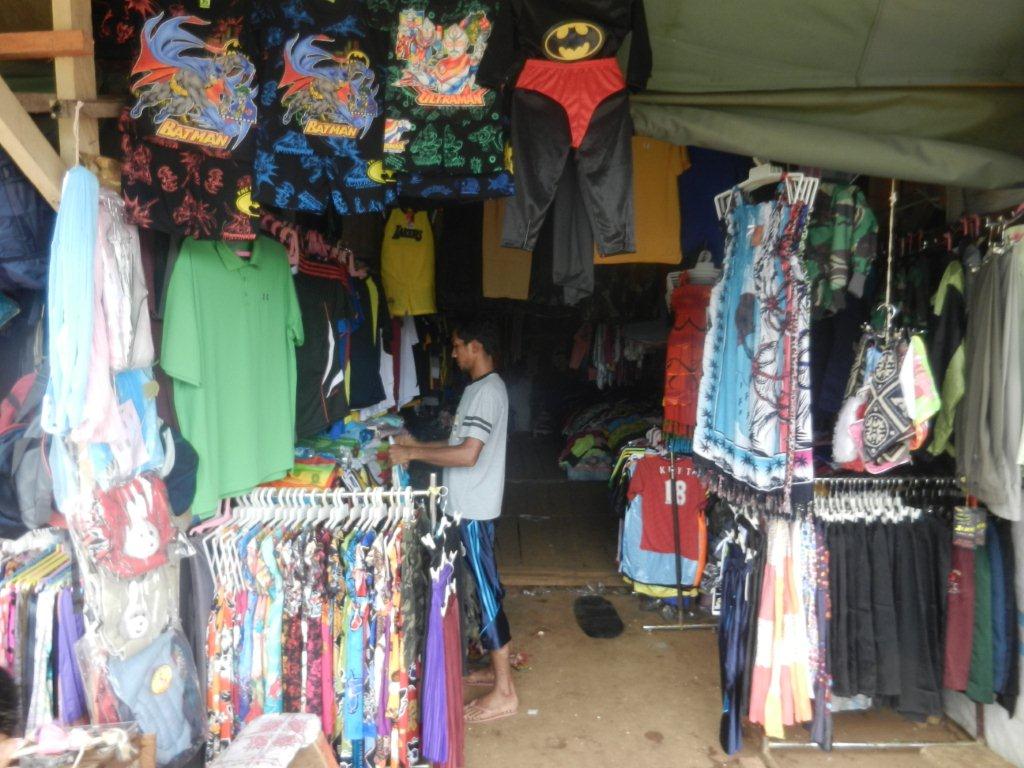
Clothes on sale at Batas Market
Clothes, food items, cigarettes, alcohol, electronic goods and all manner of goods are sold here.
The Indonesian sellers are very aggressive and approach you with their sales pitch, “papa, papa”, as they ply their trade.

PNG customer checking out electronic goods at Batas Market
One of the hottest-selling items here are male sprays, which the salesmen say will, “keep you hard all night and make her very happy”.
I’m man enough to say that I don’t need one right now!
Pornographic movies, sold in SIM cards, sell like hot cakes to PNG customers as well as sexual toys for both men and women.
The clothes and toys are cheaper and of better quality than that sold in other Asian shops in PNG, and I end up spending some K300 on clothes and toys, both for my kids and myself.
After that, my escort and I walk back across the border, stopping for a chat with Indonesian border guards, who we find are just as good salesmen as their countrymen and women at Batas Market.

Goodbye Indonesia
The next day, Saturday, we take a drive around Vanimo town and see that there is not much by way of market as the place is inundated with Indonesian goods from the border.
We take a drive along part of the East Coast Road, which leads on to Aitape and then Wewak, before turning back to town for lunch.


 Along the East Coast Road towards Aitape
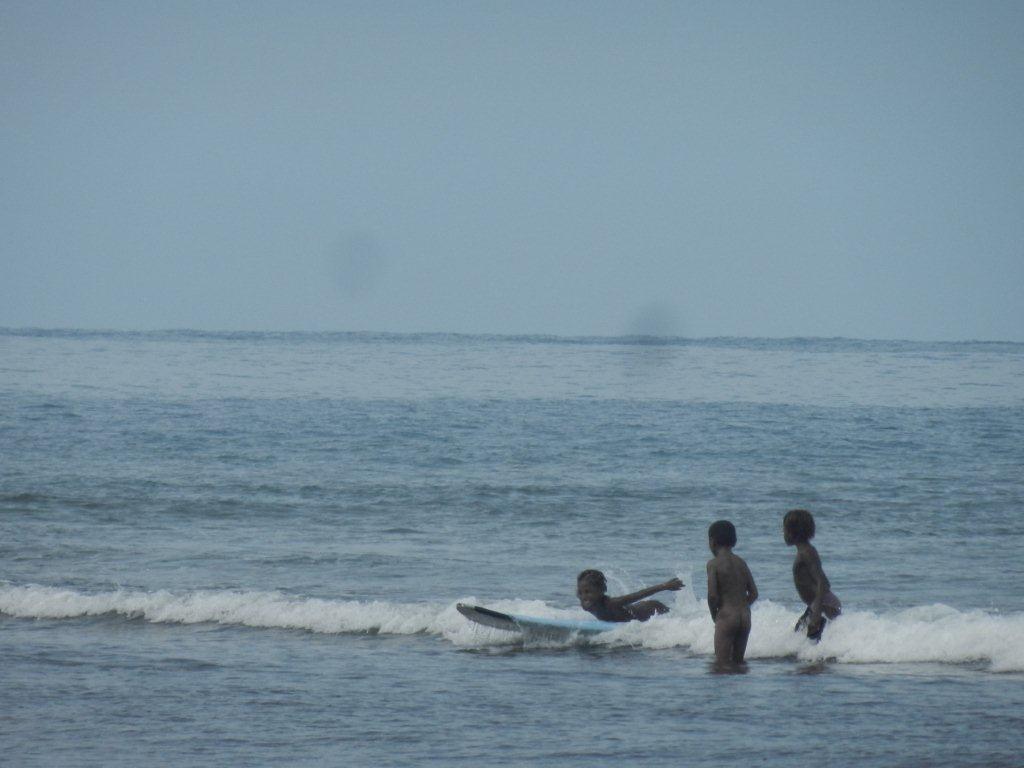
After lunch, we take another drive to Wutung, stopping along the way at picturesque Lido village, home of some of the best surf in PNG, which draws in surfers from all over the world here in search of that fabled “perfect wave”.

Children surfing at Lido village
 Lido is a neat, well-kept village, and children are swimming and riding the waves, elderly women fishing, oblivious to all the politics that has divided their village as well as Vanimo.
Splinters is the first feature-length documentary film about the evolution of indigenous surfing in PNG.
In the 1980s an intrepid Australian pilot left behind a surfboard in the seaside village of Lido.

Picture-perfect beach scene at Lido village
Twenty years on, surfing is not only a pillar of village life but also a means to prestige.
Next year, Lido will host an international surfing tournament, which surfers from all over the world will attend.
After Lido, we drive on to Wutung, where we leave our vehicle at the border post and walk across the border to Batas Market to do some more shopping.


Motorcycles loaded with goods from Batas Market on the PNG side of the border
Loaded with bags, we walk back across the border, and take the drive back to Vanimo. Evening in Vanimo is absolutely spectacular, pretty as a picture, as the sun sets.
That’s why West Sepik is called Sandaun (Sunset) province.
And the sun sets on one of the most-beautiful places in PNG.

Wutung lighthouse along the border


Thursday, July 05, 2012

Ramu Agri Industries Ltd builds two satellite towns

By MALUM NALU

RAMU Agri Investments Ltd (RAIL) is building two  satellite towns – “estate villages” – at Surinam and Dumpu in the Usino-Bundi area of Madang province, past its sugar town of Gusap, The National reports.
 Quality housing is being built for staff, complete with trade stores, community centres and sporting facilities.
New employee housing being built at Dumpu.-Nationalpics by MALUM NALU

This is all part of the multi-million kina expansion of oil palm in Ramu Valley of Madang province and adjoining Markham Valley of Morobe province after having its product rated as among the best in the world.
These projects include the biggest-ever 440km-long irrigation project in Papua New Guinea using water from the Gusap River, a second mill at Dumpu, and getting more outgrowers from Ramu and Markham valleys.
Management housing at Surinam

Dumpu estate mana­ger, Lama Kuri, told The National during a recent site visit that palm oil planting in Dumpu started in 2006 and 2007 on the site of the cattle ranch of well-known former Madang politician, the late Sir Bruce Jephcott.
Signboard at Dumpu

“This used to be a cattle area that was run by the late Sir Bruce Jephcott,” he said.
“When palm oil development started, we started moving all the cattle out to Leron Plains Cattle Ranch in the Markham Valley of Morobe province.
“We’ve got a total of 2,157ha here.
“We’ve already got 27 new houses on site, with 16 new ones coming up,” Kuri said.
New houses going up at Dumpu

“We’ve got two divisional managers, four field supervisors, one estate clerk and one junior clerk.”
He said they have a total of 360 employees on the estate.
“Most of our emplo­yees are from the local area, with others from Madang, Eastern Highlands, Chimbu, Enga, Southern Highlands, Morobe and other pro­vinces.
“We give priority for employment to locals from around the area.”
Children of all employees at Dumpu are transported to and from school at Gusap every day by 25-seater buses owned by RAIL.
Kuri is excited about all the developments ta­king place in what used to be grassland and cattle paddocks in the past.
“It’s like a town here,” he said.
“It used to be grassland and cattle country before.
“When I first came here, there was only one house, which is my house.
“I see a lot of houses coming up now.
“Many people are making positive comments about the place.
“We will have trade stores, community hall, clinic, street lights. It will be a town of its own.
“Our employees are very happy to live on site.”
RAIL general mana­ger Jamie Graham told The National that a new oil palm mill was also planned for Dumpu.
Signboard at Surinam

“We’re also planning a new mill to be located near Dumpu,” he said.
“We would hope to start by the end of 2013.
“We would hope to have that in operation by the end of 2015.”

Cell phone opens new opportunities

By MALUM NALU

TECHNOLOGICAL innovations are opening access to new business opportunities in Papua New Guinea, according to the World Bank, The National reports.
In its  latest PNG Economic Briefing, The Challenge of Transforming Today’s Boom into Better Living Standards for Tomorrow, the bank said the private sector is generating new opportunities, through innovative business structures and technological changes that fit PNG’s conditions well.
“As many as two and a half million Papua New Guineans had mobile phone handsets by early this year, compared with only thousands four years previously,” the report said.
“This employs large number directly, for example, Digicel has a network of around 30,000 distributors of pre-paid credit vouchers either new to informal retail business or enjoying increased turnover.
“The benefits of mobile phone technology are particularly great for a country constrained by PNG’s geography and often remote population, for example, on access to finance.
“Bank of PNG issued Digicel with the country’s first mobile banking licence last February.”
The report said major retail banks were trialling new mobile banking platforms designed to enable access to financial services, particularly savings accounts.
Nationwide Microbank staff assisting a Porebada village woman to access her bank account on the mobile phone.-Picture courtesy of NATIONWIDE MICROBANK

“These services include mobile agents using low-cost computers connected with mobile phone networks to open bank accounts for individuals.
“Individuals and small businesses are then able to transfer funds by mobile phones and deposit and withdraw funds from local agents, located in trade stores, for example.
“This reduces the costs of dealing in cash – for example, of theft or in handling cash, which can be scarce in remote areas.”
The report said Bank South Pacific was targeting 200,000 holders of such accounts by 2014.
“These innovations have the potential to dramatically deepen many Papua New Guineans’ engagement with the cash economy,” it said.
“They can allow small farmers to shift from relying on opportunistic production of cash crops when cash is needed to more strategic production, so raising incomes and allowing savings to be built to buffer against shocks or to support investments in productive capacity.”
A “Financial Inclusion Day” is planned for later this year following a 2008 World Bank report which found out that only 8% of the population in PNG has access to financial services while a whopping 90% are “financially excluded”.
The Consultative Implementation and Monitoring Council’s informal economy committee, realising the seriousness of the problem, held a meeting on Tuesday to start planning for the day.
According to a CIMC concept paper presented at the committee meeting on Tuesday, PNG ranked at the bottom of the table among Asia-Pacific countries, when it came to “financial inclusion”.
“Some degree of financial exclusion exists in all countries, even wealthy ones, but PNG is at the bottom of the league table among countries in the Asia-Pacific region,” it said.
“Even allowing for the relatively low population densities and rugged topography that make the provision of any services difficult in PNG, the country has performed very poorly in providing access to formal financial services for its people.
“Only about 8% of its population is ‘financially included’, or 92% excluded.”