Monday, April 18, 2011

Joe Leahy's Neighbours: A parable for mordern-day Papua New Guinea

By MALUM NALU


Joe Leahy shot to fame as the star of internationally-acclaimed movies, Joe Leahy’s Neighbours and its sequel Black Harvest, which have also been widely shown on local television.

Joe Leahy manages a smile amidst all his problems.-Pictures by MALUM NALU
Today, at age 72 but still sprightly as ever since the filming of Joe Leahy’s Neighbours and Black Harvest in the 1980s, Leahy is desperately looking for money to revive his rundown Kilma coffee plantation in the Nebilyer Valley of Western Highlands province.

At age 72, and fit as ever, is Joe Leahy in boots, jeans, jacket and hat.
I met him in Goroka, Eastern Highlands, on Tuesday, April 12, when he and other Western Highlands coffee growers had travelled there for the launch of the World Bank-funded coffee project, and we got into a lively conversation.

A perennial coffee farmer…Joe Leahy (fourth from right, backrow) with other Western Highlands coffee growers in Goroka.
If Joe Leahy’s story is a parable for modern-day Papua New Guinea, more so our coffee growers and those living in the highlands, perhaps everyone takes his own meaning from it and reads his own life into it.
Having watched both movies several times, unrehearsed documentaries which can make you laugh one moment and drive you to tears the next, I was keen to know how Leahy’s coffee business had prospered since.
Joe Leahy’s Neighbours traces the fortunes of Joe Leahy, the mixed-race son of Australian explorer Michael Leahy, in his uneasy relationship with his tribal neighbors.
He built his coffee plantation on land bought from the Ganiga tribe in the mid 1970s.
European-educated, raised in the highlands, freed by his mixed race from the entanglements of tribal obligation, Leahy leads a Western lifestyle governed by individualism and the pursuit of affluence.
While Leahy may live in Western grandeur, he is still surrounded by his subsistence-level Ganiga "neighbors," who never let him forget the original source of his prosperity.
He spends much of his waking hours just keeping the lid on things.
Australian filmmakers Bob Connolly and Robin Anderson lived for 18 continuous months in 1985 and 1986 on the edge of his plantation, in the "no man's land" between Leahy and the Ganiga.
Their lively, non-judgmental narrative eloquently captures the conflicting values of tribalism and capitalism.
Black Harvest, the final film shot in 1989, charts the progress of Leahy in convincing the Ganiga tribespeople to join him in a coffee-growing venture.
He provides the money and the expertise; they supply the land and labor.
But on the eve of success, world coffee price collapses and tribal warfare erupts in the valley, as the Ganigas team up with the Ulgas to fight the Kulgas.
Always suspect because of his mixed-race status, Leahy is in deep trouble with the tribespeople when his promises of riches fail to materialise.
As he organises to emigrate with his family to Australia, he is a saddened man with an uncertain future.
So much has happened since then, Leahy remaining in his beloved Western Highlands – the Promised Land discovered by his father and uncles in the 1930s and eloquently captured in First Contact – while his Central province wife and children have settled permanently in Australia.
‘The plantation (Kilma), since the movies were shot in the 1980s, has closed, that’s why I’m in Goroka,” Leahy tells me.
“I’ve been trying to get money from the NADP (national agriculture development plan) to revive the plantation; however, all that money has been siphoned elsewhere.
“The plantation has all gone bush.
"I’m still living there.
“I applied for NADP funding but I got nothing, so I’m here to see if the World Bank can help us.
“The government has the ideas in place; however, it is the implementing agencies that are not making it happen
“What I’m doing now is looking for cash to revive the plantation.”
Such was the intensity of the fighting between the Ulgas and the Kulgas in the Nebilyer Valley that it continued unabated, for more than 10 years, claiming countless lives.
"Everything’s been destroyed,” Leahy tells me.
“The infrastructure, everything’s there, and all I need is the money and things will be back again.
“Before the fighting erupted, the plantation was fully operational.
“We borrowed money from the PNGBC (PNG Banking Corporation) and were paying it off.
“Then the fighting broke out and we were in debt with the PNGBC
“I started the plantation in the 1970s.
“In 1975/1976, the plantation was in full production.
“The fighting started in the 1980s and continued for more than 10 years.
“Now is the time to pump money into rural areas so that people can look after themselves.”
After the daylight robbery of the NADP by the infamous “paper farmers” of Waigani, Leahy, and coffee growers in the highlands, see the World Bank project as manna from heaven.
“The World Bank project is a blessing from heaven,” he says.
“The system is there but the people who are there should make it work.
“Bureaucrats live if a dream world.
“They are not looking at reality.”
A look of sadness appears on Leahy’s face as he talks about Kilma plantation, his wife, and seven children, two girls and five boys.
“The plantation’s not operational,” he tells me.
“It’s all bush now.
“Thieves are going there, stealing.
“I just live on the place and do bits and pieces.
“What we need is money and law-and-order.
“My children have all left and are looking after themselves.
“They’re all married and have got kids.
“During the fighting, my wife asked me to leave.
“I said I will never leave this place.
“She’s in Australia with the kids.”
Leahy says the warring tribes now realise the economic development’s they’ve missed out on for all these years because of tribal fighting.
“They accused me of stealing their money and their land,” he adds, forlornly.
“Now they look back and see that they’ve done wrong.
“They’re living a miserable life."

Hidden Valley mine supports Coffee Industry Corporation objectives

The Hidden Valley Mine is implementing the Coffee Industry Corporation’s (CIC) plans to improve coffee production in the country.

A coffee farmer from Biawen attends to one of his coffee trees during the pruning practical session.
The CIC is focusing on adding value in the marketing chain for farmers to increase export volume and quality.
Its strategy includes rehabilitation of all aging senile coffee trees, expansion into new growth areas and establishment of nurseries, mobilisation of smallholder coffee growers, promote marketing systems which revolve around quality.
Hidden Valley is helping to achieve these objectives in partnership with Mainland Holdings Limited (MHL) through a coffee training programme.
The mine is funding the trainings which are conducted by MHL for villages located in the footprint of the mining operation in the Wau/Bulolo district of Morobe province.
The objective of the programme is to enhance the income of the rural people through coffee production.
The first training was conducted for Biangai villages in Wau from July to August, 2010.
It involved six Biangai villages including the two principal landowners of the Hidden Valley Gold Mine: Kwembu and Winima.
The training was aimed at enhancing the income of the Biangai community through improved coffee management practices.
It focused on improving the skills and knowledge of farmers on, coffee nursery establishment and field planting, coffee garden management, basic garden rehabilitation and pruning practices, coffee quality improvement through improved harvesting and processing techniques and basic financial management and cash handling practices and Marketing.
The training was conducted in two phases, theory and practical.
It attracted a huge turnout with a total of 95 participants in attendance.
Five came from Winima, 10 from Kwembu, 58 from Biawen, 10 from Werewere, 10 from Elauru and three from Kaisenik and also comprised of 16 females, two of whom were ward councilors, seven church pastors and a grade 11 female student of Grace Memorial Secondary School.
The participants were presented with shade cloth for nursery and drying beds, secateurs and saws for pruning, nails for the nursery buildings, yellow cover cloth for the drying roofs, and topped it off with 17 coffee cherry pulping machines to assist them to continue to take care of their coffee gardens.

Miss PNG sees real life in remote Nabak

By ELLEN TIAMU

MISS Papua New Guinea Rachel Sapery James visited a remote village in Morobe last Friday morning, describing it as the highlight of her visit to the province, The National reports.

She visited Sakarang village, Nabak district, as part of her Red Cross Miss PNG duties to spread the word on the work of the organisation.
She told villagers of the importance of keeping clean, using clean water and keeping food clean to combat cholera and tuberculosis.
James encouraged the villagers to take care of their environment, saying it was their livelihood and any destruction of the eco-system would mean possible threats on their lives.
Helicopter company Manolos Aviation assisted her with transport to the inland village, which highlighted to her the plight of many women in the province, and country, who needlessly die because they could not easily access health centres and hospitals.
Manolos Aviation flies women, men and children from remote areas of Morobe needing urgent and life-saving medical attention into Lae’s Angau Memorial Hospital.
James described her visit to the village as the best part of her visit to Morobe.

Attorney general: State owns all resources

ATTORNEY-General Sir Arnold Amet is adamant the state owns all resources found six feet or deeper in the land, The National reports. This included minerals and oil, he said.
Refuting ambassador Peter Donigi of Warner Shand Lawyers, who claimed that the state did not own natural resources, Sir Arnold said the Petroleum Act and Mining Act vested ownership of minerals and petroleum resources with the state.
The former chief justice said, as such, the state was the proper party to the gas agreement and it had validly executed the gas agreement (PNG LNG Agreement of May 22, 2008).
“Both the Oil and Gas Act 1998 and the Mining Act 1992 vest ownership of minerals and petroleum resources with the state,” Sir Arnold said in a statement last Friday.
“These two acts adopted state ownership rights for minerals and petroleum resources from pre-independence laws.”
Sir Arnold said Donigi had previously raised the issue in the National Court on a number of occasions and, each time, the court had ruled ownership rested with the state.
“Donigi has and continues to incite landowners from the LNG project areas with his vague argument, instead of pursuing legal redress through the higher courts to have the matter resolved,” the attorney-general said.
Attempts to get comments from Donigi failed as he was said to be in Hela.
The relevant laws state that all minerals and petroleum resources lying six feet below the surface of the land belong to the state.
There is a private member’s bill promoted by North Fly MP Boka Kondra that seeks to amend those particular clauses to vest all ownership of minerals and hydrocarbon resources in the owners of the land on which the resources are found.
It is yet to be made into law.

House of Assembly sold


By JUNIOR UKAHA

THE first House of Assembly in downtown Port Moresby is to be turned into a hotel, The National reports.
The state sold the site to the Lamana Development Group which plans to turn the historical building into a modern hotel.
The one-time seat-of-power is located in downtown Port Moresby, next to the AON Building on McGregor Street.
How the land was obtained and why this iconic building was sold to the developer is not known but contractors began demolition work last week.
David Western Constructions Ltd managing director David Kini said they were contracted by Lamana Development Group, the new owner of the area, to clear up the place.
He said his company had been hired to demolish the old House of Assembly and build a replica of the building that would serve as a hotel.
“We have been instructed by our client to demolish the old building and build a replica of it,” Kini said.
The National visited the site last Friday and saw workmen erecting a fence around the property to stop public access.
It is understood that the national government, through the National Museum and Arts Gallery (NMAG), was owner of the land before its acquisition by the Lamana Development Group.
Nine families who lived in the area were paid K200,000 by the developer and told to move out to make way for construction work to begin.
John Sine, from Chimbu, who has lived in the area for the past 35 years, thought it was a joke when he first saw the contractors.
“It looks like the government does not care about the cultural and historical significance of this place,” he said.
“I will not be surprised if the government and other selfish politicians and people in authority sell the country to foreigners in their greed to acquire more money and wealth.”
The state and concerned parties did attempt to restore the old parliament as a national heritage and former governor-general Sir Paulias Matane headed a committee which attempted to raise funds to restore the building.
Money was committed by government but it is uncertain where these funds might be.
The building was formerly a “whites only” hospital in the 1950s and was turned into a House of Assembly in 1961 when at the insistence of the UN and Australia decided to prepare the former territories of Papua and New Guinea for self-governing status.
Attempts to get comments from NMAG and the Lands Department were unsuccessful.

Chinese murdered after killing youth in Goroka

Asian, two local women escape after car accident

By ZACHERY PER and JOHN SUPA

A CHINESE national was set upon by a mob and murdered soon after he shot dead a youth of Chimbu origin in Goroka over the weekend, The National reports.
The Chinese, identified as Alex Seng Da, was in the company of another colleague and two females in a vehicle that ran off the road at Asariufa section of the Highlands Highway on Saturday evening.
When curious youths approached the accident scene, the Chinese man allegedly took out a pistol and shot dead a young man, named as William Morea of Gunagi area in the Sinasina area of Chimbu.
Relatives of the youth regrouped and attacked the Asian and murdered him while his accomplice and the females escaped.
The body of Seng Da and Morea are at the Glenrowen Funeral Home. The incident occurred at around 8pm on Saturday.
Eyewitnesses, who gave accounts of the incident, said Seng Da and another Chinese were driving into Goroka town with two PNG women passengers when the vehicle ran off the road about 100m from the Zokizoi River bridge at Asariufa village near Goroka main market.
When bystanders rushed to the scene of the accident, Seng Da allegedly pulled out a pistol and shot the youth in the head.
The villagers retaliated and beat the Chinese national to death. There were also cuts on his body, indicating the use of sharp objects.
The vehicle involved in the accident was burnt.
The deceased Asian was an employee of Seng Da Supermarket.
Opportunists from the Council Camp and Banana Block capitalised on the situation and ransacked the Bintangor store at West Goroka.
However, quick action by Goroka police prevented further lootings.
Eastern Highlands provincial police commander Supt Augustine Wampe, when confirming the incident, condemned the actions of looters.
He said what occurred on Saturday night was being treated by police as criminal in nature and police were investigating.
He warned opportunists that police would come down hard on them.
Wampe could not establish whether the firearm was licenced or not.
The small Chinese community in Goroka was mourning the death of Seng Da.
Wampe said police knew the identities of those involved in killing the Chinese and would soon be making arrests.
Investigations are continuing.
Wampe also praised Goroka Rural LLG president Jeffery Sasuo for his handling of the situation.
Sasuo had warned potential looters that all buildings in Goroka were owned by locals but were leased to other people such as the Asians and any attempt to vandalise these assets would be met with extreme retribution from the locals.

Sunday, April 17, 2011

Papua New Guinea’s coffee industry: For the people, by the people

By JOHN FOWKE
John Fowke
Our coffee industry began in a very small way, in the 1890s, soon after the arrival of Australian and German colonists, but it did not begin to grow large and to prosper until coffee became established in the Highlands in the 1950s.
Initially, in the mid-1950s, white settlers took up land purchased from willing sellers and established small plantations; around 100 of these, each of up to 150 acres in extent, although full development took time.
These were owner-managers, empowered more by enthusiasm for the place and the project in hand than by ready capital.
Most were burdened by loans from the time they established their farms until the big coffee-boom of the late 1970s, when almost all of them sold out to local landowner groups.
Today there is only one foreign-owned coffee-plantation operator in PNG, namely W.R.Carpenter Estates Ltd. Of Mt Hagen, owned by Malaysian interests.
Beginning in the 1950s, the developing plantations provided an example, a challenge which was soon taken up everywhere through the main highland valleys.
In the Bena Bena Valley, situated on what had been the original small airstrip and camp used by Jim Taylor and the Leahy brothers in 1933, a great nursery was established in 1952.
Whole communities, enemies and related clans together, travelled from the “het blo wara” and from the lower reaches of the river to till the soil and see the seed-beds established.
In 12, months they returned to receive allocations of tall, healthy seedlings.
In the meantime, they had been schooled in the setting-out, the draining and establishment of shade-trees on their small family-owned coffee blocks.
This went on in all the areas which were under the banner and surveillance of the Administration.
By far the greatest grower population today resides in the five highland provinces, where coffee is king in terms of local commerce and lifestyle.
As a well-known coffee man who has seen it all develop observed, “It’d be a sad old Highlands if we’d never been able to get coffee to grow here.”
A significant minority of coffee-growers, though, is well-established in both the mountainous and in certain low-altitude regions of several coastal provinces.
There is growing interest in establishing coffee in mountainous parts of New Britain, New Ireland, and more recently, in Bougainville, and the Coffee Industry Corporation is working with provincial authorities in these districts.
Thus our industry encompasses by far the largest group of smallholder or village-based cash-crop producers in the nation, in an industry which, whilst with a tendency to be unruly because of its free-enterprise and open nature, is an efficient one in terms of distribution of the gross export income received each season.
By way of contrast the palm-oil industry, dependant upon major foreign investment in the mills and plantations which provide centres of operations which draw product from so-called out-growers, the foreign-controlled company is king and the price for palm-fruit is set unilaterally without the effect of local competition, the central mill being the only buyer. However prices paid to coffee-growers reflect a competitive internal market with a great many aggressive players.
As well, coffee has been adopted seamlessly into the ancient subsistence-farming systems of our land, grown wherever there is the space and the people who want to grow it.
Here are no de-tribalised out-grower communities with all the social pressures and crime related to growing families with very limited land and limited employment opportunities.
Statistics tell us that 90% of the coffee exported from PNG comes from the smallholders, the subsistence-farming village-based sector comprising some 400,000 families conferring a direct, in-the-hand cash income to around 1.5 million people.
The declining plantation sector, faced with heavy pressures of cost and theft, buys and processes some 50% of its own exports of coffee in freshly-picked cherry form from neighboring small growers and the few remaining 20-hectare-scheme blocks.
Thus it actually only contributes about half of its statistically-recorded production of 10% of total exports from its own fields of coffee.
The annual production actually grown by the plantation sector is down to around 5 % of exports although with the added purchased fresh cherry, recorded production as shipped comes to something over 10% of total.
To explain further, many of the old plantations, taken over by local business groups and corporations in the late 70s have languished, defaulted on their loans, and have been effectively abandoned.
Whilst no maintenance is done the coffee which the trees produce is picked and sold by villagers and thus, physically and statistically-speaking, most of it enters the village smallholder sector.
Coffee, especially in the highlands provinces is as much a part of life as gardening, pig-raising and hunting, and is an equal contributor within the complex of inter-clan relations and traditional social observances.
It is instrumental in meeting modern needs within society; clothing, bus-fares, medical treatment, school-fees, as well as customary obligations and bride-price. Largely-speaking, and despite the industry’s efforts to encourage the formation of group-marketing organisations including a number of coffee co-operatives, the selling of coffee is typically executed by individual choice of time, place and buyer.
Despite this there are one or two emerging examples which are very encouraging; for instance the Kundiawa-based group managed by Brian Kuglame and supported by PNG Coffee Exports, who also support a large group of progressive growers near Goroka.
The work done over several years by Jerry Kapka’s Kongo Coffeee at Suave is impressive, and Monpi Coffee Exports of Goroka have invested a lot in time and money in encouraging farmer groups and factories to obtain certification under various price-enhancing marketing schemes.
These exporters are to the fore in engagement with the recently-announced World bank financed PPIP partnership scheme which will place much emphasis upon development of niche markets for smallholder coffee.
In the main, though, and as at present, coffee-sellers harvest, process and then sell or hold in storage according to each individual family’s plans of the moment.
Most coffee is sold either to self-funded roadside buyers who travel out to growing areas during the season, or is taken to centers where there are coffee factories, and sold directly to a factory.
Factories generally pay a bonus to defray the cost of transport in these transactions, and selling at the factory-door is encouraged by CIC for these reasons and for the reason that quality-assessment is usually more stringent at factories whereas roadside buyers are inclined to mix coffee of varying moisture contents and levels of defective beans.
Thus it may be seen that coffee is sold as and when the grower wants cash, and provided it is sold where more than one buyer or factory is present, fetches a competitive price, a price paid in full in a single transaction.This is an efficient market, although in its freedom it has problems related to evenness of quality, as intimated above.
The question of quality control will be addressed in a further article.
As to industry financing, PNG’s banks are historically opposed to lending to coffee-industry operators, considering with justice that the industry is an inherently risky one for lenders.
This is where PNG’s registered exporters come in, for they alone finance each season’s crop, a huge amount in hard currency.
This is something which is not widely known outside the industry.
Our exporters must not only be accomplished commodity-traders with good agents in consuming countries, they must also be able to trade effectively in the money-market, negotiating advances or loans from overseas and landing these when the ruling exchange-rate is favourable.
A knowledge of the money-market and the ability to hedge money transactions as well as coffee contracts against future rises and falls is an essential part of the trade.
If you don’t know how to do this you must have an arrangement with someone who does.
Exporting coffee is a complex, high-risk business, and a great many registered exporters have folded over the years.
Among these were the two largest, Angco Ltd., and Coffee International Ltd., plus many smaller entities.
Registered factories take forward contracts for tonnages from the exporters who will make advances which keep the whole trade rolling on a day-to-day basis.
Coffee is delivered to exporters and new contracts are undertaken; in this way the industry functions throughout the season, turning over product in its journey from grower to factory to point of shipment and on to its ultimate overseas destination.


NEXT WEEK: Who are the coffee exporters? Do Growers get a fair share? Do we really need 21 registered exporters and 53 registered factories? And what is the story about quality control and downstream processing? Look for answers in this blog.

Coffee growers urged to cash in on high prices

By MALUM NALU
Coffee Industry Corporation chief executive officer Navi Anis has urged growers to make the most of current record price highs.

Women sorting out coffee beans in a shed used by exporter, Monpi Coffee, in Goroka last Wednesday.-Pictures by MALUM NALU
The price of Arabica coffee is now at a record high, fetching K7 to K7.50/kg for parchment or factory door in the main highlands centres, up from the normal K3/kg.
Coastal variety Robusta is popping up at the Lae market at K4/kg.
Business is subsequently booming in the main highlands centres of Kainantu and Goroka in Eastern Highlands; Kundiawa in Chimbu; Minj and Banz in the proposed Jiwaka; Mt Hagen in Western Highlands; and Wapenamenda in Enga.

Even the smaller Arabica coffee centres such as Wau, Bulolo and Aseki in Morobe are benefitting from the price hike.
The CIC’s weekly market report last week said prices were lower at the beginning of the week but had experienced a sharp hike.
It reported that Arabica gained by a hefty 15.2% and Robusta by 4.8%.
“Prices have been on the increase for the last 12 months as a result of some weather-related problems in some of our competitors,” Anis said.

“The biggest beneficiaries at the moment are the growers.
“Not too long ago, it was K3 per kg, now it’s K7-K8 per kg.
“What you see now is 15-year record highs.
“The price has been going up, and up and up.
“It has now stabilised at 260 US cents per pound, which is about K13 or K14 green bean, FOB ex Lae.
“The global market outlook is that it will hold for some time.”
Anis said statistics also pointed to a global increase in coffee consumption and this augered well for the PNG industry.

“Global consumption has always been going up,” he said.
“We think the prices will hold, at least for the immediate future.”

Coffee industry ‘stagnant’, at cross roads: CEO

By MALUM NALU
The coffee industry has been “stagnant” for the last 10-15 years and needs to be revived, according to Coffee Industry Corporation chief executive officer Navi Anis.

Coffee Industry Corporation head office in Goroka.-Picture by MALUM NALU
Coffee is currently averaging 900,000 bags per year since the all-time high of 1.23 million bags in 1998, following the drought of 1997.
Papua New Guinea is one of 60 coffee-producing countries and accounts for 1.1% of world exports, however, has found a niche market as one of the great coffees of the world.
Despite this hibernation, statistics show that coffee remains the single most- important commodity at smallholder level in PNG – ahead of coconut, cocoa, palm oil and rubber - and smallholder coffee growers remain the backbone of the industry, given the decline in the estate (plantation) sector
Anis made no secret about this in an interview after last Tuesday’s launch of the coffee segment of the US$46.3 million Productive Partnerships in Agriculture (PPAP) project at the University of Goroka.
“The industry is stagnant and at its crossroads,” he said.
“It has been for the last 10-15 years.
“It needs a push start.
“This PPAP facility is very timely.”
Anis said to overcome this stagnation, investment in coffee – specifically through rehabilitation and new planting - was required.
“The PPAP project is timely and represents the single-biggest intervention since the coffee leaf rust eradication programme of the late 1980s,” he said.
“Successful implementation will have a positive impact on the industry.”
Anis said apart from the stagnation in production, other major issues and challenges for the industry included:

• Decline of the estate sector;

• Inconsistent smallholder coffee quality with resultant discount (up to 14%) in the World Market (NY “C”);

• Potential threat of coffee berry borer;

• Rural infrastructure and transport;

• Land tenure issues;

• Coffee theft (cherry); and

• Lack of Investment (growth and production)

Anis said the way forward in production was through mobilisation of smallholder coffee growers as production units (co-operatives); demand-driven research and extension; rehabilitation of all aging senile coffee trees; establishment of nurseries; and expansion into new growth areas.
In marketing, he suggested mobilisation of smallholder coffee growers into co-operatives; promoting marketing systems which revolve around quality and price premiums; and product development for niche market such as product profiling and consistency, certification and branding.
CIC was established under the CIC (Statutory Powers & Functions) Act 1991 and is a company registered under the Companies Act, empowered with state regulatory powers and functions.
It represents a merger of Coffee Industry Board, Coffee Development Agency and Coffee Research Institute.
It has board representation by government (three) and industry (nine) – comprising of smallholders (six), blockholders (one), plantation processors (one) and exporters (one).
CIC get its funding from export levies and other internal revenue, direct national government funding through recurrent and public investment programme, donor agencies, provincial governments and private sector.
Functions are industry regulation; research and extension; and promotion.
Mission is to maximise financial returns to all coffee growers; and contribute towards the government’s economic and social policy goals.

Friday, April 15, 2011

Court orders stop on actions against judge

By JULIA DAIA BORE

THE National Court yesterday stopped all police and lower court
actions against a recently appointed acting judge of the National and
Supreme Court, Justice Royale Thompson, The National reports.
She was hauled before the court in a matter which she discharged in
her previous role as a private lawyer acting for a foreign oil tanker,
its contents, ship's captain and its Singaporean owners.
Police alleged that Thompson had wrongly caused an advertisement to be
placed in the newspapers on Jan 14 this year stating that the oil
tanker, UBT Fjord, had not escaped but had lawfully left the country.
The advertisement claimed the UBT Fjord, with its K14 million worth of
oil content, had lawfully left the country; contrary to the state's
claims that it was officially impounded in Simpson's Harbour in Rabaul
pending legal actions against the ship's captain relating to alleged
"stealing" of the oil in the Autonomous Region of Bougainville port of
Loloho.
Yesterday, Justice Catherine Davani said (arresting officer and East
New Britain provincial police commander Sylvester) Kalaut's three
affidavits were "false and misleading information".
"The court must never be used by individuals for their personal
battles," Davani ruled. "Only genuine claims must be filed and
pursued. If the claims are not genuine, they should rightly be stayed
or dismissed or withdrawn or discontinued.
"This case is clearly an abuse of process where the plaintiff was
arrested on charges based on facts known to the police prosecutor, and
whoever lodged the complaint, as being incorrect and false."
Davani also pointed out that "in this case, the plaintiff (Thompson)
is an acting judge of the National Court of PNG. If this case were to
continue, it would seriously prejudice the plaintiff's continued
practice as a judge and will seriously hamper and interfere with her
day-to-day conduct of cases. It will also bring the judiciary into
disrepute.
"As for Supt Kalaut, he will not suffer any harm or repercussions. He
arrested the plaintiff on alleged criminal charges and he is
determined to prosecute these cases to the end," the judge ruled
yesterday.
Following the oil tanker's departure early this year, Kalaut flew to
Port Moresby and arrested Thompson on April 1.
Kalaut claimed that the placement of the advertisement had amounted to
an act of "perverting the course of justice".
Davani ruled in essence that the entire events leading up to the
arrest was an "abuse of process" and her final orders stated:
*The information signed by Kalaut were permanently stayed as an abuse
of process;
*The first defendant (Kalaut) shall pay the whole cost of the
proceedings, to be taxed, if not agreed;
*Bail monies of K2,000 paid by the plaintiff (Thompson) on April 1
were refunded to her, forthwith; and
*Either party was at liberty to apply, on three days notice to each
other; and time is abridged to time of settlement to take place
forthwith.
Prior to this decision, the two daily newspapers were barred by a
court order from publishing all matters pertaining to the case.

Mob defends Wararu

Cop car damaged, detective assaulted by Sepik villagers

AN attempt by police to arrest East Sepik Governor Peter Wararu in
Wewak yesterday turned nasty when an angry mob from his electorate
chased away policemen and hurled missiles at the vehicle smashing all
its windows, The National reports.
Consequently, a local police detective, investigating a series of
allegations against the East Sepik governor, was assaulted and hit
with the end of a bush knife and lost consciousness.
Police last night said police detective Ron Poki was nursing wounds at
his Wewak home.
Poki was on his way to meet Wararu when he was allegedly stopped and assaulted.
The detective and two others, believed to be his colleagues, left the
vehicle at Haniak village and escaped on foot while the vehicle was
worked on by angry villagers.
The vehicle was about to be set ablaze when Nongori village ward
member Benedict Poriefi intervened and had it moved to his village for
safe-keeping.
Acting Police Commissioner Anthony Wagambie last night confirmed the
incident in Wewak.
"The detective was investigating allegations against the governor; the
people's actions were uncalled for."
Wagambie said: "The officer was badly beaten and lost consciousness."
The National, however, was told by the villagers that they were angry
after receiving information that Wararu, who is Yangoru-Saussia MP,
was going to be arrested and charged at 5pm yesterday.
The arrest, they said, would mean a stop-work on a vital road project
from Tangori to other isolated villages in the Numbo and East Yangoru
LLGs.
After receiving information of Wararu's impending arrest, the people
were about to drive down to Wewak to witness his arrest at 5pm when
they saw a police 10-seater Landcruiser, believed to be that of former
East Sepik police chief Snr Insp Charles Parinjo, heading in their
direction.
Wagambie said the police vehicle was damaged with the policeman's
personal belongings, including a laptop and confidential documents,
removed.
Local Haniak villagers last night also confirmed the incident.
They said the police detective was hit on the side of his head with
the back of a bush knife and lost consciousness.
"The personal items must be returned immediately to the rightful
owner," Wagambie warned last night.
The East Sepik governor met a huge crowd, mostly men, at Tangori
police station last night after the women and children had returned
home and urged them not to take the law into their own hands.
He told supporters outside the police station that he had been
informed that he was going to be arrested after Parinjo, but did not
know the reason.
Wararu said if he had committed a crime, then he should be called in
by police for a record of interview and not to be treated like a
common criminal as he was a leader.
The governor said his electorate had witnessed minimal development in
the last six years because of continuous court challenges.
He said with only 12 months away from the next elections, he wanted to
bring progress his electorate by building roads and other
infrastructure development.
"There should be no hindrances caused by intending candidates or
police politics," Wararu told his people last night.
He also attributed the arrest of Parinjo and his planned arrest to a
recent incident involving Michael Somare Jnr.
The governor also expressed dissatisfaction at the acting police
commissioner's direction for his men to arrest politicians.
Wararu said he would join other MPs to ask Prime Minister Sir Michael
Somare to have Wagambie removed from the top cop job.
Meanwhile, Parinjo was last night escorted by West Sepik provincial
police commander Tobby Hamago and his men to Vanimo for his court
hearing on Monday.
East Sepik PPC Vincent Pokas was understood to be out of the province
and could not be reached for comments.

Tuesday, April 12, 2011

Massive boost for PNG coffee industry

From MALUM NALU in Goroka


 Papua New Guinea coffee farmers are set to benefit from a massive US$46.3 million project which was launched today in Goroka today(Tuesday, April 12).

 Funded by the World Bank, government of PNG, International Fund for Agricultural Development (IFAD), and sources within the private sector, the 'Productive Partnerships in Agriculture Project' (PPAP) aims to improve the livelihoods of rural communities by assisting coffee farmers.

 Hundreds of smallholder coffee growers from Western Highlands, the new Jiwaka, Chimbu and Eastern Highlands provinces packed the Mark Solon Auditorium at the University of Goroka for the launching.

 Many, however, were disappointed when they found out that this was not going to be free money for them, as the project will be professionally-managed on World Bank principles with jobs to be contracted out.

 The crowd and speakers became emotional at times as they shouted down the government's controversial National Agriculture Development Plan (NADP) and "paper farmers" of Waigani, whom they said had been stealing their money for far too long, with the new project being a real blessing for the industry.

 "NADP is for the rich, fat and computer people," Coffee Industry Corporation (CIC) board chairman James Korarome, also chairman of Eastern Highlands' smallgrowers',  told a cheering crowd.

 "The 'paper farmers' are thieves.

 "The NADP funds have all been stolen.

 "I believe this PPAP is for the small growers in the village."

 The animated crowd also heard presentations from CIC chief executive officer Navi Anis, Department of Agriculture and Livestock acting deputy secretary George Mosusu, various World Bank and IFAD representatives, exporters' chairman John Edwards, processors' chairman Jerry Kapka, plantation representative Max Kumbamong, Western Highlands' smallgrowers' chairman Peter Kewa and Jiwaka smallgrowers' chairman James Koimo.

 Yesterday's coffee launching was preceeded by the cocoa segment in Kokopo and Buka last week.

 Breakdown of funds was not announced in either Kokopo, Buka or Goroka, however, it is understood that bulk of the money will be pumped into coffee.

 "The World Bank has seen the need of the coffee industry in this country," Korarome said.

The PPAP will focus on areas dependent on coffee such as Eastern Highlands, Western Highlands, Chimbu and the new Jiwaka provinces,  with possible expansion to other areas subject to review.

 The coffee segment aims to undertake a number of measures to support smallholder coffee farmers including: strengthening links between smallholder farmers and agricultural businesses; increasing access to farming technologies and services; improving coordination of agricultural institutions; providing critical infrastructure for market access; and enabling the introduction of efficient and sustainable farming techniques which will lead to increased smallholder income.

 The six-year PPAP project will be implemented by DAL; CIC; and Cocoa Board.

 Total project costs are estimated at US$46.3 million.

 These costs will be met through the International Development Association (IDA) credit of US$25 million, an IFAD loan of approximately US$14 million, additional financing from the government of PNG (US$1.5 million), and contributions from the private sector (including smallholder farmers) of US$5.8 million.

 The project, which was approved by the World Bank's Board in April, 2010, is a product of extensive consultations with community representatives, local level government, grower associations and co-operatives, youth and women's groups, extension workers, the private sector, and other key stakeholders.

Sunday, April 10, 2011

Government plans not ‘sacrosanct'

By MALUM NALU

Government plans such as Vision 2050 and PNG Development Strategic Plan (DSP) 2010-2030 should not be considered “sacrosanct”, Institute of National Affairs executive director Paul Barker said at the weekend.He was replying to a full-page advertisement in The National last Friday by National Planning and Monitoring Minister, Paul Tiensten, extolling the virtues of DSP and hitting back at critics of its highly-ambitious agricultural projections for 2030.
Barker voiced concern at a very personal attack by Tiensten on Coconut Cocoa Institute chief executive officer, Dr Eric Omuru, who has described the projections for copra and cocoa as a “joke”.
“If these are meant to be national plans, not just government plans, it is critical that there is wide public participation and endorsement,” Barker said.
“Medium and longer term plans are valuable tools if suitable resources are provided to enable their implementation, but it requires that the targets and forecasts are realistic and well-researched.
“ PNG has had many plans and strategies, but, as with the medium term development strategy (MTDS) 2005-2010, inadequate funding was provided to enable effective implementation, for example only K30 million for national road maintenance for the whole country, although access was the top priority in the MTDS.
“Unfortunately, also, the MTDS evaluation was not made publicly available and discussed to contribute to the development of future plans.
“It has been emphasised that the quality and implementation of plans is dependent partly upon both sound prior consultation with the respective stakeholders and their feeling ownership of the process, which they will be responsible for implementing.
“Unfortunately, it was widely perceived that the preparation of the DSP was undertaken discreetly by a small team in a central agency, with inadequate feedback from respective line agencies and non-government stakeholders. “
Barker said everyone would like to cooperate to achieve major economic development and particularly to ensure broad-based opportunities from this development, including through positive improvements in agricultural production, but to achieve that required a full understanding of the opportunities and constraints and the context of the industries.
“It is essential, therefore, to embrace the inputs of the industry professional s, including both public and private sector participants, who will have a better understanding of what is achievable, and who will, after all, be responsible for subsequent implementation,” he said.
“This embracing and respect for each others’ contribution - how government can assist the industry and vice versa - and recognition of considerable past experience provides the best opportunity for progress, rather than criticising the CCI director’s comments at a workshop.
“His comments were not isolated, but have been consistently expressed by sector professionals, if nervously, over the past year, since the DSP forecasts have been revealed.
“Discarding past experience and referring only to modelling is unhelpful, as models remain only as good as the inputs into them.
“Consultation, mutual respect and cooperation is a better way for all players to refine plans and move forward than mutual criticism, and will best serve the interests of the farmers and the wider community.”

False agriculture commodity statistics

By MALUM NALU
National Planning and Monitoring Minister Paul Tiensten seems to have ignored feedback from agriculture professionals in favor of “false statistics” from his department and Department of Agriculture and Livestock, according to Institute of National Affairs executive director Paul Barker.
Barker said this at the weekend after a full-page advertisement by Tiensten in The National last Friday defending DNPM from criticisms leveled at it by cocoa, copra, palm oil and coffee experts in this newspaper last week.
Cocoa, copra, palm oil and coffee experts last week rubbished huge increases projected for 2030 by Tiensten’s PNG Development Strategic Plan (PNGDSP 2010-2030), saying they had not been consulted before making such projections, which were impossible with government attitude towards agriculture.
Staff from the two departments have since been pointing fingers at other over who was responsible for the figures, which will also be part of the much-vaunted Vision 2050, while the farmers continue to work their land oblivious to all the fuss going on.
Tiensten hit back with the advertisement, and a strong personal attack on PNG Coconut Cocoa Institute chief executive officer Dr Eric Omuru, who had described the projections as a “joke” at a workshop the week before.
“False statistics are useless for everyone,” Barker said.
“It is disappointing that the planning minister should choose to criticise the feedback being provided by professionals with respect to the 20-year strategic plan (DSP), and notably the agricultural forecasts.
“Constructive feedback should be encouraged, recognised and appreciated, not condemned.”
Barker said with respect to the agricultural targets, it had long been pointed out that these were unrealistic, with eight-fold increases in coffee production, six-fold in cocoa, and others having little link with reality or past experience.
“When asked where these figures were sourced, planning department staff stated they obtained them from the agriculture department,” he said.
“Agriculture department staff stated they didn’t provide these figures, whilst the respective commodity institutions and other agricultural industry bodies stated firmly that the figures were unrealistic and that they’d not been consulted.
“Regardless of the source of these figures, and who’s right and who’s wrong, it was urged that the respect public and non-government bodies should get together promptly to ensure that realistic figures are prepared promptly and mutually accepted, so that there can be targets which everyone co-operates to achieve.
“It must be remembered that agriculture is undertaken by farmers making their own investment decisions, based upon their own perception of returns to their land and effort.
“Care must be taken by authorities to understand the needs of these farmer, their potential and constraints which need to be addressed.
“Many of these constraints relate to poor public infrastructure such as roads and ports, and services, whilst others relate to natural factors, such as local land availability and suitability, as well as to options for the farmers, or opportunity costs, such as whether they prefer to grow vegetables instead of coffee).
“If the bulk of the industry professionals say the figures are unrealistic, for various reasons, and need to be revised, these observations should be heeded and recognised and not dismissed out of hand.
“Maybe industry players are being too conservative and should be encouraged to see greater potential, but in all likelihood their views are based upon long and practical realities.”
Barker said in the 1960s and 70s the world saw great application of top-down “long-term plans”, largely emanating from remote bureaucrats in the capitals of the old Soviet-style “command economies”.
“In some cases, the targets were totally unrealistic, with requirements, for example, to double rice production in a few years,” he said.
“Officials didn’t dare challenge the targets given, for fear of losing their jobs or worse, so in many cases the result was extensive falsification of statistics.
“ It wasn’t even possible sometimes for the plants or animals, let alone the farmers and the infrastructure, to achieve the increased production levels required, but officials and departments/provinces would nevertheless announce that the targets had been achieved or even better.”

Tiensten hits back at agriculture experts

By MALUM NALU
National Planning and Monitoring Minister Paul Tiensten has defended his department’s highly-ambitious agricultural projections for 2030 and hit back at experts who had criticised it as being unrealistic.
Experts from cocoa, copra, palm oil and coffee described the projections in The National last week as unrealistic and said they had not been consulted before the projections were made in Tiensten’s PNG development strategic plan (DSP) 2010-2030.
The minister was particularly harsh on Cocoa and coconut Institute chief executive officer, Dr Eric Omuru, who had described the projections as a “joke”.
“The CEO’s criticism was based on shallow administrative points and not on practical economic and scientific reasoning as he may have been trained and paid to do,” Tiensten said in a full-page advertisement in The National last Friday.
“He argued that the CCI and others were not closely consulted during PNGDSP formulation process and that the set targets were unrealistic, given the current constraints the agriculture sector currently has.
“The criticism lacked intellectual substance but only devised to derail the government’s efforts to break from past ‘business as usual’ practice to map out a new strategic plan for PNG’s advancement into a middle-income country by 2030.
Tiensten said his department, in consultation with Department of Agriculture and Livestock had in 2008 and 2009 provided cocoa, palm oil, coffee and copra projections.
“We did consult and gather the intelligence from the core agency responsible for agriculture in PNG (DAL),” he said.
“Most importantly, these are targets, not ‘business as usual’ projections based on one sector strategy.”
“They are based on a whole range of measures in the PNGDSP that will substantially boost the productive capacity, including:

• Investment in major infrastructure development aimed at tripling the road network in rural areas and the extension of electricity to most of the rural population;

• Implementation of the land development programme which will end the current lease-lease back system;

• Initiatives to increase extension services, including research and development to achieve a 60% productivity growth; and

• Undertaking a major drive to boost literacy and technical education of the rural population.”

Tiensten added: “What has happened in the past does not point to the future.
“The PNGDSP makes a break from ‘business as usual’ to map out a new path of real development for PNG.
“The PNGDSP deliberately sets out ambitious, yet achievable targets.
“Without ambition, there can be no hope to achieve progress.”

Coffee expert accuses agriculture planners of living in ‘fantasy’ land

By MALUM NALU

A coffee industry expert has accused architects of the controversial National Agriculture Development Plan (NADP) of living in “fantasy” with their unrealistic projections for the industry.
Well-known coffee personality, David Rumbarumba, has joined cocoa, copra and palm oil in rubbishing unrealistic projections contained in the “realigned” NADP, which were provided to the Department of National Planning and Monitoring’s (DNPM) national development strategic plan 2030 (DSP 2030).
The NADP expects coffee to reach 500,000 metric tonnes in 2030 from 73, 868mt this year – a massive 700% increase.
This projection will also be part of the much-vaunted Vision 2050.
“Five hundred metric tonnes is 8, 333, 333 bags of green bean (exportable coffee),” said Rumbarumba, who is general manager of Awute Coffee Producers.
“This is more than 700% increase from current average of 73, 868mt (1, 231,133 bags).
“Correct current average volume is around 54,000mt, or 900, 000 bags – not even a million bags!
“Basing on this target, 500,000mt will be more than 900% achieved in 19 years!
“Wow!
“This target is ridiculously ambiguous and an unrealistic dream, or shall I say ‘fantasy’, by the government and its agents.
“Where does the DNPM and DAL get their data from?
“I can gurantee that such a volumetric target will not be achieved in 19 years or even 100 years, and I can certainly bet my life on that.”
Rumbarumba said only once in coffee’s 60-year history, in 1998 after the 1997 drought, did coffee achieve its biggest-ever production of 1.23 million bags, and it had since slumped
He said coffee was competing with other subsistence crops for land space, due to population growth, and there was no gurantee that there would be more plantings.Rumbarumba said compounded by all the problems, the government had not even invested in coffee over the years, even leaving stakeholders to fund research and extension industry levy.
“A reasonable target for coffee in the next 20 years would be to double the volume from current 54,000mt (900,000 bags) to 110,00mt, or a target of two million bags,” he said.
“This was the industry’s target in its two five-year strategic plans 10 years ago, but it was not achieved, because the government failed to support the plan with funding of its programmes.
“We in the coffee industry believe two million bags can be achievable with right and consistent financial and policy support from the national government.”
Rumbarumba called on government to:

• Directly fund the Coffee Industry Corporation with K30-K40 million a year to reactivate research and extension programmes, industry regulations, farmer training and marketing programmes, coffee nursery developments, and coffee rehabilitation;

• Create a government ministry for commodities, separate from agriculture and livestock; and

• Create a commodities bank with open and soft lending policie

Department of Agriculture and Livestock turns ‘logger’

By MALUM NALU
Department of Agriculture and Livestock has turned forester, venturing into the forests of Papua New Guinea with forest clearance authority (FCA) projects, saying that it is part of “wealth creation under Vision 2050”.
These cover “oil palm” and “cocoa” projects, among others, however, skeptical landowners and people of Papua New Guinea now see it as a front for logging.
According to a department FCA update, obtained by media, “one of its responsibilities is to provide leadership in overseeing coordination, assessment and approval of integrated agriculture agro-forestry projects (defined as Forest Clearance Authority) of the government”.
“The FCA agro-forestry projects are essential interventions that support the medium-term objectives of the National Agriculture Development Plan (NADP) as these projects have profound impact on the PNG economy and bring in immediate benefit to the resource owners in the rural communities,” it said.
“The production targets across all agricultural commodities set by the National Development Strategic Plan (NDSP) 2010-2030 can only be realised by increasing rehabilitation of existing croplands and new development of virgin land.
“The integrated agro-forestry projects provide an appropriate strategic intervention as poverty and economic corridor projects with ‘far-reaching’ contribution towards achieving these outcomes and targets.
“However, it is also imperative for increased awareness as planning based on environmental sustainability, climate adaption and compatible development come to fore.”
The update says to date, 32 projects have been registered and 17 have received DAL approval.
“Fourteen of these approved projects have been issued FCA by PNG Forest Authority (PNGFA) and have progressed with initial project development activities,” it says.
“Sixteen projects are in the process of being assessed and listed as pending projects.
“By land use, there are 20 oil palm projects, seven have been approved and have commenced development.
“There are eight cocoa projects, seven have commenced development.”

Friday, April 08, 2011

Abal promises feedback on business summit proposals


ACTING Prime Minister Sam Abal has assured the newly-formed PNG Indigenous Business Council that within three months, the national government will put forward its position on recommendations from the indigenous business summit in Kokopo, The National reports.
Summit patron Sir Rabbie Namaliu presented the joint communiqué, called the Kokopo Declaration, to Abal yesterday at the Vunapope Hall where hundreds of national business people cheered and clapped in unison.
The Kokopo summit also ended yesterday.
The acting prime minister, when accepting the Kokopo Declaration containing 10 recommendations, said the creation of a national business council was the greatest thing ever done in PNG.
Abal said he had initially considered to take a year to work on the recommendations but, with the elections just around the corner, it would take about three months as a practical quest to make them part of legislation and form structural policies.
“This government will make it work and take up the issue of national partnership and go as far as we can until the elections,” the Wabag MP said.
“We will not be complacent about it, we will walk the talk.”
However, Abal stressed this should now not be taken as an anti-foreigners’ lobby campaign.
He said national business people had made a stand to move forward and must cut out regionalism in conducting businesses as this could lead to disaster.
The 10 points in the Kokopo Declaration were:

*Creation of a ministry for indigenous business sector;

*Creation of a PNG Indigenous Business Council;

*Establish a foreign investment and review board;

*Provision of seed capital and tax incentives;

*Capacity building and entrepreneur training;

*Creation of an indigenous land mobilisation authority;

*Establish a national context monitoring authority;

*Determination of national equity;

*Control on major basket of commodities; and

*Work permits and visas.

Also in attendance yesterday were governors Luther Wenge of Morobe and Western Highlands’ Tom Olga, Deputy Speaker of Parliament and Talasea MP Francis Marus, Internal Security Minister Bob Dadae, Attorney-General Sir Arnold Amet and government chief secretary Margaret Elias.

Ramu needs support for more sugar

RAMU Sugar’s parent company, Ramu Agri Industries Ltd (RAIL), has welcomed the expression of support for sugar production in Ramu Valley made by Morobe Governor Luther Wenge following his statements made in the media regarding RAIL’s involvement in oil palm and the increasing cost of sugar prices experienced lately, The National reports.
The company said they looked forward to the Morobe government’s assistance in protecting the production of domestic sugar in the years to come, without needing to phase out sugar production.
Responding to recent media reports, RAIL has stated that the company has invested heavily in the sugar enterprise at Ramu since the acquisition by New Britain Palm Oil Ltd (NBPOL) in late 2008.
It said that during 2009-10, nearly K18 million had been spent on improvements in the sugar factory and refitting the plant and field machinery in the sugar cane production operation.
RAIL said another K7 million had been budgeted for capital improvements to the sugar enterprise for this year and also the land under sugar cane production had remained stable but planting of new canes in the field has increased in an effort to increase production.
The management also refuted claims by Wenge that the company was not giving priority to sugar production, stating that the government had detailed plans to remove protection from domestic sugar production and expose the people of PNG to the wildly fluctuating prices in recent weeks.
RAIL said the Treasury department was informed of the high level of investment that was being undertaken to secure sugar production.
The statement said the company invested in planting thousands of hectares of oil palm on land that was previously used for rough cattle grazing at Gusap.
The acquisition of additional land near Umi, for an expansion of oil palm, had allowed for oil palm development without reducing land committed for sugar production.
NBPOL has invested heavily in sugar, beef and oil palm which had increased employment at a rate never before seen in the Ramu Valley during the past two years and invited Treasury and Finance Minister Peter O’Neill and Wenge to visit and see the company’s commitment for sustainable, agricultural development in PNG.

Thursday, April 07, 2011

Young Papua New Guinea scientist uncovers huge untapped potential for kaukau

By MALUM NALU

Joel Waramboi from Kubalia, East Sepik province, is one of Papua New Guinea’s most highly-qualified experts in food science, post-harvest technology, starch, processing and quality management of food and alternative food and cash crops.

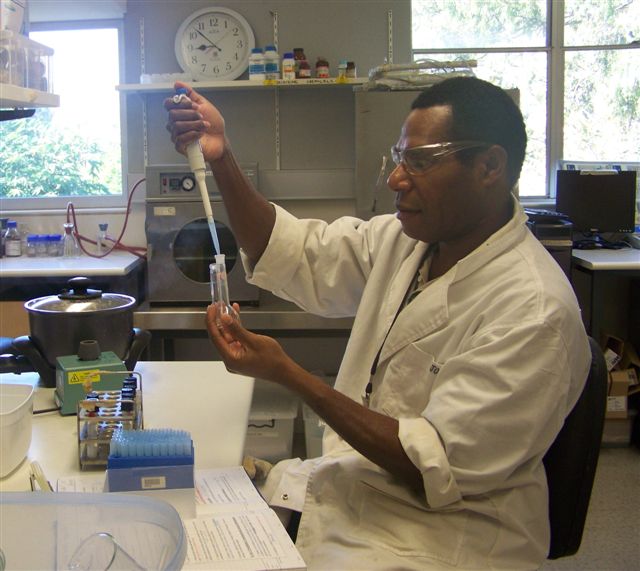
Joel Waramboi working in the laboratory
He also has experience in agricultural production and farming systems.
Waramboi is now breaking new ground with his research into kaukau (sweet potato), PNG’s most widely-grown food crop, while undergoing further studies in Australia.
 “Although production data on our food crops remain sketchy, available information shows that, PNG produces about 2.9 million tonnes of sweet potato, 700,000 tonnes of banana, 300,000 tonnes of yams, 350,000 tonnes of taro and 80,000 tonnes of cassava annually,” he says.
“Globally, sweet potato is one of the most-important root crops, with more than 133 million tonnes produced annually.
“It is a staple food for millions of people and the seventh most-abundant crop after wheat, rice, maize, potato, barley and cassava.

Kaukau flour
“In PNG, of the large volume produced, less than 1% is sold in domestic markets and hardly any quantity is either processed or exported.
“So where does the 99% of the crop go to?
“It simply ends up in the cooking pot”

Kaukau variety Beauregard
Waramboi has a bachelor of science degree (with merit) from University of Technology (Unitech) in Lae specialising in food technology, and a master of science degree (with merit) in post-harvest technology from the University of Greenwich, United Kingdom.
The 37-year-old will be completing his doctor of philosophy (PhD) degree in 2012 at the University of Queensland (UQ), Australia.
Waramboi is a senior scientist with the National Agricultural Research Institute (NARI), and conducts applied and adaptive research on post-harvest and processing aspects of food crops, alternative and emerging food and cash crops and natural resource management issues.
Currently he is with the Queensland Alliance for Agriculture & Food Innovation, a leading research organisation within the UQ researching on food and nutrition issues.
Waramboi has vast experience in implementing research and development projects.
He has conducted research, training and outreach activities with farmers and organisations around PNG.
In 2005, he implemented a project funded by the Agriculture Innovations Grant Scheme (AIGS) of the Australian government and trained national and provincial agriculture staff on proper vanilla curing and quality management aspects in West Sepik, East Sepik and Milne Bay provinces.

Kaukau variety Beerwah Gold
One of his notable contributions to PNG is the development and release of four improved rice varieties.
Besides his input on rice production research, he implemented a project on evaluation of the eating qualities of rice varieties in several locations around PNG.
“Based on these studies, four rice varieties, namely NR1, NR9, NR15 and NR16 were released by NARI to the PNG farming community in May 2004,” Waramboi recalls.
“These varieties are now grown by farmers around the country.”
Waramboi has also worked on processing and value-addition of PNG staple foods like kaukau and taro by processing them into products like flour, chips, crisps and ice cream.
He has also done some product development work on coconut and fruit (pineapple, pawpaw, carambola) jam, peanut butter, roasted peanuts, imitation milk (peanut, soy bean) and starch extraction (cassava and sago). Some of these technologies have been tested with farmers, and all have the potential to be adopted and up-scaled by individuals or cottage industries in PNG.
Waramboi has the ability to put good project ideas and proposals for donor funding.
Some of his contributions have won major funding support from organisations like the Autralian Centre for International Agricultural Research (ACIAR) and the public investment programme (PIP) of the PNG national government.
His profession has taken him abroad to several countries.
In 2002, he attended an international training course on seed storage and germplasm conservation in Beijing, China.
In 2007, he attended another course in Changchun, China on corn and starch processing technology looking at starch extraction, modification and processing into food and industrial products like plastics, pharmaceuticals, chemicals, cosmetics and textiles.
Later that year, he was part of the PNG government delegation to Malaysia on the sago commercialisation project for PNG.
Waramboi has published papers both locally and internationally.
Within NARI, he has published six Toktoks or extension leaflets on rice post-harvest technologies.
In 2003, he published a technical bulletin on the physico-chemical and eating qualities of rice.
In 2005, he published a paper in the Journal of Agriculture, Foresty and Fisheries with DAL followed by an article in the Rice Relay with Trukai Industries Ltd.
From his current PhD studies on kaukau, he has published several papers.

Kaukau variety Kestle
In 2009, his first research paper on flour and starch properties of PNG and Australian varieties was presented at the International Potato Centre in Lima, Peru.
Early this year, he published a paper in the journal Food Chemistry, a high-impact journal of Elsevier Publishers, England.
He has submitted another paper on starch digestion in kaukau to Carbohydrate Polymers which should be available for public consumption by mid 2011.
In February this year, he also presented two papers at the Australian Institute of Food Science and Technology conference in Brisbane.
In his current research, he has extensively studied 25 varieties of kaukau for their flour and starch properties, nutritional value, processing parameters (temperature, moisture, heat transfer etc), granule structure, pasting, gelatinisation, and digestibility behaviours of these varieties.
In the digestion studies, his research will be the first to develop an in-vitro (test tube) technique to model digestion behaviours in these varieties.
“The study is also the first to identify and report resistant starch (RS) in several PNG sweet potato varieties like L3 and L135 which are beneficial for human health.” Waramboi says.
“When sweet potato is consumed, the RS basically escapes digestion in the small intestine, and gets fermented into fatty acids in the colon (large intestine) to help reduce lifestyle diseases like diabetes, high blood pressure and obesity, which are now becoming so common in PNG.”
Waramboi is also researching into carotene (the yellow/orange pigments that give colour to fruits and vegetables) in kaukau.
“Carotenoids are pro-vitamins, and when converted in vitamin A, they have beneficial health effects like prevention of night blindness” he explains.
“In Africa, the Bill & Melinda Gates Foundation has funded several projects to promote coloured flesh sweet potato varieties in schools and villages, and similar projects can be done in PNG to promote coloured flesh sweet potato, for example, kerot, for their natural goodness and health properties.”
He has also successfully developed extruded snack foods from flours of white and orange fleshed varieties using extrusion processing technology.
“This research has enabled me to optimise process control parameters like moisture contents, screw speed, temperature, heat flow and expansion properties to get high quality and ready-to-eat snack foods from sweet potato,” Waramboi adds.
“Low-cost extrusion technologies are available, and can be introduced to villages in PNG.
“My research is also looking at nutrient retention in processed products because some nutrients like protein, minerals and carotene can be lost during processing, especially at high temperatures.”
Waramboi continues to work hard, and is satisfied, both personally and professionally with his achievements and contributions to PNG.
He would like to see more young people making a career in science because most countries now are prospering through innovations and interventions and science and technology.
Waramboi was born on Feb 5, 1974, to illiterate and subsistence parents from Paparom village, Kubalia, East Sepik.
He did his grades one to six from 1982-1987 at Sassoya Primary School, grades seven to 10 from 1988-1991 at Brandi High School in East Sepik Province, and grades 11 to 12 at Aiyura National High School in Eastern Highlands from 1992-1993.
From 1994-1997, Waramboi studied for his bachelor of science degree at Unitech.
After graduation, he was employed as a trainee manager with Andersons Foodland, eventually managing its wholesale department.
He resigned in October 1999.
In February 2000, he joined the first batch of NARI cadet scientists and eventually became a permanent staff in late 2002 with the institute.
From 2003-2004 he did his masters degree in England and in 2009, started his PhD in Australia.

Interested persons can contact him on j.waramboi@uq.edu.au

World Bank launches cocoa project

By SOLDIER BURUKA

A World Bank-funded agriculture development project launched this week will be a major boost for smallholder cocoa and coffee farmers.

Acting Minister for Agriculture and Livestock Paru Aihi cuts the ribbon to formally launch the World Bank and PNG Government funded PPAP in Kokopo. Looking on is World Bank sustainable development manager Charles Feinsten.
Cocoa and coffee are two of the country’s most-important agricultural commodities and with the formal launching of the Productive Partnerships in Agriculture Project (PPAP); it should contribute to a positive impact in the social and economic wellbeing of the majority of the rural population.
PPAP, supported by the World Bank, International Fund for Agriculture Development (IFAD) and PNG Government, will benefit coffee and cocoa institutions, the smallholder producers and the smallholders in market access and is anticipated to improve performance at all value chains and public-private partnerships.
The formal launching of the PPAP took place in Kokopo on Tuesday, April 5, attended by World Bank and government officials, agricultural agencies, farmer organisations and farmers, followed by a similar launching the next day.
The coffee component will be launched in Goroka next week followed by a national launching in Port Moresby.
At the Kokopo launching, Minister for Higher Education and acting Agriculture Minister Paru Aihi told a big gathering at the Gazelle International Hotel that it was not only fitting but also significant that the World Bank and IFAD had chosen the two most-important commodities that directly influenced the economic wellbeing of the rural communities.
He said it was also the Somare-Abal government’s desire to ensure that majority of the rural population that depends on cocoa and coffee must ultimately be the beneficiaries.
“The government has created a conducive political and economic environment which has resulted in the confidence of such highly-esteemed bodies like the World Bank and IFAD to fund this project, “he said.
Aihi said the government recognised that PPAP would contribute to growth of our agricultural export industries, enhancement of smallholder income, and rehabilitation of market access infrastructure, and called on all stakeholders involved in the implementation process to work together.
As far as cocoa is concerned, Aihi said this was a massive investment over 20 years after the smallholder cocoa and coconut rehabilitation program in the 1980s which saw cocoa production averaging 30,000 to 40,000 tonnes.

Acting Minister for Agriculture and Livestock Paru Aihi later took time out to visit current cocoa research programmes at Cocoa Coconut Institute at Tavilo. Here cocoa breeder Jeffrie Marfu explains work on high-yielding varieties as one way of stopping the cocoa pod borer disease.
Through PPAP, he expected increased cocoa production and revitalisation of support services including marketing and transportation.
Aihi expressed his gratitude to the World Bank and IFAD for their assistance and indicated that the government had committed a total of K5 million to support the project over its six-year period.
World Bank representative, Charles Feinsten, said PPAP would improve the incomes and livelihoods of smallholder coffee and cocoa farmers by: building relationships between farmers and agri-business for better access to markets, technologies, and services; strengthening industry coordination; and providing access roads and wharves to ensure coffee and cocoa producers could readily get to markets.
The project will directly help local farmers, offering training and support, assisting them to adopt better farming practices.
Community consultations will continue to take place throughout the duration of the project in order to build true partnerships and ensure sustainability.
The project will initially take place in areas where rural household dependency on coffee and cocoa income is high, especially East New Britain Province, the Autonomous Region of Bougainville, Eastern Highlands Province, Western Highlands Province, Jiwaka Province and Simbu province.
The possibility of expanding into other provinces will be reviewed during the second year of the project, and again during the fourth.

Coffee expert says national agriculture development plan living in ‘fantasy’ land


By MALUM NALU

A coffee industry expert has accused architects of the controversial National Agriculture Development Plan (NADP) of living in “fantasy” with their unrealistic projections for the industry.
Well-known coffee personality, David Rumbarumba, has joined cocoa, copra and palm oil in rubbishing unrealistic projections contained in the “realigned” NADP, which were provided to the Department of National Planning and Monitoring’s (DNPM) national development strategic plan 2030 (DSP 2030).
The NADP expects coffee to reach 500,000 metric tonnes in 2030 from 73, 868mt this year – a massive 700% increase.
This projection will also be part of the much-vaunted Vision 2050.
“Five hundred metric tonnes is 8, 333, 333 bags of green bean (exportable coffee),” said Rumbarumba, who is general manager of Awute Coffee Producers.
“This is more than 700% increase from current average of 73, 868mt (1, 231,133 bags).
“Correct current average volume is around 54,000mt, or 900, 000 bags – not even a million bags!
“Basing on this target, 500,000mt will be more than 900% achieved in 19 years!
“Wow!
“This target is ridiculously ambiguous and an unrealistic dream, or shall I say ‘fantasy’, by the government and its agents.
“Where does the DNPM and DAL get their data from?
“I can gurantee that such a volumetric target will not be achieved in 19 years or even 100 years, and I can certainly bet my life on that.”
Rumbarumba said only once in coffee’s 60-year history, in 1998 after the 1997 drought, did coffee achieve its biggest-ever production of 1.23 million bags, and it had since slumped
He said coffee was competing with other subsistence crops for land space, due to population growth, and there was no gurantee that there would be more plantings.
Rumbarumba said compounded by all the problems, the government had not even invested in coffee over the years, even leaving stakeholders to fund research and extension industry levy.
“A reasonable target for coffee in the next 20 years would be to double the volume from current 54,000mt (900,000 bags) to 110,00mt, or a target of two million bags,” he said.
“This was the industry’s target in its two five-year strategic plans 10 years ago, but it was not achieved, because the government failed to support the plan with funding of its programmes.
“We in the coffee industry believe two million bags can be achievable with right and consistent financial and policy support from the national government.”
Rumbarumba called on government to:

• Directly fund the Coffee Industry Corporation with K30-K40 million a year to reactivate research and extension programmes, industry regulations, farmer training and marketing programmes, coffee nursery developments, and coffee rehabilitation;

• Create a government ministry for commodities, separate from agriculture and livestock; and

• Create a commodities bank with open and soft lending policies.