By MALUM NALU
National Planning and Monitoring Minister Paul Tiensten seems to have ignored feedback from agriculture professionals in favor of “false statistics” from his department and Department of Agriculture and Livestock, according to Institute of National Affairs executive director Paul Barker.
Barker said this at the weekend after a full-page advertisement by Tiensten in The National last Friday defending DNPM from criticisms leveled at it by cocoa, copra, palm oil and coffee experts in this newspaper last week.
Cocoa, copra, palm oil and coffee experts last week rubbished huge increases projected for 2030 by Tiensten’s PNG Development Strategic Plan (PNGDSP 2010-2030), saying they had not been consulted before making such projections, which were impossible with government attitude towards agriculture.
Staff from the two departments have since been pointing fingers at other over who was responsible for the figures, which will also be part of the much-vaunted Vision 2050, while the farmers continue to work their land oblivious to all the fuss going on.
Tiensten hit back with the advertisement, and a strong personal attack on PNG Coconut Cocoa Institute chief executive officer Dr Eric Omuru, who had described the projections as a “joke” at a workshop the week before.
“False statistics are useless for everyone,” Barker said.
“It is disappointing that the planning minister should choose to criticise the feedback being provided by professionals with respect to the 20-year strategic plan (DSP), and notably the agricultural forecasts.
“Constructive feedback should be encouraged, recognised and appreciated, not condemned.”
Barker said with respect to the agricultural targets, it had long been pointed out that these were unrealistic, with eight-fold increases in coffee production, six-fold in cocoa, and others having little link with reality or past experience.
“When asked where these figures were sourced, planning department staff stated they obtained them from the agriculture department,” he said.
“Agriculture department staff stated they didn’t provide these figures, whilst the respective commodity institutions and other agricultural industry bodies stated firmly that the figures were unrealistic and that they’d not been consulted.
“Regardless of the source of these figures, and who’s right and who’s wrong, it was urged that the respect public and non-government bodies should get together promptly to ensure that realistic figures are prepared promptly and mutually accepted, so that there can be targets which everyone co-operates to achieve.
“It must be remembered that agriculture is undertaken by farmers making their own investment decisions, based upon their own perception of returns to their land and effort.
“Care must be taken by authorities to understand the needs of these farmer, their potential and constraints which need to be addressed.
“Many of these constraints relate to poor public infrastructure such as roads and ports, and services, whilst others relate to natural factors, such as local land availability and suitability, as well as to options for the farmers, or opportunity costs, such as whether they prefer to grow vegetables instead of coffee).
“If the bulk of the industry professionals say the figures are unrealistic, for various reasons, and need to be revised, these observations should be heeded and recognised and not dismissed out of hand.
“Maybe industry players are being too conservative and should be encouraged to see greater potential, but in all likelihood their views are based upon long and practical realities.”
Barker said in the 1960s and 70s the world saw great application of top-down “long-term plans”, largely emanating from remote bureaucrats in the capitals of the old Soviet-style “command economies”.
“In some cases, the targets were totally unrealistic, with requirements, for example, to double rice production in a few years,” he said.
“Officials didn’t dare challenge the targets given, for fear of losing their jobs or worse, so in many cases the result was extensive falsification of statistics.
“ It wasn’t even possible sometimes for the plants or animals, let alone the farmers and the infrastructure, to achieve the increased production levels required, but officials and departments/provinces would nevertheless announce that the targets had been achieved or even better.”
Sunday, April 10, 2011

Tiensten hits back at agriculture experts
By MALUM NALU
National Planning and Monitoring Minister Paul Tiensten has defended his department’s highly-ambitious agricultural projections for 2030 and hit back at experts who had criticised it as being unrealistic.
Experts from cocoa, copra, palm oil and coffee described the projections in The National last week as unrealistic and said they had not been consulted before the projections were made in Tiensten’s PNG development strategic plan (DSP) 2010-2030.
The minister was particularly harsh on Cocoa and coconut Institute chief executive officer, Dr Eric Omuru, who had described the projections as a “joke”.
“The CEO’s criticism was based on shallow administrative points and not on practical economic and scientific reasoning as he may have been trained and paid to do,” Tiensten said in a full-page advertisement in The National last Friday.
“He argued that the CCI and others were not closely consulted during PNGDSP formulation process and that the set targets were unrealistic, given the current constraints the agriculture sector currently has.
“The criticism lacked intellectual substance but only devised to derail the government’s efforts to break from past ‘business as usual’ practice to map out a new strategic plan for PNG’s advancement into a middle-income country by 2030.
Tiensten said his department, in consultation with Department of Agriculture and Livestock had in 2008 and 2009 provided cocoa, palm oil, coffee and copra projections.
“We did consult and gather the intelligence from the core agency responsible for agriculture in PNG (DAL),” he said.
“Most importantly, these are targets, not ‘business as usual’ projections based on one sector strategy.”
“They are based on a whole range of measures in the PNGDSP that will substantially boost the productive capacity, including:
• Investment in major infrastructure development aimed at tripling the road network in rural areas and the extension of electricity to most of the rural population;
• Implementation of the land development programme which will end the current lease-lease back system;
• Initiatives to increase extension services, including research and development to achieve a 60% productivity growth; and
• Undertaking a major drive to boost literacy and technical education of the rural population.”
Tiensten added: “What has happened in the past does not point to the future.
“The PNGDSP makes a break from ‘business as usual’ to map out a new path of real development for PNG.
“The PNGDSP deliberately sets out ambitious, yet achievable targets.
“Without ambition, there can be no hope to achieve progress.”
National Planning and Monitoring Minister Paul Tiensten has defended his department’s highly-ambitious agricultural projections for 2030 and hit back at experts who had criticised it as being unrealistic.
Experts from cocoa, copra, palm oil and coffee described the projections in The National last week as unrealistic and said they had not been consulted before the projections were made in Tiensten’s PNG development strategic plan (DSP) 2010-2030.
The minister was particularly harsh on Cocoa and coconut Institute chief executive officer, Dr Eric Omuru, who had described the projections as a “joke”.
“The CEO’s criticism was based on shallow administrative points and not on practical economic and scientific reasoning as he may have been trained and paid to do,” Tiensten said in a full-page advertisement in The National last Friday.
“He argued that the CCI and others were not closely consulted during PNGDSP formulation process and that the set targets were unrealistic, given the current constraints the agriculture sector currently has.
“The criticism lacked intellectual substance but only devised to derail the government’s efforts to break from past ‘business as usual’ practice to map out a new strategic plan for PNG’s advancement into a middle-income country by 2030.
Tiensten said his department, in consultation with Department of Agriculture and Livestock had in 2008 and 2009 provided cocoa, palm oil, coffee and copra projections.
“We did consult and gather the intelligence from the core agency responsible for agriculture in PNG (DAL),” he said.
“Most importantly, these are targets, not ‘business as usual’ projections based on one sector strategy.”
“They are based on a whole range of measures in the PNGDSP that will substantially boost the productive capacity, including:
• Investment in major infrastructure development aimed at tripling the road network in rural areas and the extension of electricity to most of the rural population;
• Implementation of the land development programme which will end the current lease-lease back system;
• Initiatives to increase extension services, including research and development to achieve a 60% productivity growth; and
• Undertaking a major drive to boost literacy and technical education of the rural population.”
Tiensten added: “What has happened in the past does not point to the future.
“The PNGDSP makes a break from ‘business as usual’ to map out a new path of real development for PNG.
“The PNGDSP deliberately sets out ambitious, yet achievable targets.
“Without ambition, there can be no hope to achieve progress.”
Coffee expert accuses agriculture planners of living in ‘fantasy’ land
By MALUM NALU
A coffee industry expert has accused architects of the controversial National Agriculture Development Plan (NADP) of living in “fantasy” with their unrealistic projections for the industry.
Well-known coffee personality, David Rumbarumba, has joined cocoa, copra and palm oil in rubbishing unrealistic projections contained in the “realigned” NADP, which were provided to the Department of National Planning and Monitoring’s (DNPM) national development strategic plan 2030 (DSP 2030).
The NADP expects coffee to reach 500,000 metric tonnes in 2030 from 73, 868mt this year – a massive 700% increase.
This projection will also be part of the much-vaunted Vision 2050.
“Five hundred metric tonnes is 8, 333, 333 bags of green bean (exportable coffee),” said Rumbarumba, who is general manager of Awute Coffee Producers.
“This is more than 700% increase from current average of 73, 868mt (1, 231,133 bags).
“Correct current average volume is around 54,000mt, or 900, 000 bags – not even a million bags!
“Basing on this target, 500,000mt will be more than 900% achieved in 19 years!
“Wow!
“This target is ridiculously ambiguous and an unrealistic dream, or shall I say ‘fantasy’, by the government and its agents.
“Where does the DNPM and DAL get their data from?
“I can gurantee that such a volumetric target will not be achieved in 19 years or even 100 years, and I can certainly bet my life on that.”
Rumbarumba said only once in coffee’s 60-year history, in 1998 after the 1997 drought, did coffee achieve its biggest-ever production of 1.23 million bags, and it had since slumped
He said coffee was competing with other subsistence crops for land space, due to population growth, and there was no gurantee that there would be more plantings.Rumbarumba said compounded by all the problems, the government had not even invested in coffee over the years, even leaving stakeholders to fund research and extension industry levy.
“A reasonable target for coffee in the next 20 years would be to double the volume from current 54,000mt (900,000 bags) to 110,00mt, or a target of two million bags,” he said.
“This was the industry’s target in its two five-year strategic plans 10 years ago, but it was not achieved, because the government failed to support the plan with funding of its programmes.
“We in the coffee industry believe two million bags can be achievable with right and consistent financial and policy support from the national government.”
Rumbarumba called on government to:
• Directly fund the Coffee Industry Corporation with K30-K40 million a year to reactivate research and extension programmes, industry regulations, farmer training and marketing programmes, coffee nursery developments, and coffee rehabilitation;
• Create a government ministry for commodities, separate from agriculture and livestock; and
• Create a commodities bank with open and soft lending policie
A coffee industry expert has accused architects of the controversial National Agriculture Development Plan (NADP) of living in “fantasy” with their unrealistic projections for the industry.
Well-known coffee personality, David Rumbarumba, has joined cocoa, copra and palm oil in rubbishing unrealistic projections contained in the “realigned” NADP, which were provided to the Department of National Planning and Monitoring’s (DNPM) national development strategic plan 2030 (DSP 2030).
The NADP expects coffee to reach 500,000 metric tonnes in 2030 from 73, 868mt this year – a massive 700% increase.
This projection will also be part of the much-vaunted Vision 2050.
“Five hundred metric tonnes is 8, 333, 333 bags of green bean (exportable coffee),” said Rumbarumba, who is general manager of Awute Coffee Producers.
“This is more than 700% increase from current average of 73, 868mt (1, 231,133 bags).
“Correct current average volume is around 54,000mt, or 900, 000 bags – not even a million bags!
“Basing on this target, 500,000mt will be more than 900% achieved in 19 years!
“Wow!
“This target is ridiculously ambiguous and an unrealistic dream, or shall I say ‘fantasy’, by the government and its agents.
“Where does the DNPM and DAL get their data from?
“I can gurantee that such a volumetric target will not be achieved in 19 years or even 100 years, and I can certainly bet my life on that.”
Rumbarumba said only once in coffee’s 60-year history, in 1998 after the 1997 drought, did coffee achieve its biggest-ever production of 1.23 million bags, and it had since slumped
He said coffee was competing with other subsistence crops for land space, due to population growth, and there was no gurantee that there would be more plantings.Rumbarumba said compounded by all the problems, the government had not even invested in coffee over the years, even leaving stakeholders to fund research and extension industry levy.
“A reasonable target for coffee in the next 20 years would be to double the volume from current 54,000mt (900,000 bags) to 110,00mt, or a target of two million bags,” he said.
“This was the industry’s target in its two five-year strategic plans 10 years ago, but it was not achieved, because the government failed to support the plan with funding of its programmes.
“We in the coffee industry believe two million bags can be achievable with right and consistent financial and policy support from the national government.”
Rumbarumba called on government to:
• Directly fund the Coffee Industry Corporation with K30-K40 million a year to reactivate research and extension programmes, industry regulations, farmer training and marketing programmes, coffee nursery developments, and coffee rehabilitation;
• Create a government ministry for commodities, separate from agriculture and livestock; and
• Create a commodities bank with open and soft lending policie
Department of Agriculture and Livestock turns ‘logger’
By MALUM NALU
Department of Agriculture and Livestock has turned forester, venturing into the forests of Papua New Guinea with forest clearance authority (FCA) projects, saying that it is part of “wealth creation under Vision 2050”.
These cover “oil palm” and “cocoa” projects, among others, however, skeptical landowners and people of Papua New Guinea now see it as a front for logging.
According to a department FCA update, obtained by media, “one of its responsibilities is to provide leadership in overseeing coordination, assessment and approval of integrated agriculture agro-forestry projects (defined as Forest Clearance Authority) of the government”.
“The FCA agro-forestry projects are essential interventions that support the medium-term objectives of the National Agriculture Development Plan (NADP) as these projects have profound impact on the PNG economy and bring in immediate benefit to the resource owners in the rural communities,” it said.
“The production targets across all agricultural commodities set by the National Development Strategic Plan (NDSP) 2010-2030 can only be realised by increasing rehabilitation of existing croplands and new development of virgin land.
“The integrated agro-forestry projects provide an appropriate strategic intervention as poverty and economic corridor projects with ‘far-reaching’ contribution towards achieving these outcomes and targets.
“However, it is also imperative for increased awareness as planning based on environmental sustainability, climate adaption and compatible development come to fore.”
The update says to date, 32 projects have been registered and 17 have received DAL approval.
“Fourteen of these approved projects have been issued FCA by PNG Forest Authority (PNGFA) and have progressed with initial project development activities,” it says.
“Sixteen projects are in the process of being assessed and listed as pending projects.
“By land use, there are 20 oil palm projects, seven have been approved and have commenced development.
“There are eight cocoa projects, seven have commenced development.”
Department of Agriculture and Livestock has turned forester, venturing into the forests of Papua New Guinea with forest clearance authority (FCA) projects, saying that it is part of “wealth creation under Vision 2050”.
These cover “oil palm” and “cocoa” projects, among others, however, skeptical landowners and people of Papua New Guinea now see it as a front for logging.
According to a department FCA update, obtained by media, “one of its responsibilities is to provide leadership in overseeing coordination, assessment and approval of integrated agriculture agro-forestry projects (defined as Forest Clearance Authority) of the government”.
“The FCA agro-forestry projects are essential interventions that support the medium-term objectives of the National Agriculture Development Plan (NADP) as these projects have profound impact on the PNG economy and bring in immediate benefit to the resource owners in the rural communities,” it said.
“The production targets across all agricultural commodities set by the National Development Strategic Plan (NDSP) 2010-2030 can only be realised by increasing rehabilitation of existing croplands and new development of virgin land.
“The integrated agro-forestry projects provide an appropriate strategic intervention as poverty and economic corridor projects with ‘far-reaching’ contribution towards achieving these outcomes and targets.
“However, it is also imperative for increased awareness as planning based on environmental sustainability, climate adaption and compatible development come to fore.”
The update says to date, 32 projects have been registered and 17 have received DAL approval.
“Fourteen of these approved projects have been issued FCA by PNG Forest Authority (PNGFA) and have progressed with initial project development activities,” it says.
“Sixteen projects are in the process of being assessed and listed as pending projects.
“By land use, there are 20 oil palm projects, seven have been approved and have commenced development.
“There are eight cocoa projects, seven have commenced development.”
Friday, April 08, 2011
Abal promises feedback on business summit proposals
ACTING Prime Minister Sam Abal has assured the newly-formed PNG Indigenous Business Council that within three months, the national government will put forward its position on recommendations from the indigenous business summit in Kokopo, The National reports.
Summit patron Sir Rabbie Namaliu presented the joint communiqué, called the Kokopo Declaration, to Abal yesterday at the Vunapope Hall where hundreds of national business people cheered and clapped in unison.
The Kokopo summit also ended yesterday.
The acting prime minister, when accepting the Kokopo Declaration containing 10 recommendations, said the creation of a national business council was the greatest thing ever done in PNG.
Abal said he had initially considered to take a year to work on the recommendations but, with the elections just around the corner, it would take about three months as a practical quest to make them part of legislation and form structural policies.
“This government will make it work and take up the issue of national partnership and go as far as we can until the elections,” the Wabag MP said.
“We will not be complacent about it, we will walk the talk.”
However, Abal stressed this should now not be taken as an anti-foreigners’ lobby campaign.
He said national business people had made a stand to move forward and must cut out regionalism in conducting businesses as this could lead to disaster.
The 10 points in the Kokopo Declaration were:
*Creation of a ministry for indigenous business sector;
*Creation of a PNG Indigenous Business Council;
*Establish a foreign investment and review board;
*Provision of seed capital and tax incentives;
*Capacity building and entrepreneur training;
*Creation of an indigenous land mobilisation authority;
*Establish a national context monitoring authority;
*Determination of national equity;
*Control on major basket of commodities; and
*Work permits and visas.
Also in attendance yesterday were governors Luther Wenge of Morobe and Western Highlands’ Tom Olga, Deputy Speaker of Parliament and Talasea MP Francis Marus, Internal Security Minister Bob Dadae, Attorney-General Sir Arnold Amet and government chief secretary Margaret Elias.
Ramu needs support for more sugar
RAMU Sugar’s parent company, Ramu Agri Industries Ltd (RAIL), has welcomed the expression of support for sugar production in Ramu Valley made by Morobe Governor Luther Wenge following his statements made in the media regarding RAIL’s involvement in oil palm and the increasing cost of sugar prices experienced lately, The National reports.
The company said they looked forward to the Morobe government’s assistance in protecting the production of domestic sugar in the years to come, without needing to phase out sugar production.
Responding to recent media reports, RAIL has stated that the company has invested heavily in the sugar enterprise at Ramu since the acquisition by New Britain Palm Oil Ltd (NBPOL) in late 2008.
It said that during 2009-10, nearly K18 million had been spent on improvements in the sugar factory and refitting the plant and field machinery in the sugar cane production operation.
RAIL said another K7 million had been budgeted for capital improvements to the sugar enterprise for this year and also the land under sugar cane production had remained stable but planting of new canes in the field has increased in an effort to increase production.
The management also refuted claims by Wenge that the company was not giving priority to sugar production, stating that the government had detailed plans to remove protection from domestic sugar production and expose the people of PNG to the wildly fluctuating prices in recent weeks.
RAIL said the Treasury department was informed of the high level of investment that was being undertaken to secure sugar production.
The statement said the company invested in planting thousands of hectares of oil palm on land that was previously used for rough cattle grazing at Gusap.
The acquisition of additional land near Umi, for an expansion of oil palm, had allowed for oil palm development without reducing land committed for sugar production.
NBPOL has invested heavily in sugar, beef and oil palm which had increased employment at a rate never before seen in the Ramu Valley during the past two years and invited Treasury and Finance Minister Peter O’Neill and Wenge to visit and see the company’s commitment for sustainable, agricultural development in PNG.
The company said they looked forward to the Morobe government’s assistance in protecting the production of domestic sugar in the years to come, without needing to phase out sugar production.
Responding to recent media reports, RAIL has stated that the company has invested heavily in the sugar enterprise at Ramu since the acquisition by New Britain Palm Oil Ltd (NBPOL) in late 2008.
It said that during 2009-10, nearly K18 million had been spent on improvements in the sugar factory and refitting the plant and field machinery in the sugar cane production operation.
RAIL said another K7 million had been budgeted for capital improvements to the sugar enterprise for this year and also the land under sugar cane production had remained stable but planting of new canes in the field has increased in an effort to increase production.
The management also refuted claims by Wenge that the company was not giving priority to sugar production, stating that the government had detailed plans to remove protection from domestic sugar production and expose the people of PNG to the wildly fluctuating prices in recent weeks.
RAIL said the Treasury department was informed of the high level of investment that was being undertaken to secure sugar production.
The statement said the company invested in planting thousands of hectares of oil palm on land that was previously used for rough cattle grazing at Gusap.
The acquisition of additional land near Umi, for an expansion of oil palm, had allowed for oil palm development without reducing land committed for sugar production.
NBPOL has invested heavily in sugar, beef and oil palm which had increased employment at a rate never before seen in the Ramu Valley during the past two years and invited Treasury and Finance Minister Peter O’Neill and Wenge to visit and see the company’s commitment for sustainable, agricultural development in PNG.
Thursday, April 07, 2011
Young Papua New Guinea scientist uncovers huge untapped potential for kaukau
By MALUM NALU
Joel Waramboi from Kubalia, East Sepik province, is one of Papua New Guinea’s most highly-qualified experts in food science, post-harvest technology, starch, processing and quality management of food and alternative food and cash crops.
He also has experience in agricultural production and farming systems.
Waramboi is now breaking new ground with his research into kaukau (sweet potato), PNG’s most widely-grown food crop, while undergoing further studies in Australia.
“Although production data on our food crops remain sketchy, available information shows that, PNG produces about 2.9 million tonnes of sweet potato, 700,000 tonnes of banana, 300,000 tonnes of yams, 350,000 tonnes of taro and 80,000 tonnes of cassava annually,” he says.
“Globally, sweet potato is one of the most-important root crops, with more than 133 million tonnes produced annually.
“It is a staple food for millions of people and the seventh most-abundant crop after wheat, rice, maize, potato, barley and cassava.
“In PNG, of the large volume produced, less than 1% is sold in domestic markets and hardly any quantity is either processed or exported.
“So where does the 99% of the crop go to?
“It simply ends up in the cooking pot”
Waramboi has a bachelor of science degree (with merit) from University of Technology (Unitech) in Lae specialising in food technology, and a master of science degree (with merit) in post-harvest technology from the University of Greenwich, United Kingdom.
The 37-year-old will be completing his doctor of philosophy (PhD) degree in 2012 at the University of Queensland (UQ), Australia.
Waramboi is a senior scientist with the National Agricultural Research Institute (NARI), and conducts applied and adaptive research on post-harvest and processing aspects of food crops, alternative and emerging food and cash crops and natural resource management issues.
Currently he is with the Queensland Alliance for Agriculture & Food Innovation, a leading research organisation within the UQ researching on food and nutrition issues.
Waramboi has vast experience in implementing research and development projects.
He has conducted research, training and outreach activities with farmers and organisations around PNG.
In 2005, he implemented a project funded by the Agriculture Innovations Grant Scheme (AIGS) of the Australian government and trained national and provincial agriculture staff on proper vanilla curing and quality management aspects in West Sepik, East Sepik and Milne Bay provinces.
One of his notable contributions to PNG is the development and release of four improved rice varieties.
Besides his input on rice production research, he implemented a project on evaluation of the eating qualities of rice varieties in several locations around PNG.
“Based on these studies, four rice varieties, namely NR1, NR9, NR15 and NR16 were released by NARI to the PNG farming community in May 2004,” Waramboi recalls.
“These varieties are now grown by farmers around the country.”
Waramboi has also worked on processing and value-addition of PNG staple foods like kaukau and taro by processing them into products like flour, chips, crisps and ice cream.
He has also done some product development work on coconut and fruit (pineapple, pawpaw, carambola) jam, peanut butter, roasted peanuts, imitation milk (peanut, soy bean) and starch extraction (cassava and sago). Some of these technologies have been tested with farmers, and all have the potential to be adopted and up-scaled by individuals or cottage industries in PNG.
Waramboi has the ability to put good project ideas and proposals for donor funding.
Some of his contributions have won major funding support from organisations like the Autralian Centre for International Agricultural Research (ACIAR) and the public investment programme (PIP) of the PNG national government.
His profession has taken him abroad to several countries.
In 2002, he attended an international training course on seed storage and germplasm conservation in Beijing, China.
In 2007, he attended another course in Changchun, China on corn and starch processing technology looking at starch extraction, modification and processing into food and industrial products like plastics, pharmaceuticals, chemicals, cosmetics and textiles.
Later that year, he was part of the PNG government delegation to Malaysia on the sago commercialisation project for PNG.
Waramboi has published papers both locally and internationally.
Within NARI, he has published six Toktoks or extension leaflets on rice post-harvest technologies.
In 2003, he published a technical bulletin on the physico-chemical and eating qualities of rice.
In 2005, he published a paper in the Journal of Agriculture, Foresty and Fisheries with DAL followed by an article in the Rice Relay with Trukai Industries Ltd.
From his current PhD studies on kaukau, he has published several papers.
In 2009, his first research paper on flour and starch properties of PNG and Australian varieties was presented at the International Potato Centre in Lima, Peru.
Early this year, he published a paper in the journal Food Chemistry, a high-impact journal of Elsevier Publishers, England.
He has submitted another paper on starch digestion in kaukau to Carbohydrate Polymers which should be available for public consumption by mid 2011.
In February this year, he also presented two papers at the Australian Institute of Food Science and Technology conference in Brisbane.
In his current research, he has extensively studied 25 varieties of kaukau for their flour and starch properties, nutritional value, processing parameters (temperature, moisture, heat transfer etc), granule structure, pasting, gelatinisation, and digestibility behaviours of these varieties.
In the digestion studies, his research will be the first to develop an in-vitro (test tube) technique to model digestion behaviours in these varieties.
“The study is also the first to identify and report resistant starch (RS) in several PNG sweet potato varieties like L3 and L135 which are beneficial for human health.” Waramboi says.
“When sweet potato is consumed, the RS basically escapes digestion in the small intestine, and gets fermented into fatty acids in the colon (large intestine) to help reduce lifestyle diseases like diabetes, high blood pressure and obesity, which are now becoming so common in PNG.”
Waramboi is also researching into carotene (the yellow/orange pigments that give colour to fruits and vegetables) in kaukau.
“Carotenoids are pro-vitamins, and when converted in vitamin A, they have beneficial health effects like prevention of night blindness” he explains.
“In Africa, the Bill & Melinda Gates Foundation has funded several projects to promote coloured flesh sweet potato varieties in schools and villages, and similar projects can be done in PNG to promote coloured flesh sweet potato, for example, kerot, for their natural goodness and health properties.”
He has also successfully developed extruded snack foods from flours of white and orange fleshed varieties using extrusion processing technology.
“This research has enabled me to optimise process control parameters like moisture contents, screw speed, temperature, heat flow and expansion properties to get high quality and ready-to-eat snack foods from sweet potato,” Waramboi adds.
“Low-cost extrusion technologies are available, and can be introduced to villages in PNG.
“My research is also looking at nutrient retention in processed products because some nutrients like protein, minerals and carotene can be lost during processing, especially at high temperatures.”
Waramboi continues to work hard, and is satisfied, both personally and professionally with his achievements and contributions to PNG.
He would like to see more young people making a career in science because most countries now are prospering through innovations and interventions and science and technology.
Waramboi was born on Feb 5, 1974, to illiterate and subsistence parents from Paparom village, Kubalia, East Sepik.
He did his grades one to six from 1982-1987 at Sassoya Primary School, grades seven to 10 from 1988-1991 at Brandi High School in East Sepik Province, and grades 11 to 12 at Aiyura National High School in Eastern Highlands from 1992-1993.
From 1994-1997, Waramboi studied for his bachelor of science degree at Unitech.
After graduation, he was employed as a trainee manager with Andersons Foodland, eventually managing its wholesale department.
He resigned in October 1999.
In February 2000, he joined the first batch of NARI cadet scientists and eventually became a permanent staff in late 2002 with the institute.
From 2003-2004 he did his masters degree in England and in 2009, started his PhD in Australia.
Interested persons can contact him on j.waramboi@uq.edu.au
Joel Waramboi from Kubalia, East Sepik province, is one of Papua New Guinea’s most highly-qualified experts in food science, post-harvest technology, starch, processing and quality management of food and alternative food and cash crops.
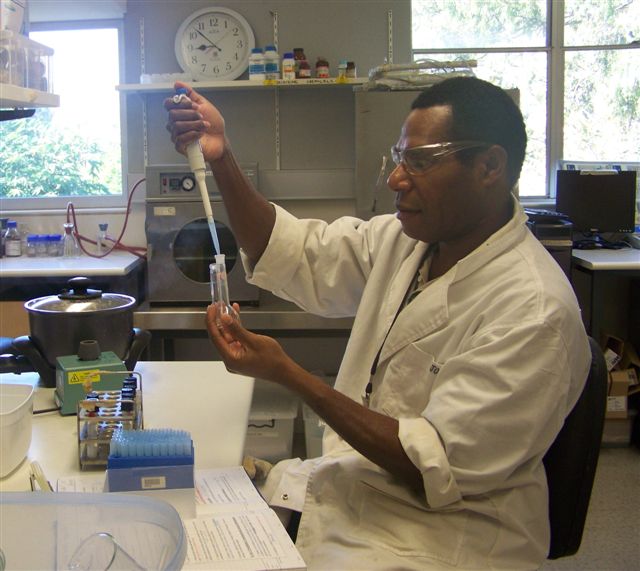 |
Joel Waramboi working in the laboratory
|
Waramboi is now breaking new ground with his research into kaukau (sweet potato), PNG’s most widely-grown food crop, while undergoing further studies in Australia.
“Although production data on our food crops remain sketchy, available information shows that, PNG produces about 2.9 million tonnes of sweet potato, 700,000 tonnes of banana, 300,000 tonnes of yams, 350,000 tonnes of taro and 80,000 tonnes of cassava annually,” he says.
“Globally, sweet potato is one of the most-important root crops, with more than 133 million tonnes produced annually.
“It is a staple food for millions of people and the seventh most-abundant crop after wheat, rice, maize, potato, barley and cassava.
 |
Kaukau flour
|
“So where does the 99% of the crop go to?
“It simply ends up in the cooking pot”
 |
Kaukau variety Beauregard
|
The 37-year-old will be completing his doctor of philosophy (PhD) degree in 2012 at the University of Queensland (UQ), Australia.
Waramboi is a senior scientist with the National Agricultural Research Institute (NARI), and conducts applied and adaptive research on post-harvest and processing aspects of food crops, alternative and emerging food and cash crops and natural resource management issues.
Currently he is with the Queensland Alliance for Agriculture & Food Innovation, a leading research organisation within the UQ researching on food and nutrition issues.
Waramboi has vast experience in implementing research and development projects.
He has conducted research, training and outreach activities with farmers and organisations around PNG.
In 2005, he implemented a project funded by the Agriculture Innovations Grant Scheme (AIGS) of the Australian government and trained national and provincial agriculture staff on proper vanilla curing and quality management aspects in West Sepik, East Sepik and Milne Bay provinces.
 |
Kaukau variety Beerwah Gold
|
Besides his input on rice production research, he implemented a project on evaluation of the eating qualities of rice varieties in several locations around PNG.
“Based on these studies, four rice varieties, namely NR1, NR9, NR15 and NR16 were released by NARI to the PNG farming community in May 2004,” Waramboi recalls.
“These varieties are now grown by farmers around the country.”
Waramboi has also worked on processing and value-addition of PNG staple foods like kaukau and taro by processing them into products like flour, chips, crisps and ice cream.
He has also done some product development work on coconut and fruit (pineapple, pawpaw, carambola) jam, peanut butter, roasted peanuts, imitation milk (peanut, soy bean) and starch extraction (cassava and sago). Some of these technologies have been tested with farmers, and all have the potential to be adopted and up-scaled by individuals or cottage industries in PNG.
Waramboi has the ability to put good project ideas and proposals for donor funding.
Some of his contributions have won major funding support from organisations like the Autralian Centre for International Agricultural Research (ACIAR) and the public investment programme (PIP) of the PNG national government.
His profession has taken him abroad to several countries.
In 2002, he attended an international training course on seed storage and germplasm conservation in Beijing, China.
In 2007, he attended another course in Changchun, China on corn and starch processing technology looking at starch extraction, modification and processing into food and industrial products like plastics, pharmaceuticals, chemicals, cosmetics and textiles.
Later that year, he was part of the PNG government delegation to Malaysia on the sago commercialisation project for PNG.
Waramboi has published papers both locally and internationally.
Within NARI, he has published six Toktoks or extension leaflets on rice post-harvest technologies.
In 2003, he published a technical bulletin on the physico-chemical and eating qualities of rice.
In 2005, he published a paper in the Journal of Agriculture, Foresty and Fisheries with DAL followed by an article in the Rice Relay with Trukai Industries Ltd.
From his current PhD studies on kaukau, he has published several papers.
 |
Kaukau variety Kestle
|
Early this year, he published a paper in the journal Food Chemistry, a high-impact journal of Elsevier Publishers, England.
He has submitted another paper on starch digestion in kaukau to Carbohydrate Polymers which should be available for public consumption by mid 2011.
In February this year, he also presented two papers at the Australian Institute of Food Science and Technology conference in Brisbane.
In his current research, he has extensively studied 25 varieties of kaukau for their flour and starch properties, nutritional value, processing parameters (temperature, moisture, heat transfer etc), granule structure, pasting, gelatinisation, and digestibility behaviours of these varieties.
In the digestion studies, his research will be the first to develop an in-vitro (test tube) technique to model digestion behaviours in these varieties.
“The study is also the first to identify and report resistant starch (RS) in several PNG sweet potato varieties like L3 and L135 which are beneficial for human health.” Waramboi says.
“When sweet potato is consumed, the RS basically escapes digestion in the small intestine, and gets fermented into fatty acids in the colon (large intestine) to help reduce lifestyle diseases like diabetes, high blood pressure and obesity, which are now becoming so common in PNG.”
Waramboi is also researching into carotene (the yellow/orange pigments that give colour to fruits and vegetables) in kaukau.
“Carotenoids are pro-vitamins, and when converted in vitamin A, they have beneficial health effects like prevention of night blindness” he explains.
“In Africa, the Bill & Melinda Gates Foundation has funded several projects to promote coloured flesh sweet potato varieties in schools and villages, and similar projects can be done in PNG to promote coloured flesh sweet potato, for example, kerot, for their natural goodness and health properties.”
He has also successfully developed extruded snack foods from flours of white and orange fleshed varieties using extrusion processing technology.
“This research has enabled me to optimise process control parameters like moisture contents, screw speed, temperature, heat flow and expansion properties to get high quality and ready-to-eat snack foods from sweet potato,” Waramboi adds.
“Low-cost extrusion technologies are available, and can be introduced to villages in PNG.
“My research is also looking at nutrient retention in processed products because some nutrients like protein, minerals and carotene can be lost during processing, especially at high temperatures.”
Waramboi continues to work hard, and is satisfied, both personally and professionally with his achievements and contributions to PNG.
He would like to see more young people making a career in science because most countries now are prospering through innovations and interventions and science and technology.
Waramboi was born on Feb 5, 1974, to illiterate and subsistence parents from Paparom village, Kubalia, East Sepik.
He did his grades one to six from 1982-1987 at Sassoya Primary School, grades seven to 10 from 1988-1991 at Brandi High School in East Sepik Province, and grades 11 to 12 at Aiyura National High School in Eastern Highlands from 1992-1993.
From 1994-1997, Waramboi studied for his bachelor of science degree at Unitech.
After graduation, he was employed as a trainee manager with Andersons Foodland, eventually managing its wholesale department.
He resigned in October 1999.
In February 2000, he joined the first batch of NARI cadet scientists and eventually became a permanent staff in late 2002 with the institute.
From 2003-2004 he did his masters degree in England and in 2009, started his PhD in Australia.
Interested persons can contact him on j.waramboi@uq.edu.au
World Bank launches cocoa project
By SOLDIER BURUKA
A World Bank-funded agriculture development project launched this week will be a major boost for smallholder cocoa and coffee farmers.
Cocoa and coffee are two of the country’s most-important agricultural commodities and with the formal launching of the Productive Partnerships in Agriculture Project (PPAP); it should contribute to a positive impact in the social and economic wellbeing of the majority of the rural population.
PPAP, supported by the World Bank, International Fund for Agriculture Development (IFAD) and PNG Government, will benefit coffee and cocoa institutions, the smallholder producers and the smallholders in market access and is anticipated to improve performance at all value chains and public-private partnerships.
The formal launching of the PPAP took place in Kokopo on Tuesday, April 5, attended by World Bank and government officials, agricultural agencies, farmer organisations and farmers, followed by a similar launching the next day.
The coffee component will be launched in Goroka next week followed by a national launching in Port Moresby.
At the Kokopo launching, Minister for Higher Education and acting Agriculture Minister Paru Aihi told a big gathering at the Gazelle International Hotel that it was not only fitting but also significant that the World Bank and IFAD had chosen the two most-important commodities that directly influenced the economic wellbeing of the rural communities.
He said it was also the Somare-Abal government’s desire to ensure that majority of the rural population that depends on cocoa and coffee must ultimately be the beneficiaries.
“The government has created a conducive political and economic environment which has resulted in the confidence of such highly-esteemed bodies like the World Bank and IFAD to fund this project, “he said.
Aihi said the government recognised that PPAP would contribute to growth of our agricultural export industries, enhancement of smallholder income, and rehabilitation of market access infrastructure, and called on all stakeholders involved in the implementation process to work together.
As far as cocoa is concerned, Aihi said this was a massive investment over 20 years after the smallholder cocoa and coconut rehabilitation program in the 1980s which saw cocoa production averaging 30,000 to 40,000 tonnes.
Through PPAP, he expected increased cocoa production and revitalisation of support services including marketing and transportation.
Aihi expressed his gratitude to the World Bank and IFAD for their assistance and indicated that the government had committed a total of K5 million to support the project over its six-year period.
World Bank representative, Charles Feinsten, said PPAP would improve the incomes and livelihoods of smallholder coffee and cocoa farmers by: building relationships between farmers and agri-business for better access to markets, technologies, and services; strengthening industry coordination; and providing access roads and wharves to ensure coffee and cocoa producers could readily get to markets.
The project will directly help local farmers, offering training and support, assisting them to adopt better farming practices.
Community consultations will continue to take place throughout the duration of the project in order to build true partnerships and ensure sustainability.
The project will initially take place in areas where rural household dependency on coffee and cocoa income is high, especially East New Britain Province, the Autonomous Region of Bougainville, Eastern Highlands Province, Western Highlands Province, Jiwaka Province and Simbu province.
The possibility of expanding into other provinces will be reviewed during the second year of the project, and again during the fourth.
A World Bank-funded agriculture development project launched this week will be a major boost for smallholder cocoa and coffee farmers.
 |
Acting Minister for Agriculture and Livestock Paru Aihi cuts the ribbon to formally launch the World Bank and PNG Government funded PPAP in Kokopo. Looking on is World Bank sustainable development manager Charles Feinsten.
|
PPAP, supported by the World Bank, International Fund for Agriculture Development (IFAD) and PNG Government, will benefit coffee and cocoa institutions, the smallholder producers and the smallholders in market access and is anticipated to improve performance at all value chains and public-private partnerships.
The formal launching of the PPAP took place in Kokopo on Tuesday, April 5, attended by World Bank and government officials, agricultural agencies, farmer organisations and farmers, followed by a similar launching the next day.
The coffee component will be launched in Goroka next week followed by a national launching in Port Moresby.
At the Kokopo launching, Minister for Higher Education and acting Agriculture Minister Paru Aihi told a big gathering at the Gazelle International Hotel that it was not only fitting but also significant that the World Bank and IFAD had chosen the two most-important commodities that directly influenced the economic wellbeing of the rural communities.
He said it was also the Somare-Abal government’s desire to ensure that majority of the rural population that depends on cocoa and coffee must ultimately be the beneficiaries.
“The government has created a conducive political and economic environment which has resulted in the confidence of such highly-esteemed bodies like the World Bank and IFAD to fund this project, “he said.
Aihi said the government recognised that PPAP would contribute to growth of our agricultural export industries, enhancement of smallholder income, and rehabilitation of market access infrastructure, and called on all stakeholders involved in the implementation process to work together.
As far as cocoa is concerned, Aihi said this was a massive investment over 20 years after the smallholder cocoa and coconut rehabilitation program in the 1980s which saw cocoa production averaging 30,000 to 40,000 tonnes.
 |
Acting Minister for Agriculture and Livestock Paru Aihi later took time out to visit current cocoa research programmes at Cocoa Coconut Institute at Tavilo. Here cocoa breeder Jeffrie Marfu explains work on high-yielding varieties as one way of stopping the cocoa pod borer disease.
|
Aihi expressed his gratitude to the World Bank and IFAD for their assistance and indicated that the government had committed a total of K5 million to support the project over its six-year period.
World Bank representative, Charles Feinsten, said PPAP would improve the incomes and livelihoods of smallholder coffee and cocoa farmers by: building relationships between farmers and agri-business for better access to markets, technologies, and services; strengthening industry coordination; and providing access roads and wharves to ensure coffee and cocoa producers could readily get to markets.
The project will directly help local farmers, offering training and support, assisting them to adopt better farming practices.
Community consultations will continue to take place throughout the duration of the project in order to build true partnerships and ensure sustainability.
The project will initially take place in areas where rural household dependency on coffee and cocoa income is high, especially East New Britain Province, the Autonomous Region of Bougainville, Eastern Highlands Province, Western Highlands Province, Jiwaka Province and Simbu province.
The possibility of expanding into other provinces will be reviewed during the second year of the project, and again during the fourth.
Coffee expert says national agriculture development plan living in ‘fantasy’ land
By MALUM NALU
A coffee industry expert has accused architects of the controversial National Agriculture Development Plan (NADP) of living in “fantasy” with their unrealistic projections for the industry.
Well-known coffee personality, David Rumbarumba, has joined cocoa, copra and palm oil in rubbishing unrealistic projections contained in the “realigned” NADP, which were provided to the Department of National Planning and Monitoring’s (DNPM) national development strategic plan 2030 (DSP 2030).
The NADP expects coffee to reach 500,000 metric tonnes in 2030 from 73, 868mt this year – a massive 700% increase.
This projection will also be part of the much-vaunted Vision 2050.
“Five hundred metric tonnes is 8, 333, 333 bags of green bean (exportable coffee),” said Rumbarumba, who is general manager of Awute Coffee Producers.
“This is more than 700% increase from current average of 73, 868mt (1, 231,133 bags).
“Correct current average volume is around 54,000mt, or 900, 000 bags – not even a million bags!
“Basing on this target, 500,000mt will be more than 900% achieved in 19 years!
“Wow!
“This target is ridiculously ambiguous and an unrealistic dream, or shall I say ‘fantasy’, by the government and its agents.
“Where does the DNPM and DAL get their data from?
“I can gurantee that such a volumetric target will not be achieved in 19 years or even 100 years, and I can certainly bet my life on that.”
Rumbarumba said only once in coffee’s 60-year history, in 1998 after the 1997 drought, did coffee achieve its biggest-ever production of 1.23 million bags, and it had since slumped
He said coffee was competing with other subsistence crops for land space, due to population growth, and there was no gurantee that there would be more plantings.
Rumbarumba said compounded by all the problems, the government had not even invested in coffee over the years, even leaving stakeholders to fund research and extension industry levy.
“A reasonable target for coffee in the next 20 years would be to double the volume from current 54,000mt (900,000 bags) to 110,00mt, or a target of two million bags,” he said.
“This was the industry’s target in its two five-year strategic plans 10 years ago, but it was not achieved, because the government failed to support the plan with funding of its programmes.
“We in the coffee industry believe two million bags can be achievable with right and consistent financial and policy support from the national government.”
Rumbarumba called on government to:
• Directly fund the Coffee Industry Corporation with K30-K40 million a year to reactivate research and extension programmes, industry regulations, farmer training and marketing programmes, coffee nursery developments, and coffee rehabilitation;
• Create a government ministry for commodities, separate from agriculture and livestock; and
• Create a commodities bank with open and soft lending policies.
World Bank-funded coffee project to be launched in Goroka
By MALUM NALU
The coffee segment of the Productive Partnership in Agriculture Project (PPAP) will be launched next Tuesday at the Mark Solon Auditorium of the University of Goroka.
PPAP is a joint World Bank and International Fund for Agriculture Development (IFAD) - financed project covering both the cocoa and coffee sub-sectors.
The project commenced in January.
Project mobilisation was expected to be completed in last month, with the launching next Tuesday.
The development objective of the PPAP is to improve the livelihoods of smallholder cocoa and coffee producers through the improvement of the performance and sustainability of value chains in the cocoa and coffee-growing areas.
This will be achieved through strengthening industry coordination and institutions, facilitating linkages between smallholder farmers and agri-business for the provision of technologies and services, and through the provision of critical market access infrastructure.
The project will be launched by Finance and Treasury Minister Peter O’ Neill and witnessed by provincial and district administration staff and political heads from Western Highlands, Chimbu and Western Highlands provinces.
There will also be representation from coffee exporters, processors, plantations and the all-important smallholder growers.
Guests will include Eastern Highlands Governor Malcolm Kela Smith, Department of Agriculture and Livestock deputy secretary and PPAP project preparation team leader Francis Daink, as well as CIC board chairman and Eastern Highlands small growers’ chairman James Korarome, Western Highlands small growers’ chairman Peter Kewa, PNG blockholders’ chairman Pugma Kopi and Jiwaka small growers’ chairman James Koimo.
The coffee segment of the Productive Partnership in Agriculture Project (PPAP) will be launched next Tuesday at the Mark Solon Auditorium of the University of Goroka.
 |
A smallholder coffee growers’ field training in Wahgi Valley, Western Highlands province.Improving the livelihood of smallholder growers is one of the objectives of the PPAP.-Picture by MALUM NALU
|
The project commenced in January.
Project mobilisation was expected to be completed in last month, with the launching next Tuesday.
The development objective of the PPAP is to improve the livelihoods of smallholder cocoa and coffee producers through the improvement of the performance and sustainability of value chains in the cocoa and coffee-growing areas.
This will be achieved through strengthening industry coordination and institutions, facilitating linkages between smallholder farmers and agri-business for the provision of technologies and services, and through the provision of critical market access infrastructure.
The project will be launched by Finance and Treasury Minister Peter O’ Neill and witnessed by provincial and district administration staff and political heads from Western Highlands, Chimbu and Western Highlands provinces.
There will also be representation from coffee exporters, processors, plantations and the all-important smallholder growers.
Guests will include Eastern Highlands Governor Malcolm Kela Smith, Department of Agriculture and Livestock deputy secretary and PPAP project preparation team leader Francis Daink, as well as CIC board chairman and Eastern Highlands small growers’ chairman James Korarome, Western Highlands small growers’ chairman Peter Kewa, PNG blockholders’ chairman Pugma Kopi and Jiwaka small growers’ chairman James Koimo.
Pyrethrum has lots of potential for Papua New Guinea
By MALUM NALU
Pyrethrum is not a high-profile cash crop such as coffee; however, it is a potential money-spinner for 880,000 people dwelling in high altitude areas where coffee cannot grow.
Potential pyrethrum-growing areas include Laiagam, Kandep, Wabag and Wapenamanda areas of Enga province; Tambul of Western Highlands; Ialibu and Upper Mendi areas of Southern Highlands; Kerowagi, Gumine and Gembogl areas of Chimbu; and Okapa, Henganofi and Lufa areas of Eastern Highlands.
Pyrethrum (Tanacetum cinerariaefolium) is a daisy-like plant which is cultivated for the production of pyrethrins and insecticides (insect poison).
It has six active chemicals which do not harm people or animals and rapidly degrades in the environment (no residue problems), and has low risk of insect resistance
Currently, according to pyrethrum scientists Kud Sitango and Enopa Lindsay of the National Agriculture Research Institute, 90% of the pyrethrum is grown in Enga Province, with production having ceased in other pyrethrum-growing areas
People, however, can make money by growing pyrethrum, with current production estimated at 50-60 tonnes per year and generating income valued at about K150, 000 annually.
Most of this is from Laigam in Enga.
Sitango and Lindsay say pyrethrum is suitable a farm crop because:
• In PNG it is non-seasonal, all year-around crop;
• There are always flowers to harvest and sell;
• It can be stored;
• It can always be sold even though the price is not high;
• It can be grown in small plots or around the base of the kaukau (sweet potato) mound;
• It can be worked by hand labor alone and requires little capital,
• It is easy to grow because planting materials are readily available and easily obtained; and
• It is currently regarded as the “women and children’s crop” in Enga Province.
A four-year Australian Centre for Integrated Agriculture Research (ACIAR) pyrethrum project started in January 2007 and ended in December 2010, however, according to Sitango and Lindsay, “most of the planned activities were implemented partially completed due to lack of appropriate knowledge and supervision”.
“Pyrethrum was introduced into PNG on trial basis in the late 1950s and it became a good attractive cash crop for the highlands (above2, 000 metres),” they said in their ACIAR report.
“From the 1960s to the late 1980s, the pyrethrum industry played a major role in sustaining the livelihood of some 65-85,000 people in the highland areas.
“Local women, children and old people were the key workers in this industry and these important social groupings were the key beneficiaries from this industry.
“In 1995, the pyrethrum extraction factory that purchased the crop from the growers closed down and this resulted in a lot of primarily subsistence farmers losing their major source of cash income.
“In 2000-2001, the Enga provincial government purchased this extraction factory and spent some $A1.2 million to re-commission this factory.
“Pre-1995, all of the pyrethrum crude extract, called oleoresin, produced in PNG was sold to an American company.
“This marketing arrangement ceased when the factory closed in 1995 and the PNG industry has not been able to re-establish a market for their pyrethrum extract products.
“There are two main reasons for this failure to gain a marketing position: Pyrethrum is an insecticide and producers are required to have access to the full toxicology, ecotoxicology and use pattern Data Package before their products can obtain access into the vast majority of world markets.
“Unfortunately, the PNG industry does not have access to this data and the costs of obtaining this Data Package are in the order of $A3-4 million.
“The pyrethrum oleoresin produced by the PNG industry requires an additional refining process before it can be used by the product formulators and there are only three major pyrethrum refineries in the world.
“Botanical Resources Australia–Agricultural Services Pty Ltd (BRA) developed a business arrangement with the Enga Government in late October 2005 to buy pyrethrum.
“BRA is one of the two largest pyrethrum producers in the world producing 40% of the world usage of pyrethrum products.
“BRA has a modern and technologically-advanced production and manufacturing facility in Tasmania and a strong production base in Tasmania.
“BRA is also a share owner of a comprehensive Data Package on pyrethrum, including detailed information on toxicology, enviro-toxicology, residue, efficacy and risk analysis for a wide range of situations.
“BRA has used this data to support the registration of pyrethrum in all of the major markets, including the USA, Europe, Japan, Korea as well as Australia.
“Without access to this data package or a similar data package, a pyrethrum producer will not be able to register their product in these major world markets.
“The PNG industry is still recovering from the joint shock of the factory closure and the subsequent withdrawal of the key US pyrethrum buyer.”
All is not lost, however, thanks to NARI and the Enga provincial government.
Enga provincial government’s objective on pyrethrum is to alleviate poverty and improve cash income in the province, promoting it as cash crop
NARI’s objective on pyrethrum is an emerging crop and potential cash crop for high altitude to improve cash income problem faced by 880, 000 people, (15% of total 5.5million PNG population).
NARI, and the unwavering support of the Enga provincial government – through its Enga Pyrethrum Company, which runs the Kagamuga pyrethrum extraction factory in Mt Hagen – and of course a small band of dedicated farmers has seen pyrethrum continue to thrive.
 |
| Daisy-like pyrethrum flower at the experimental paddock at Tambul, Western Highlands.Pictures by MALUM NALU |
Potential pyrethrum-growing areas include Laiagam, Kandep, Wabag and Wapenamanda areas of Enga province; Tambul of Western Highlands; Ialibu and Upper Mendi areas of Southern Highlands; Kerowagi, Gumine and Gembogl areas of Chimbu; and Okapa, Henganofi and Lufa areas of Eastern Highlands.
Pyrethrum (Tanacetum cinerariaefolium) is a daisy-like plant which is cultivated for the production of pyrethrins and insecticides (insect poison).
It has six active chemicals which do not harm people or animals and rapidly degrades in the environment (no residue problems), and has low risk of insect resistance
Currently, according to pyrethrum scientists Kud Sitango and Enopa Lindsay of the National Agriculture Research Institute, 90% of the pyrethrum is grown in Enga Province, with production having ceased in other pyrethrum-growing areas
 |
| NARI’s ‘Team Pyrethrum’ (from left) team leader Kud Sitango, field assistant Danny Momo, scientist Enopa Lindsay and field assistant Kennufa Moui at the project signboard in Tambul, Western Highlands. |
Most of this is from Laigam in Enga.
Sitango and Lindsay say pyrethrum is suitable a farm crop because:
• In PNG it is non-seasonal, all year-around crop;
• There are always flowers to harvest and sell;
• It can be stored;
• It can always be sold even though the price is not high;
• It can be grown in small plots or around the base of the kaukau (sweet potato) mound;
• It can be worked by hand labor alone and requires little capital,
• It is easy to grow because planting materials are readily available and easily obtained; and
• It is currently regarded as the “women and children’s crop” in Enga Province.
A four-year Australian Centre for Integrated Agriculture Research (ACIAR) pyrethrum project started in January 2007 and ended in December 2010, however, according to Sitango and Lindsay, “most of the planned activities were implemented partially completed due to lack of appropriate knowledge and supervision”.
“Pyrethrum was introduced into PNG on trial basis in the late 1950s and it became a good attractive cash crop for the highlands (above2, 000 metres),” they said in their ACIAR report.
 |
| Dried pyrethrum flowers. |
“Local women, children and old people were the key workers in this industry and these important social groupings were the key beneficiaries from this industry.
“In 1995, the pyrethrum extraction factory that purchased the crop from the growers closed down and this resulted in a lot of primarily subsistence farmers losing their major source of cash income.
“In 2000-2001, the Enga provincial government purchased this extraction factory and spent some $A1.2 million to re-commission this factory.
“Pre-1995, all of the pyrethrum crude extract, called oleoresin, produced in PNG was sold to an American company.
“This marketing arrangement ceased when the factory closed in 1995 and the PNG industry has not been able to re-establish a market for their pyrethrum extract products.
 |
| Pyrethrum seeds. |
“Unfortunately, the PNG industry does not have access to this data and the costs of obtaining this Data Package are in the order of $A3-4 million.
“The pyrethrum oleoresin produced by the PNG industry requires an additional refining process before it can be used by the product formulators and there are only three major pyrethrum refineries in the world.
“Botanical Resources Australia–Agricultural Services Pty Ltd (BRA) developed a business arrangement with the Enga Government in late October 2005 to buy pyrethrum.
“BRA is one of the two largest pyrethrum producers in the world producing 40% of the world usage of pyrethrum products.
“BRA has a modern and technologically-advanced production and manufacturing facility in Tasmania and a strong production base in Tasmania.
“BRA is also a share owner of a comprehensive Data Package on pyrethrum, including detailed information on toxicology, enviro-toxicology, residue, efficacy and risk analysis for a wide range of situations.
“BRA has used this data to support the registration of pyrethrum in all of the major markets, including the USA, Europe, Japan, Korea as well as Australia.
“Without access to this data package or a similar data package, a pyrethrum producer will not be able to register their product in these major world markets.
“The PNG industry is still recovering from the joint shock of the factory closure and the subsequent withdrawal of the key US pyrethrum buyer.”
 |
| Team leader Kud Sitango, field assistant Danny Momo, scientist Enopa Lindsay and field assistant Kennufa Moui around a pyrethrum flower in Tambul |
Enga provincial government’s objective on pyrethrum is to alleviate poverty and improve cash income in the province, promoting it as cash crop
NARI’s objective on pyrethrum is an emerging crop and potential cash crop for high altitude to improve cash income problem faced by 880, 000 people, (15% of total 5.5million PNG population).
NARI, and the unwavering support of the Enga provincial government – through its Enga Pyrethrum Company, which runs the Kagamuga pyrethrum extraction factory in Mt Hagen – and of course a small band of dedicated farmers has seen pyrethrum continue to thrive.
K110 million for roads okayed by cabinet
PROVINCIAL and rural roads in 10 provinces will be given US$43 million (K110 million) over the next five years for phase two of the roads maintenance and rehabilitation project (RMRP II), The National reports.
Cabinet approved the World Bank’s proposed credit financing yesterday and agreed to pump in US$10 million (K26 million) as counterpart funding.
Acting Prime Minister Sam Abal said this would be appropriated in the national budget over a five-year period beginning next year.
He said NEC recently endorsed an equivalent of special drawing rights (SDR) US$27.4 million from the World Bank’s international development association (IDA) to pay for the road project.
Provinces included under the RMRP were East and West New Britian, Manus, Northern, Morobe, Gulf, Central, Madang, Milne Bay and Western.
“The RMRP will focus on national and district roads and is set to start in the latter part of 2011 and will continue until 2016.
“The World Bank’s involvement in the roads sector is to continue its support of the national transport strategy,” Abal said.
He said this strategy would concentrate on limited resources and investment in the areas of greatest economic potential, thereby maximising the opportunities for development and growth, both nationally and regionally.
Abal, who is also works minister, said the government had recognised the importance of adequate transport infrastructure and had reflected this in its development blueprints – Vision 2050, PNG development strategic plan 2010-30 and the medium-term development plan 2011-15.
Gulf administrator on K131,000 misappropriation charge
By JUNIOR UKAHA
ACTING Gulf provincial administrator Simon Peter has been charged with misappropriating more than K131,000 from the provincial account, The National reports.
Peter, 42, from Passam village in Wewak, East Sepik, was arrested by NCD police yesterday in Port Moresby.
He is understood to have been detained at the Boroko police cells awaiting his court appearance this week.
According to police briefs, Peter was alleged to have authorised payments to Gulf Governor Havila Kavo the money for personal emoluments from resources memorandum of agreement (MoA) funds in the provincial accounts between January and February last year.
The purpose of the payments to Kavo was not disclosed by police but investigators asserted that it was illegal for the provincial administrator to draw money from the province’s account to pay the politician when he (governor) was already on a parliamentary payroll.
It was understood that the Gulf provincial administration was operating on an ad hoc basis out of Port Moresby since last year.
NCD metropolitan commander Supt Joseph Tondop confirmed the arrest and said that it was unfortunate that people vested with trust and authority should betray their position and do selfish acts.
“Police have been working on the case and the arrest is a result of their investigations,” Tondop said.
He said he was not certain whether the provincial administrator and his team were operating in Port Moresby or in Kerema but said the suspect was apprehended by police in NCD.
Attempts by The National to get comments from Kavo were unsuccessful.
ACTING Gulf provincial administrator Simon Peter has been charged with misappropriating more than K131,000 from the provincial account, The National reports.
Peter, 42, from Passam village in Wewak, East Sepik, was arrested by NCD police yesterday in Port Moresby.
He is understood to have been detained at the Boroko police cells awaiting his court appearance this week.
According to police briefs, Peter was alleged to have authorised payments to Gulf Governor Havila Kavo the money for personal emoluments from resources memorandum of agreement (MoA) funds in the provincial accounts between January and February last year.
The purpose of the payments to Kavo was not disclosed by police but investigators asserted that it was illegal for the provincial administrator to draw money from the province’s account to pay the politician when he (governor) was already on a parliamentary payroll.
It was understood that the Gulf provincial administration was operating on an ad hoc basis out of Port Moresby since last year.
NCD metropolitan commander Supt Joseph Tondop confirmed the arrest and said that it was unfortunate that people vested with trust and authority should betray their position and do selfish acts.
“Police have been working on the case and the arrest is a result of their investigations,” Tondop said.
He said he was not certain whether the provincial administrator and his team were operating in Port Moresby or in Kerema but said the suspect was apprehended by police in NCD.
Attempts by The National to get comments from Kavo were unsuccessful.
Paoua New Guinea enjoys fifth year of economic stability
THIS year will be the fifth year that Papua New Guinea will enjoy economic stability, Bank of PNG Governor Loi Bakani said, The National reports. He said this on Tuesday when presenting a paper on PNG economic update at the PNG Indigenous Business Summit and Trade Expo at Kokopo, East New Britain.
He said the estimated gross domestic product (GDP) from 2007 to this year was 7.6%.
He said this was an increase of 31% – from K1,348 per person in 2007 to K1,760 per person this year – and was a major improvement on the economic conditions of economy and average per capita income in PNG.
“This trend is projected to continue for the next two years or so during the construction of the liquefied natural gas project.”
“When we come to the production and exportation of the LNG project, this is projected to go on further.”
He said to give a background of improvement in economy in the last few years, we had to depend on the external sector which was the global economy.
“PNG has the opportunity of having a stable government in the last few years and that was our problem in the past as unstable governments created a lot of uncertainty in terms of having inconsistent policies.”
“Stable government has been one of those prominent components in stability and is reflected in our economy.”
Bakani said while there was macroeconomic stability, businesses should take advantage of it to expand activities because when the tide changed (instability), volatility in exchange, high interest rates and volatile inflation would cause businesses to have doubts about doing more business.
“The improvements to rural infrastructures, marketing, down-stream processing, value-added activities and products and participation of local businesses and entrepreneurs in the agriculture sector should be the focus of government.”
Bakani said the summit would address how best local businesses, groupings like corporative societies, youths and women’s groups could participate meaningfully in some of these activities to empower them in deriving benefits from the LNG project and strong economic growth.
“We, at the central bank, will do our best to ensure the exchange rate appreciation is not pricing out our traditional export sector, making us uncompetitive in the international commodity markets.”
Meanwhile, Bakani said the government must focus on developing the traditional industries especially the agriculture sector which could alleviate the Dutch Disease.
Dutch Disease or the resource curse refers to an economic condition where a mineral boom leads to an appreciation of the exchange rate, which in turn depresses output in the tradable sector, in this case, agriculture.
He said the government must concentrate on improving the social indicators such as health, education, law and order and encourage local business as ways to lessen the Dutch Disease.
He said the estimated gross domestic product (GDP) from 2007 to this year was 7.6%.
He said this was an increase of 31% – from K1,348 per person in 2007 to K1,760 per person this year – and was a major improvement on the economic conditions of economy and average per capita income in PNG.
“This trend is projected to continue for the next two years or so during the construction of the liquefied natural gas project.”
“When we come to the production and exportation of the LNG project, this is projected to go on further.”
He said to give a background of improvement in economy in the last few years, we had to depend on the external sector which was the global economy.
“PNG has the opportunity of having a stable government in the last few years and that was our problem in the past as unstable governments created a lot of uncertainty in terms of having inconsistent policies.”
“Stable government has been one of those prominent components in stability and is reflected in our economy.”
Bakani said while there was macroeconomic stability, businesses should take advantage of it to expand activities because when the tide changed (instability), volatility in exchange, high interest rates and volatile inflation would cause businesses to have doubts about doing more business.
“The improvements to rural infrastructures, marketing, down-stream processing, value-added activities and products and participation of local businesses and entrepreneurs in the agriculture sector should be the focus of government.”
Bakani said the summit would address how best local businesses, groupings like corporative societies, youths and women’s groups could participate meaningfully in some of these activities to empower them in deriving benefits from the LNG project and strong economic growth.
“We, at the central bank, will do our best to ensure the exchange rate appreciation is not pricing out our traditional export sector, making us uncompetitive in the international commodity markets.”
Meanwhile, Bakani said the government must focus on developing the traditional industries especially the agriculture sector which could alleviate the Dutch Disease.
Dutch Disease or the resource curse refers to an economic condition where a mineral boom leads to an appreciation of the exchange rate, which in turn depresses output in the tradable sector, in this case, agriculture.
He said the government must concentrate on improving the social indicators such as health, education, law and order and encourage local business as ways to lessen the Dutch Disease.
Wednesday, April 06, 2011
Shop shelves low on sugar
By BOSORINA ROBBY
PORT Moresby shops yesterday reported acute shortage of sugar on their shelves – whether it is Ramu Sugar or King Sugar from Seeto Kui, The National reports.
The major shops such as Stop N Shop and the TST and mini-supermarkets in the suburbs had limited stock or had run out since last week.
At the TST Tokarara Supermarket, the 1kg packet was selling for K6.90 while the 500g was selling for K3.90.
The management said these were the last in stock before they run dry.
There was a notice at the shop urging shoppers to limit their purchases to 2kg each.
At the JMart Supermarket at Erima, the management had restricted customers’ sales to only two packets of 500g Ramu Sugar at K3.90, adding that stock was very low.
However, they are also selling imported sugar from Australia and Thailand such as the Fabulous White Sugar selling for K8.45/kg and the K23.20/2kg.
Its unrefined brown sugar is selling for K10.30/kg.
The Black and Gold white sugar is selling for K11.50/kg and the unrefined brown sugar is K18.30/kg.
Lin Pure Refined Sugar from Thailand is selling for K5.50/kg while Number One Brothers Sugar is selling K1.80/200g and CSR brown sugar unrefined is selling for K11.50/500g.
According to the Ramu Agri Industries (RAI), Papua New Guinea’s only sugar producer and supplier, the shortage was due to many factors but mainly environmental.
RAI took out a paid newspaper advertisement last week explaining that the amount of sugar produced was dependent on the growing conditions in the Ramu Valley.
It said cane growth and sugar production had been affected by the wetter than normal weather in the past five years, resulting in pests and diseases in the fields and the sugar content.
The company had since asked the Government to lower import tariffs on sugar so as not to pass on the high costs to consumers.
RAI was also expected to import 4,000 metric tonnes of sugar this month to meet the demand for sugar until the start of the Ramu cane harvest next month.
According to the global markets, not all sugar-producing countries sell their processed sugar on international trade markets.
Currently, 70% the world’s sugar is consumed in the country where harvested and only 30% is traded outside country of origin.
Similarly, approximately 70% of the world’s sugar comes from the sugar cane while the rest comes from its alternate, the sugar beet.
PORT Moresby shops yesterday reported acute shortage of sugar on their shelves – whether it is Ramu Sugar or King Sugar from Seeto Kui, The National reports.
The major shops such as Stop N Shop and the TST and mini-supermarkets in the suburbs had limited stock or had run out since last week.
At the TST Tokarara Supermarket, the 1kg packet was selling for K6.90 while the 500g was selling for K3.90.
The management said these were the last in stock before they run dry.
There was a notice at the shop urging shoppers to limit their purchases to 2kg each.
At the JMart Supermarket at Erima, the management had restricted customers’ sales to only two packets of 500g Ramu Sugar at K3.90, adding that stock was very low.
However, they are also selling imported sugar from Australia and Thailand such as the Fabulous White Sugar selling for K8.45/kg and the K23.20/2kg.
Its unrefined brown sugar is selling for K10.30/kg.
The Black and Gold white sugar is selling for K11.50/kg and the unrefined brown sugar is K18.30/kg.
Lin Pure Refined Sugar from Thailand is selling for K5.50/kg while Number One Brothers Sugar is selling K1.80/200g and CSR brown sugar unrefined is selling for K11.50/500g.
According to the Ramu Agri Industries (RAI), Papua New Guinea’s only sugar producer and supplier, the shortage was due to many factors but mainly environmental.
RAI took out a paid newspaper advertisement last week explaining that the amount of sugar produced was dependent on the growing conditions in the Ramu Valley.
It said cane growth and sugar production had been affected by the wetter than normal weather in the past five years, resulting in pests and diseases in the fields and the sugar content.
The company had since asked the Government to lower import tariffs on sugar so as not to pass on the high costs to consumers.
RAI was also expected to import 4,000 metric tonnes of sugar this month to meet the demand for sugar until the start of the Ramu cane harvest next month.
According to the global markets, not all sugar-producing countries sell their processed sugar on international trade markets.
Currently, 70% the world’s sugar is consumed in the country where harvested and only 30% is traded outside country of origin.
Similarly, approximately 70% of the world’s sugar comes from the sugar cane while the rest comes from its alternate, the sugar beet.
Doctors can earn three times more in LNG project
By JAMES APA GUMUNO
DOCTORS engaged by the LNG project are paid three times more than their counterparts engaged in the public sector, The National reports.
A surgeon at the Mt Hagen General Hospital said yesterday a doctor engaged in the LNG project earned between K7,000 and K11,200 a fortnight while the Health Department was paying its doctors between K1,500 and K3,000.
This discrepancy is known by working doctors, who are currently agitating for increased perks and privileges with their employer, the state, and unless remedied, is likely to see an exodus of doctors from the public sector.
Although the claim could not be substantiated by the LNG project developers, the surgeon, who wished to remain anonymous, said many of his colleagues had been and “are being lured” by the LNG project and other resource companies.
Dr Thomas Vinit, the chairman of the review committee, confirmed last night that there was a grave danger of too many specialist doctors leaving the public sector unless the state could break away from the single line salary structure to compensate specialists properly in order to retain them.
“We actually did a job value study and established that there is too much discrepancy between what is on offer from private sector and what the go¬vernment is paying doctors.
“The government spends so much money on training doctors for up to 14 years.
“ If these doctors were suddenly to leave, it would leave a big vacuum in the public health sector.
“What we did (going on strike) was to prevent people from moving out. The government has got to see that.”
Vinit said if the national doctors were to be involved in a mass resignation and then return on individual contracts with the government, it would cost the go¬vernment a lot more because each specialist would be demanding the market rate.
“It takes the government up to K200,000 to train one doctor. To have that doctor leave with all the skills is a big loss,” he said.
The Mt Hagen surgeon said it was common knowledge that ExxonMobil and its sub-contractors were attracting specialist doctors.
The surgeon was considering his options too, he told The National.
He said: “Why should I keep on suffering on substandard pay when there are opportunities out there which I can explore and earn a decent living for me and my fa¬mily?”
He said the week-long NDA strike last week should send a clear message to the government that they must improve the pay and working conditions of national doctors – pay and conditions which he claimed had changed very little in the past 20 years.
DOCTORS engaged by the LNG project are paid three times more than their counterparts engaged in the public sector, The National reports.
A surgeon at the Mt Hagen General Hospital said yesterday a doctor engaged in the LNG project earned between K7,000 and K11,200 a fortnight while the Health Department was paying its doctors between K1,500 and K3,000.
This discrepancy is known by working doctors, who are currently agitating for increased perks and privileges with their employer, the state, and unless remedied, is likely to see an exodus of doctors from the public sector.
Although the claim could not be substantiated by the LNG project developers, the surgeon, who wished to remain anonymous, said many of his colleagues had been and “are being lured” by the LNG project and other resource companies.
Dr Thomas Vinit, the chairman of the review committee, confirmed last night that there was a grave danger of too many specialist doctors leaving the public sector unless the state could break away from the single line salary structure to compensate specialists properly in order to retain them.
“We actually did a job value study and established that there is too much discrepancy between what is on offer from private sector and what the go¬vernment is paying doctors.
“The government spends so much money on training doctors for up to 14 years.
“ If these doctors were suddenly to leave, it would leave a big vacuum in the public health sector.
“What we did (going on strike) was to prevent people from moving out. The government has got to see that.”
Vinit said if the national doctors were to be involved in a mass resignation and then return on individual contracts with the government, it would cost the go¬vernment a lot more because each specialist would be demanding the market rate.
“It takes the government up to K200,000 to train one doctor. To have that doctor leave with all the skills is a big loss,” he said.
The Mt Hagen surgeon said it was common knowledge that ExxonMobil and its sub-contractors were attracting specialist doctors.
The surgeon was considering his options too, he told The National.
He said: “Why should I keep on suffering on substandard pay when there are opportunities out there which I can explore and earn a decent living for me and my fa¬mily?”
He said the week-long NDA strike last week should send a clear message to the government that they must improve the pay and working conditions of national doctors – pay and conditions which he claimed had changed very little in the past 20 years.
Tuesday, April 05, 2011
Land secretary tells lies about land leases
By MALUM NALU
Secretary for Lands and Physical Planning Pepi Kimas may have told lies about his department’s involvement in giving away land to foreign businesses under special purpose business agriculture leases (SPABLs).
Kimas claims his department has not been selling land to foreigners, instead shifting the blame to landowner companies, however, government gazettal notices provided to media yesterday (Tuesday) show that he has been granting SPABLs amounting to 5.2 million hectares since March 2003.
National Land Development Advisory Group (NLDAG) chairman Thomas Webster, also director of the National Research Institute (NRI), made the revelation yesterday as affected landowners gathered at the Holiday Inn in Port Moresby last night to talked about “structural theft” of their land at a meeting organised by the Centre for Environmental Law and Community Rights (CELCOR).
A detailed listing of gazettal notices including dates, gazette number, grantee’s name, term of lease, land area, land portion, milinch, fourmil, and provinces was also provided by Webster.
“According to records available from government gazettal notices, the granting of SPABLs, culminating in the current total of 5.2 million ha, has been executed by the secretary for lands and physical planningas a delegate of the minister for land and physical Planning since March 2003,” he said.
“The concerns raised by non-government organisations and academics have been ongoing, and because there has never been any response by the government despite this being brought to the attention of the National Land Development Programme Management Committee, the NGOs had taken the matter up with the United Nations, claiming that the process is flawed.
“NGOs alleged that the ultimate result is disempowerment rather than empowering customary landowners.
“Granting 99-year SPABL leases effectively removes all customary land user rights over the land for three generations whereas the normal lease-lease-back (LLB) arrangements are usually 25 to 40 years.
“NGOs are therefore calling for the immediate suspension of the granting of SPABL.”
Webster said the NRI had also been concerned that some SPABLs were being issued to individuals and business entities when the National Land Development Programme (NLDP) had advocated for customary Land to be registered into incorporated land groups (ILGs), recognising communal land ownership and user right systems, practised by PNG societies.
The ILGs can then lease the land to a developer.
“Two new laws, the Land Registration (Customary) (Amendment) Act and the Land
Group Incorporation (Amendment) Act was passed by Parliament in 2009, but the latter is yet to be gazetted and come into operation,” Webster said.
“The amended Land Group Incorporation Act is better, bringing more accountability to the management of the ILG and the revenues generated from land leases.
“It also prevents the sale of land registered to an ILG – only the land lease can be sold or traded for a specified period of time.
“The continuous granting of SPABL is regrettable in that it contradicts the goals and objectives of the NLDP.
“In other words the government is sending out mixed signals; whereas NLDP places considerable emphasis on developing and empowering customary landowners, the continuous granting of SPABL by DLPP on the other hand is facilitating for their disempowerment.
“Understandably to the common villagers, this is very confusing indeed.
“The Department of Lands and Physical Planning argues that it is freeing up land for development; it maintains that it is the leaders of customary landowning groups themselves who are directly deceiving their own clansmen by signing off their user rights through SPABL.
“This line of argument needs to be placed in the perspective of growing dissent.”
Webster said in June 2009, the court upheld an appeal by Musa Valley Management Company Ltd and revoked Kimas’ decision to issue LLB title to Musida Holdings Limited for a large area of land in Northern province.
“Furthermore, unless the secretary for DLPP can prove in no uncertain terms that more than 95% of SPBAL granted to date are genuine and/or there are no existing dissent/flaws among parties/landowners, it would make more sense to revoke all land leases issued so far, consistent and similar to that done for Musa Valley Management Company Ltd in Northern province.
“It has come to our notice that due process has not been followed and the Lands Department had not insisted as required before issuance of most of the SABLs now being questioned.
“These processes allow and require consultations among all landowners as well as consent by all of them before their land is registered to one person, persons or entity.
“Since these leases are being granted by delegated authority, it would be in order for the Minister to withdraw leases issued by delegation until such time as when the new laws approved by Parliament come into effect.”
Secretary for Lands and Physical Planning Pepi Kimas may have told lies about his department’s involvement in giving away land to foreign businesses under special purpose business agriculture leases (SPABLs).
Kimas claims his department has not been selling land to foreigners, instead shifting the blame to landowner companies, however, government gazettal notices provided to media yesterday (Tuesday) show that he has been granting SPABLs amounting to 5.2 million hectares since March 2003.
National Land Development Advisory Group (NLDAG) chairman Thomas Webster, also director of the National Research Institute (NRI), made the revelation yesterday as affected landowners gathered at the Holiday Inn in Port Moresby last night to talked about “structural theft” of their land at a meeting organised by the Centre for Environmental Law and Community Rights (CELCOR).
A detailed listing of gazettal notices including dates, gazette number, grantee’s name, term of lease, land area, land portion, milinch, fourmil, and provinces was also provided by Webster.
“According to records available from government gazettal notices, the granting of SPABLs, culminating in the current total of 5.2 million ha, has been executed by the secretary for lands and physical planningas a delegate of the minister for land and physical Planning since March 2003,” he said.
“The concerns raised by non-government organisations and academics have been ongoing, and because there has never been any response by the government despite this being brought to the attention of the National Land Development Programme Management Committee, the NGOs had taken the matter up with the United Nations, claiming that the process is flawed.
“NGOs alleged that the ultimate result is disempowerment rather than empowering customary landowners.
“Granting 99-year SPABL leases effectively removes all customary land user rights over the land for three generations whereas the normal lease-lease-back (LLB) arrangements are usually 25 to 40 years.
“NGOs are therefore calling for the immediate suspension of the granting of SPABL.”
Webster said the NRI had also been concerned that some SPABLs were being issued to individuals and business entities when the National Land Development Programme (NLDP) had advocated for customary Land to be registered into incorporated land groups (ILGs), recognising communal land ownership and user right systems, practised by PNG societies.
The ILGs can then lease the land to a developer.
“Two new laws, the Land Registration (Customary) (Amendment) Act and the Land
Group Incorporation (Amendment) Act was passed by Parliament in 2009, but the latter is yet to be gazetted and come into operation,” Webster said.
“The amended Land Group Incorporation Act is better, bringing more accountability to the management of the ILG and the revenues generated from land leases.
“It also prevents the sale of land registered to an ILG – only the land lease can be sold or traded for a specified period of time.
“The continuous granting of SPABL is regrettable in that it contradicts the goals and objectives of the NLDP.
“In other words the government is sending out mixed signals; whereas NLDP places considerable emphasis on developing and empowering customary landowners, the continuous granting of SPABL by DLPP on the other hand is facilitating for their disempowerment.
“Understandably to the common villagers, this is very confusing indeed.
“The Department of Lands and Physical Planning argues that it is freeing up land for development; it maintains that it is the leaders of customary landowning groups themselves who are directly deceiving their own clansmen by signing off their user rights through SPABL.
“This line of argument needs to be placed in the perspective of growing dissent.”
Webster said in June 2009, the court upheld an appeal by Musa Valley Management Company Ltd and revoked Kimas’ decision to issue LLB title to Musida Holdings Limited for a large area of land in Northern province.
“Furthermore, unless the secretary for DLPP can prove in no uncertain terms that more than 95% of SPBAL granted to date are genuine and/or there are no existing dissent/flaws among parties/landowners, it would make more sense to revoke all land leases issued so far, consistent and similar to that done for Musa Valley Management Company Ltd in Northern province.
“It has come to our notice that due process has not been followed and the Lands Department had not insisted as required before issuance of most of the SABLs now being questioned.
“These processes allow and require consultations among all landowners as well as consent by all of them before their land is registered to one person, persons or entity.
“Since these leases are being granted by delegated authority, it would be in order for the Minister to withdraw leases issued by delegation until such time as when the new laws approved by Parliament come into effect.”
Landowners decry ‘theft’ of customary land
By MALUM NALU
Emotional landowners tonight described the controversial special purpose agriculture and business leases (SPABL) as “structural theft of our land”.
The landowners gathered at the Holiday Inn at a special gathering organised by the Centre for Environmental Law and Community Rights (CELCOR) to spell out their grievances.
“We fear that our children are being dished out the same fate as those in Rwanda, Somalia, Sudan, Congo Delta and many other countries in Africa, whose governments have induced poverty rather than protect its people against foreign interventions who came into those countries just to rip the riches and leave,” they said.
“This is a war declared on us by foreigners with the full support of our politicians, bureaucrats and local front men, and while we fight to protect our women and children, Papua New Guineans bestowed with power to look after us have abandoned us to count the gains for themselves brought on by these interventions.”
They demanded:
• That relevant government ministers cause the immediate cancellation of the titles to all customary land that was recently converted into SABLs and all permits and approvals revoked;
• That the agriculture minister direct the national agriculture council to review its approach towards the implementation of the National Agriculture Development Plan (NADP) and focus on ways in which landowners the,selves can be involved in scales within their own capacity without jeopardising their future;
• Those officers responsible for the conversion of customary land into state leases at the department of lands and physical planning are dealt with accordingly; and
• Police commissioner withdraws all police uniforms from security personnel who use police uniforms at logging camps to intimidate and abuse the rights of legitimate landowners
“We object in the strongest possible terms this act by the government, and regardless of our financial capability, we will fight it till these titles are cancelled as we believe that our land has been acquired by the government through fraudulent means,” they said.
“It is becoming a serious concern that the government, through its agencies, is granting licenses and leases without properly consulting us before converting titles to our customary land into state leases.
“To date, the government has gazetted more than 5.7 million hectares of our customary land that was converted into state leases over 99 years.
“Our message is simple: we want trespassers out of our land with immediate effect!”
Emotional landowners tonight described the controversial special purpose agriculture and business leases (SPABL) as “structural theft of our land”.
The landowners gathered at the Holiday Inn at a special gathering organised by the Centre for Environmental Law and Community Rights (CELCOR) to spell out their grievances.
“We fear that our children are being dished out the same fate as those in Rwanda, Somalia, Sudan, Congo Delta and many other countries in Africa, whose governments have induced poverty rather than protect its people against foreign interventions who came into those countries just to rip the riches and leave,” they said.
“This is a war declared on us by foreigners with the full support of our politicians, bureaucrats and local front men, and while we fight to protect our women and children, Papua New Guineans bestowed with power to look after us have abandoned us to count the gains for themselves brought on by these interventions.”
They demanded:
• That relevant government ministers cause the immediate cancellation of the titles to all customary land that was recently converted into SABLs and all permits and approvals revoked;
• That the agriculture minister direct the national agriculture council to review its approach towards the implementation of the National Agriculture Development Plan (NADP) and focus on ways in which landowners the,selves can be involved in scales within their own capacity without jeopardising their future;
• Those officers responsible for the conversion of customary land into state leases at the department of lands and physical planning are dealt with accordingly; and
• Police commissioner withdraws all police uniforms from security personnel who use police uniforms at logging camps to intimidate and abuse the rights of legitimate landowners
“We object in the strongest possible terms this act by the government, and regardless of our financial capability, we will fight it till these titles are cancelled as we believe that our land has been acquired by the government through fraudulent means,” they said.
“It is becoming a serious concern that the government, through its agencies, is granting licenses and leases without properly consulting us before converting titles to our customary land into state leases.
“To date, the government has gazetted more than 5.7 million hectares of our customary land that was converted into state leases over 99 years.
“Our message is simple: we want trespassers out of our land with immediate effect!”
Security issues bug Japan gas investors
By PATRICK TALU
SECURITY concerns in Papua New Guinea are undermining potential Japanese investment in liquefied natural gas, The National reports.
This was revealed by an investor who is in the country to get an update on his company’s investment here and to gather more information on the ongoing LNG project.
Requesting not to be named, the investor said Japan had an immediate need for liquefied natural gas (LNG) and PNG was being considered a major supplier of clean energy.
He said his country would have enough supply of LNG in light of the two huge multi-billion clean energy projects to be operated by ExxonMObil and InterOil Corp.
The source said Japan imported clean energy from the Middle East and African countries but due to current crisis in those countries, PNG appears to be a potential supplier that could play a dominant role in the energy market.
He said PNG had “world class LNG projects” underway which could compete with those in Australia.
However, he said: “PNG’s potential as supplier has been undermined by the ongoing security issues and non-conducive climate for investment.
“Japanese investors want to invest in the energy sector but the country’s security issues made us hesitant to do so.
“We have already existing investments in various sectors here as well as in the current PNG LNG project through joint venture partnerships and other direct investments.
“We would like to invest more in other sectors like mining but we would very much need security guarantee for our money,” he said.
He also pointed out that PNG is rich in natural resources but managing and distributing the wealth to Papua New Guineans was another thing.
The Japanese investor stressed that the current activities pertaining to Hides 4 PDL7 LNG plant site, the Juni Technical Collage, Kombolu Camp dispute, Kaiam incident and unending landowners’ demands for fulfillment of government commitments to landowners were being closely watched by international investors.
He said it was of paramount importance that necessary measures were taken seriously to safeguard major projects that would help transform PNG into a robust economy.
SECURITY concerns in Papua New Guinea are undermining potential Japanese investment in liquefied natural gas, The National reports.
This was revealed by an investor who is in the country to get an update on his company’s investment here and to gather more information on the ongoing LNG project.
Requesting not to be named, the investor said Japan had an immediate need for liquefied natural gas (LNG) and PNG was being considered a major supplier of clean energy.
He said his country would have enough supply of LNG in light of the two huge multi-billion clean energy projects to be operated by ExxonMObil and InterOil Corp.
The source said Japan imported clean energy from the Middle East and African countries but due to current crisis in those countries, PNG appears to be a potential supplier that could play a dominant role in the energy market.
He said PNG had “world class LNG projects” underway which could compete with those in Australia.
However, he said: “PNG’s potential as supplier has been undermined by the ongoing security issues and non-conducive climate for investment.
“Japanese investors want to invest in the energy sector but the country’s security issues made us hesitant to do so.
“We have already existing investments in various sectors here as well as in the current PNG LNG project through joint venture partnerships and other direct investments.
“We would like to invest more in other sectors like mining but we would very much need security guarantee for our money,” he said.
He also pointed out that PNG is rich in natural resources but managing and distributing the wealth to Papua New Guineans was another thing.
The Japanese investor stressed that the current activities pertaining to Hides 4 PDL7 LNG plant site, the Juni Technical Collage, Kombolu Camp dispute, Kaiam incident and unending landowners’ demands for fulfillment of government commitments to landowners were being closely watched by international investors.
He said it was of paramount importance that necessary measures were taken seriously to safeguard major projects that would help transform PNG into a robust economy.
Ulli Beier, great Papua New Guinea art mentor dies
By MALUM NALU
The great Papua New Guinea art mentor, Ulli Beier, died in Sydney on Sunday aged 88.
He will be remembered fondly by many PNG artists, writers, scholars and students.
The arts complex at the main campus of the University of PNG is named in his honour.
Many great Papua New Guineans came under his tutelage including Leo Hannett, Meg Taylor, Kathy Abel, Ekeroma Age, Leontine Ovia, Jerry Tamate, Rabbie Namaliu, Kumulau Tawali, Kakah Kais, Pia Leitao, Russell Soaba, John Waiko, Tony Siaguru, John Saunana, Peter Malala, John Kadiba, Elijah Titus, Janet Regione, Apisai Enos and Arthur Jawodimbari.
The 1960s and 1970s are remembered as a creative epoch in PNG’s history when some of the country’s best-ever poetry, prose, performances and publications were produced.
In 1967, Vincent Eri, then a student, brought Beier a story about Moveave in the Papua Gulf, and was encouraged to expand the story into a novel.
Thus Vincent Eri became the author of the first Papua novel The Crocodile.
Another literary achievement during those crucial years was the autobiography Kiki: Ten Thousand Years in a Lifetime by Albert Maori Kiki.
The first PNG literary magazine was launched in this period.
Elegantly produced and designed by Georgina Beier, Kovave was published 1969-1971.
The influence of the inimitable Beier and his equally-unflappable wife Georgina on the development of PNG literature during that era is still remembered by many people.
Beier produced 25 volumes of poetry, and the series was continued (after his return to Nigeria) by Prithvindra Chakravarthi, with a further 11 volumes, making 36 in all, and have become collectors’ items worthy of republication.
On the Beier’s return in 1974, Ulli became director of the institute of PNG Studies, and a new journal was established called Gigibori (1974-1978) with an emphasis on PNG culture.
The institute published 72 general publications on folklore, architecture, art, religion and music; 36 discussion papers on topical cultural, social and political issues; Wanpis, a novel by Russel Soaba; many works by John Kolia and the journal Gigibori.
The areas of theatre, radio production and performance promotion also developed under Beier.
He was to have travelled to PNG last August to make a presentation at a book conference at UPNG, however, was not strong enough to travel at age 88, and asked his good friend Peter Trist to travel to PNG from Australia and make the presentation on their behalf.
The great Papua New Guinea art mentor, Ulli Beier, died in Sydney on Sunday aged 88.
 |
The great Ulli Beier
|
The arts complex at the main campus of the University of PNG is named in his honour.
Many great Papua New Guineans came under his tutelage including Leo Hannett, Meg Taylor, Kathy Abel, Ekeroma Age, Leontine Ovia, Jerry Tamate, Rabbie Namaliu, Kumulau Tawali, Kakah Kais, Pia Leitao, Russell Soaba, John Waiko, Tony Siaguru, John Saunana, Peter Malala, John Kadiba, Elijah Titus, Janet Regione, Apisai Enos and Arthur Jawodimbari.
The 1960s and 1970s are remembered as a creative epoch in PNG’s history when some of the country’s best-ever poetry, prose, performances and publications were produced.
In 1967, Vincent Eri, then a student, brought Beier a story about Moveave in the Papua Gulf, and was encouraged to expand the story into a novel.
Thus Vincent Eri became the author of the first Papua novel The Crocodile.
Another literary achievement during those crucial years was the autobiography Kiki: Ten Thousand Years in a Lifetime by Albert Maori Kiki.
The first PNG literary magazine was launched in this period.
Elegantly produced and designed by Georgina Beier, Kovave was published 1969-1971.
The influence of the inimitable Beier and his equally-unflappable wife Georgina on the development of PNG literature during that era is still remembered by many people.
Beier produced 25 volumes of poetry, and the series was continued (after his return to Nigeria) by Prithvindra Chakravarthi, with a further 11 volumes, making 36 in all, and have become collectors’ items worthy of republication.
On the Beier’s return in 1974, Ulli became director of the institute of PNG Studies, and a new journal was established called Gigibori (1974-1978) with an emphasis on PNG culture.
The institute published 72 general publications on folklore, architecture, art, religion and music; 36 discussion papers on topical cultural, social and political issues; Wanpis, a novel by Russel Soaba; many works by John Kolia and the journal Gigibori.
The areas of theatre, radio production and performance promotion also developed under Beier.
He was to have travelled to PNG last August to make a presentation at a book conference at UPNG, however, was not strong enough to travel at age 88, and asked his good friend Peter Trist to travel to PNG from Australia and make the presentation on their behalf.
Agriculture plan slammed
By MALUM NALU
THE controversial National Agriculture Development Plan (NADP), which caused a scandal two years ago when millions of kina, earmarked for farmers, was allegedly stolen by “paper farmers” in Waigani, has backfired again on the Department of Agriculture and Livestock, The National reports.
In 2009, an allocation of K100 million was used up in a matter of months, with no proper accountability amid claims that much of it had gone into financing dubious projects and individuals.
This time, major agricultural commodities had rubbished unrealistic projections contained in the “realigned” NADP, which were contained in the Department of National Planning and Monitoring national development strategic plan 2030 (DSP 2030).
The development plan expected agricultural commodities to achieve the projections by 2030.
It expected cocoa to reach 310,000 metric tonnes by 2030 from 28,433 this year; copra 440,000mt from 36,383mt; palm oil 1,600,000mt from 491,715mt; and coffee 500,000mt from 73,868mt.
At least three commodities – cocoa, copra and palm oil – have scoffed these end-of-the-rainbow projections.
They said they were not consulted by DAL or DNPM before making these projections, which would also be part of the much-vaunted Vision 2050.
PNGCCI chief executive officer Dr Eric Omuru described the projections – 554% for cocoa and 400% for copra – as a joke.
Palm oil representative Ian Orrell said, maybe, that was why so much land had been given away as special agriculture and business lease (SABL) for “con” palm oil projects.
These criticisms against National Planning and DAL were made at a workshop last Friday, focusing on the liquefied natural gas project and its effect on the agriculture sector.
“The projections for various agricultural commodities, contained in DSP 2030, have been adopted as key result areas for the realigned NADP,” Omuru said.
“When I first saw these projections, I thought they were a joke!
“For the cocoa and coconut industries , which I represent in my current job, increase in cocoa production by 554% from the current average of 50,000mt to 310,00mt and for copra, an increase of 400% from the current average of 100,000mt to 440,000mt by 2030, are hard to imagine,” he said.
“Without consultation, it is hard to imagine where National Planning got the background intelligence to set these targets.”
Orrell said there had been no government support for the “real” palm oil sub-sector, with more than 15 years of government facilitation of “new” palm oil developments.
He questioned the DSP 2030 and NADP’s aim to triple palm oil exports by 2030, and expressed a strong desire for new investors.
“It appears PNG is being advertised overseas as a large available land bank,” Orrell said.
“Departments and politicians are courting any entrepreneurial proposal, no matter how little expertise, credentials or lack of financial capacity is exhibited.”
He said all these were done with no consultation with the country’s palm oil sector; and no understanding of palm oil development and requirements.
Former DAL secretary Mathew Wela Kanua warned in 2009 that the NADP was doomed to failure because its initial recommendations were not being adhered to and would also have a drastic effect on the agriculture sector in PNG.
THE controversial National Agriculture Development Plan (NADP), which caused a scandal two years ago when millions of kina, earmarked for farmers, was allegedly stolen by “paper farmers” in Waigani, has backfired again on the Department of Agriculture and Livestock, The National reports.
In 2009, an allocation of K100 million was used up in a matter of months, with no proper accountability amid claims that much of it had gone into financing dubious projects and individuals.
This time, major agricultural commodities had rubbished unrealistic projections contained in the “realigned” NADP, which were contained in the Department of National Planning and Monitoring national development strategic plan 2030 (DSP 2030).
The development plan expected agricultural commodities to achieve the projections by 2030.
It expected cocoa to reach 310,000 metric tonnes by 2030 from 28,433 this year; copra 440,000mt from 36,383mt; palm oil 1,600,000mt from 491,715mt; and coffee 500,000mt from 73,868mt.
At least three commodities – cocoa, copra and palm oil – have scoffed these end-of-the-rainbow projections.
They said they were not consulted by DAL or DNPM before making these projections, which would also be part of the much-vaunted Vision 2050.
PNGCCI chief executive officer Dr Eric Omuru described the projections – 554% for cocoa and 400% for copra – as a joke.
Palm oil representative Ian Orrell said, maybe, that was why so much land had been given away as special agriculture and business lease (SABL) for “con” palm oil projects.
These criticisms against National Planning and DAL were made at a workshop last Friday, focusing on the liquefied natural gas project and its effect on the agriculture sector.
“The projections for various agricultural commodities, contained in DSP 2030, have been adopted as key result areas for the realigned NADP,” Omuru said.
“When I first saw these projections, I thought they were a joke!
“For the cocoa and coconut industries , which I represent in my current job, increase in cocoa production by 554% from the current average of 50,000mt to 310,00mt and for copra, an increase of 400% from the current average of 100,000mt to 440,000mt by 2030, are hard to imagine,” he said.
“Without consultation, it is hard to imagine where National Planning got the background intelligence to set these targets.”
Orrell said there had been no government support for the “real” palm oil sub-sector, with more than 15 years of government facilitation of “new” palm oil developments.
He questioned the DSP 2030 and NADP’s aim to triple palm oil exports by 2030, and expressed a strong desire for new investors.
“It appears PNG is being advertised overseas as a large available land bank,” Orrell said.
“Departments and politicians are courting any entrepreneurial proposal, no matter how little expertise, credentials or lack of financial capacity is exhibited.”
He said all these were done with no consultation with the country’s palm oil sector; and no understanding of palm oil development and requirements.
Former DAL secretary Mathew Wela Kanua warned in 2009 that the NADP was doomed to failure because its initial recommendations were not being adhered to and would also have a drastic effect on the agriculture sector in PNG.
USA ejected from Papua New Guinea waters
PNG tells superpower not to fish in ‘our’ waters
PAPUA New Guinea has given notice to the United States that it is not welcome to fish in Pacific waters, The National reports.
Frustrated over the Americans’ stubbornness following two years of negotiations, PNG had opted out of the multilateral treaty on fisheries with the superpower.
The PNG position would be taken up by Pacific Island nations who are members to the treaty.
The treaty allowed US fishing vessels to fish without limit, catching in excess of 500,000 metric tonnes of fish which worked out to about US$2 billion of finished fish products each year.
In return, Pacific Island nation members of the treaty received an average of US$2 million each year in access fees and development components.
Cabinet last Thursday considered and approved a submission by Fisheries and Marine Resources Minister Ben Semri to adopt this course of action.
Acting Prime Minister Sam Abal said the treaty was outdated and could not accommodate recent economic partnership arrangements with other countries such as the European Union where it recently ratified an interim economic partnership agreement.
The EU agreement allowed duty free access for unlimited fish products into the vast European market.
This hardline stance by PNG, on behalf of smaller Pacific Island nations, would sent direct signals to Washington that the multilateral fish treaty was unsustainable.
Abal said in a statement released in Port Moresby: “This is your time, US, to recognise island countries and increase licence fees for fishing.
“The PNG government’s decision is the right thing for the nations in the region. It is about time our friends state clearly and fairly their interest with us. They must give credit where it is due,” Abal said.
“Pacific Island countries want the fishing licence fees to be increased.
“The US would have recognised that the Pacific Ocean, and the fish and fishery products, is the main livelihood of our nations.
“Obviously, we want more for our fish and related products than what has been determined by the treaty so far.”
This meant the fishing effort afforded to the US treaty could now be redirected for domestic production to utilise the opportunities presented in the European market, the world’s largest fisheries consumer market.
The treaty required a 12-month period for notification by state parties.
PAPUA New Guinea has given notice to the United States that it is not welcome to fish in Pacific waters, The National reports.
Frustrated over the Americans’ stubbornness following two years of negotiations, PNG had opted out of the multilateral treaty on fisheries with the superpower.
The PNG position would be taken up by Pacific Island nations who are members to the treaty.
The treaty allowed US fishing vessels to fish without limit, catching in excess of 500,000 metric tonnes of fish which worked out to about US$2 billion of finished fish products each year.
In return, Pacific Island nation members of the treaty received an average of US$2 million each year in access fees and development components.
Cabinet last Thursday considered and approved a submission by Fisheries and Marine Resources Minister Ben Semri to adopt this course of action.
Acting Prime Minister Sam Abal said the treaty was outdated and could not accommodate recent economic partnership arrangements with other countries such as the European Union where it recently ratified an interim economic partnership agreement.
The EU agreement allowed duty free access for unlimited fish products into the vast European market.
This hardline stance by PNG, on behalf of smaller Pacific Island nations, would sent direct signals to Washington that the multilateral fish treaty was unsustainable.
Abal said in a statement released in Port Moresby: “This is your time, US, to recognise island countries and increase licence fees for fishing.
“The PNG government’s decision is the right thing for the nations in the region. It is about time our friends state clearly and fairly their interest with us. They must give credit where it is due,” Abal said.
“Pacific Island countries want the fishing licence fees to be increased.
“The US would have recognised that the Pacific Ocean, and the fish and fishery products, is the main livelihood of our nations.
“Obviously, we want more for our fish and related products than what has been determined by the treaty so far.”
This meant the fishing effort afforded to the US treaty could now be redirected for domestic production to utilise the opportunities presented in the European market, the world’s largest fisheries consumer market.
The treaty required a 12-month period for notification by state parties.
Monday, April 04, 2011
NBPOL inks US$240 million debt facility
NEW Britain Palm Oil Ltd (NBPOL), one of the largest fully integrated industrial producers of sustainable palm oil, last Friday announced the signing of a new five-year US$240 million debt facility, The National reports. The facility will replace the previous 12 month US$200 million facility entered into in April last year to partially fund the acquisition of CTP (PNG) Ltd (now renamed Kula Palm Oil Ltd).
In a statement through the Port Moresby Stock Exchange, the company said the facility was being provided by Overseas-Chinese Banking Corp Ltd, Labuan Branch of Malaysia, Maybank International Ltd, and ANZ (PNG) Ltd.
The facility comprised two equally-sized amortising and non-amortising tranches, and represented terms which the directors believed were very competitive.
The directors were particularly pleased with the level of competition demonstrated by interested lenders during the financing process.
Furthermore, the directors noted the continuing relatively low level of leverage that this facility represented for a company of NBPOL’s size and cash generative ability.
NBPOL chief executive Nick Thompson said: “The high level of competition, the very favourable terms and the extension of NBPOL’s facilities achieved during this refinancing demonstrated the increased strength and standing of the company in the eyes of the lending community.
“As part of the process, it also became clear that risk-appetite for lending to PNG had increased substantially.
“The company now had a very stable and conservative capital structure,” he added.
NBPOL is a large-scale integrated industrial producer of sustainable palm oil in Australasia, headquartered in PNG.
It now has more than 75,000ha of planted oil palm plantations, a further 5,000ha under preparation for oil palm among others.
In a statement through the Port Moresby Stock Exchange, the company said the facility was being provided by Overseas-Chinese Banking Corp Ltd, Labuan Branch of Malaysia, Maybank International Ltd, and ANZ (PNG) Ltd.
The facility comprised two equally-sized amortising and non-amortising tranches, and represented terms which the directors believed were very competitive.
The directors were particularly pleased with the level of competition demonstrated by interested lenders during the financing process.
Furthermore, the directors noted the continuing relatively low level of leverage that this facility represented for a company of NBPOL’s size and cash generative ability.
NBPOL chief executive Nick Thompson said: “The high level of competition, the very favourable terms and the extension of NBPOL’s facilities achieved during this refinancing demonstrated the increased strength and standing of the company in the eyes of the lending community.
“As part of the process, it also became clear that risk-appetite for lending to PNG had increased substantially.
“The company now had a very stable and conservative capital structure,” he added.
NBPOL is a large-scale integrated industrial producer of sustainable palm oil in Australasia, headquartered in PNG.
It now has more than 75,000ha of planted oil palm plantations, a further 5,000ha under preparation for oil palm among others.
7.5% pay rise a year for public servants
Progressive increase over three years, says Maladina
THERE will be progressive annual pay increases for public servants averaging 7.5% each year for the next three years.
Minister for Public Service Moses Maladina said in a statement that “the government is aware of the plight of the lowest paid staff and the need to award greater percentage/higher cash increases in lower pay grades” but keeping within the overall budgetary constraint.
The minister also announced that, in a separate cabinet decision, fringe benefits for senior officers on senior management contracts in the public service had been significantly increased.
He said the increases were to reduce the pay differences between senior officers and their departmental heads and to attract and retain experienced and competent senior officers in the public service.
One of the most highly-sought and bitterly-fought issues, housing, had been refused by government.
Housing, it would seem, was not a condition of employment in the public service.
Maladina offered, instead, to increase and enhance opportunities to enter into public service home ownership allowances.
Maladina said: “The government will not accept responsibility for the payment of across-the-board housing allowances, as housing is not a condition of employment in the public service.
“Furthermore, not all public servants pay rent or provide accommodation for their families.
“The government is prepared to enhance the payment of public service home ownership allowances for those staff at all levels who are eligible to enter government-sponsored home ownership schemes.”
Maladina’s statement followed acting Prime Minister Sam Abal’s announcement last Thursday that the public service pay bill would get a huge pay increase across the board of an additional K100 million.
The government approved pay awards covering all public servants including teachers and uniformed disciplined services.
There would be flow-on increases awarded to other state services and government agencies so that the whole public sector could be catered for in this year’s personnel emoluments budget.
Maladina said the government’s move was aimed at enhancing productivity, performance and pay in government-funded organisations.
The overarching strategy would:
*Achieve a more rigourous system for management of performance and discipline utilising performance-based contracts for agency heads and their senior staff, with accountability from the top down;
*Ensure there was careful prioritised management of organisational establishments, manpower and personnel emoluments against budget ceilings to stabilise/reduce unit costs and report non-conforming agencies to NEC;
*Upgrade staff competencies and management abilities through locally-based staff development programmes and graduate development programmes promoting public sector workforce development programes through the PNG Institute of Public Administration and other accredited training institutions; and
*Award fair, equitable and affordable pay increases related to staff expectations, based on job size and work performance, to meet rising living costs against a backdrop of rising levels of economic growth and budgetary affordability.
With regard to income tax, he said he would respond to the demands of public sector unions and agencies by making representation to the minister for finance and treasury to bring to his attention the plight of the lowest paid and the need for the government to review the level of income tax threshold, noting that such a move would benefit all taxpayers proportionately.
According to the statement, Maladina said the Department of Personnel Management had advanced its review of the Public Services (Management) Act, general orders and the code of conduct to enhance performance and productivity, improve and instill discipline and strengthen ethical conduct in the public service.
He said the significant pay rise over the next three years must be returned to the public in greater productivity and efficiency.
Maladina also announced that revised senior management contracts would be executed between the personnel management secretary, other departmental heads and senior officers employed in government departments and agencies.
THERE will be progressive annual pay increases for public servants averaging 7.5% each year for the next three years.
Minister for Public Service Moses Maladina said in a statement that “the government is aware of the plight of the lowest paid staff and the need to award greater percentage/higher cash increases in lower pay grades” but keeping within the overall budgetary constraint.
The minister also announced that, in a separate cabinet decision, fringe benefits for senior officers on senior management contracts in the public service had been significantly increased.
He said the increases were to reduce the pay differences between senior officers and their departmental heads and to attract and retain experienced and competent senior officers in the public service.
One of the most highly-sought and bitterly-fought issues, housing, had been refused by government.
Housing, it would seem, was not a condition of employment in the public service.
Maladina offered, instead, to increase and enhance opportunities to enter into public service home ownership allowances.
Maladina said: “The government will not accept responsibility for the payment of across-the-board housing allowances, as housing is not a condition of employment in the public service.
“Furthermore, not all public servants pay rent or provide accommodation for their families.
“The government is prepared to enhance the payment of public service home ownership allowances for those staff at all levels who are eligible to enter government-sponsored home ownership schemes.”
Maladina’s statement followed acting Prime Minister Sam Abal’s announcement last Thursday that the public service pay bill would get a huge pay increase across the board of an additional K100 million.
The government approved pay awards covering all public servants including teachers and uniformed disciplined services.
There would be flow-on increases awarded to other state services and government agencies so that the whole public sector could be catered for in this year’s personnel emoluments budget.
Maladina said the government’s move was aimed at enhancing productivity, performance and pay in government-funded organisations.
The overarching strategy would:
*Achieve a more rigourous system for management of performance and discipline utilising performance-based contracts for agency heads and their senior staff, with accountability from the top down;
*Ensure there was careful prioritised management of organisational establishments, manpower and personnel emoluments against budget ceilings to stabilise/reduce unit costs and report non-conforming agencies to NEC;
*Upgrade staff competencies and management abilities through locally-based staff development programmes and graduate development programmes promoting public sector workforce development programes through the PNG Institute of Public Administration and other accredited training institutions; and
*Award fair, equitable and affordable pay increases related to staff expectations, based on job size and work performance, to meet rising living costs against a backdrop of rising levels of economic growth and budgetary affordability.
With regard to income tax, he said he would respond to the demands of public sector unions and agencies by making representation to the minister for finance and treasury to bring to his attention the plight of the lowest paid and the need for the government to review the level of income tax threshold, noting that such a move would benefit all taxpayers proportionately.
According to the statement, Maladina said the Department of Personnel Management had advanced its review of the Public Services (Management) Act, general orders and the code of conduct to enhance performance and productivity, improve and instill discipline and strengthen ethical conduct in the public service.
He said the significant pay rise over the next three years must be returned to the public in greater productivity and efficiency.
Maladina also announced that revised senior management contracts would be executed between the personnel management secretary, other departmental heads and senior officers employed in government departments and agencies.
I'm still waiting for an apology and compensation from Timothy Bonga
Four years on and I’m still waiting…”hello, is Timothy Bonga out there?”
Now that Timothy Bonga has been recycled as MP for Nawaeb, and made Forests Minister, perhaps he can apologise to me and compensate me for the beating that I received at his hands in 2007 before the elections.
The Taiwanese government and media have also implicated Timothy Bonga and Dr Florian Gubon in the US $30 million deal from money that was supposed to come to Papua New Guinea.
Apart from that scam, the good people of Nawaeb and the rest of Papua New Guinea should know that for no apparent reason, outgoing Eda Ranu executive chairman Mr Bonga harassed, insulted, and then assaulted me at the Lamana Gold Club on Friday evening, May 4, 2007.
The incident happened as I was about to leave Lamana after a few “Happy Hour” drinks with workmates.
Mr Bonga confronted me as I was leaving – out of the blues - and accused me of working together with Lae MP and New Generation Party leader Bart Philemon to bring him down.
He made reference to the recent newspaper reports about his payout from Eda Ranu.
I denied this, saying that I was no longer working as a fulltime journalist (I was working with Small Business Development Corporation at that time), and walked out to catch a taxi, but Mr Bonga followed me outside where he punched me, pushed me to the ground, and then proceeded to kick me in full view of security guards.
I suffered a black eye, a sore face and a painful back.
This was a criminal matter, which I wanted to pursue further with police, but decided not to, lest his election chances be jeopardised.
In true Papua New Guinea style, it is only fitting that Mr Bonga compensate me, my family, and my friends, given that he has already received his big pay cheque from Eda Ranu , is now Nawaeb MP and Forests Minister, and has publicly confirmed benefiting from Taiwanese money.
Now that Timothy Bonga has been recycled as MP for Nawaeb, and made Forests Minister, perhaps he can apologise to me and compensate me for the beating that I received at his hands in 2007 before the elections.
The Taiwanese government and media have also implicated Timothy Bonga and Dr Florian Gubon in the US $30 million deal from money that was supposed to come to Papua New Guinea.
Apart from that scam, the good people of Nawaeb and the rest of Papua New Guinea should know that for no apparent reason, outgoing Eda Ranu executive chairman Mr Bonga harassed, insulted, and then assaulted me at the Lamana Gold Club on Friday evening, May 4, 2007.
The incident happened as I was about to leave Lamana after a few “Happy Hour” drinks with workmates.
Mr Bonga confronted me as I was leaving – out of the blues - and accused me of working together with Lae MP and New Generation Party leader Bart Philemon to bring him down.
He made reference to the recent newspaper reports about his payout from Eda Ranu.
I denied this, saying that I was no longer working as a fulltime journalist (I was working with Small Business Development Corporation at that time), and walked out to catch a taxi, but Mr Bonga followed me outside where he punched me, pushed me to the ground, and then proceeded to kick me in full view of security guards.
I suffered a black eye, a sore face and a painful back.
This was a criminal matter, which I wanted to pursue further with police, but decided not to, lest his election chances be jeopardised.
In true Papua New Guinea style, it is only fitting that Mr Bonga compensate me, my family, and my friends, given that he has already received his big pay cheque from Eda Ranu , is now Nawaeb MP and Forests Minister, and has publicly confirmed benefiting from Taiwanese money.
Sunday, April 03, 2011
Agriculture plans a ‘joke’
By MALUM NALU
The PNG Cocoa Coconut Institute has rubbished projections for cocoa and coconut as contained in the national development strategic plan 2030 (DSP2030) and realigned national agriculture development plan (NADP).
PNGCCI chief executve officer, Dr Eric Omuru described the projections – 554% for cocoa and 400% for copra – as a “joke”.
He made the harsh criticism of the Department of National Planning and Monitoring (DNPM) and Department of Agriculture and Livestock (DAL) at a workshop last Friday focusing on the liquefied natural gas project and its affect on the agriculture sector.
“The projections for various agricultural commodities as contained in DSP 2030 by the DNPM have been adopted as key results areas for the realigned NADP,” Dr Omuru said.
“When I first saw these projections, I thought they were a joke!
“For the cocoa and coconut industries , which I represent in my current job, increase in cocoa production by 554% from the current average of 50,000mt to 310,00mt and for copra, an increase of 400% from the current average of 100,000mt to 440,000mt by 2030 are hard imagine.
“Without consultation with the two industries to project these targets it’s hard to imagine where the DNPM got the background intelligence to set these targets.
“Models that are used to provide projects are only as good as the information or data that it is fed with.
“The allocation of public resources or funds to the two industries is limited as is the case for most of the PNG National Agriculture Research System (NARS) organisations.
“Agencies of government that are vested with powers to allocate resources to agriculture sector agencies or industries must do justice to allocate resources to facilitate the necessary activities that are needed to generate incremental changes over time to meet the targets.
“Sadly this is not the case or reflected in the 2011 development budget appropriations.”
Dr Omuru said against a backdrop of an NADP that attracted negative connotations of the “old” NADP, the DAL must move on the lower level planning process of the realignment with a sense of urgency to convince relevant government agencies that the sector was ready deliver results.
“Reorganising to deliver results is a challenge as we have found in the PNG NARS organisations,” he said.
“Without this critical restructuring or reorganising process and resourcing, it would be counterproductive to talk of delivering results.
“The NARS have their plans and are now implementing them.
“Having commodity plans as noted by Dr Chris Dekuku (of DAL) are good but if they are not resourced, they are just that – ‘plans’.”
The PNG Cocoa Coconut Institute has rubbished projections for cocoa and coconut as contained in the national development strategic plan 2030 (DSP2030) and realigned national agriculture development plan (NADP).
PNGCCI chief executve officer, Dr Eric Omuru described the projections – 554% for cocoa and 400% for copra – as a “joke”.
He made the harsh criticism of the Department of National Planning and Monitoring (DNPM) and Department of Agriculture and Livestock (DAL) at a workshop last Friday focusing on the liquefied natural gas project and its affect on the agriculture sector.
“The projections for various agricultural commodities as contained in DSP 2030 by the DNPM have been adopted as key results areas for the realigned NADP,” Dr Omuru said.
“When I first saw these projections, I thought they were a joke!
“For the cocoa and coconut industries , which I represent in my current job, increase in cocoa production by 554% from the current average of 50,000mt to 310,00mt and for copra, an increase of 400% from the current average of 100,000mt to 440,000mt by 2030 are hard imagine.
“Without consultation with the two industries to project these targets it’s hard to imagine where the DNPM got the background intelligence to set these targets.
“Models that are used to provide projects are only as good as the information or data that it is fed with.
“The allocation of public resources or funds to the two industries is limited as is the case for most of the PNG National Agriculture Research System (NARS) organisations.
“Agencies of government that are vested with powers to allocate resources to agriculture sector agencies or industries must do justice to allocate resources to facilitate the necessary activities that are needed to generate incremental changes over time to meet the targets.
“Sadly this is not the case or reflected in the 2011 development budget appropriations.”
Dr Omuru said against a backdrop of an NADP that attracted negative connotations of the “old” NADP, the DAL must move on the lower level planning process of the realignment with a sense of urgency to convince relevant government agencies that the sector was ready deliver results.
“Reorganising to deliver results is a challenge as we have found in the PNG NARS organisations,” he said.
“Without this critical restructuring or reorganising process and resourcing, it would be counterproductive to talk of delivering results.
“The NARS have their plans and are now implementing them.
“Having commodity plans as noted by Dr Chris Dekuku (of DAL) are good but if they are not resourced, they are just that – ‘plans’.”
NGIP Agmark supports wealth fund
By MALUM NALU
Major agricultural company NGIP Agmark believes the creation of a sovereign wealth fund (SWF) will help to offset the effects of “Dutch Disease” brought about by the liquefied natural gas project.
Company representative Graham McNally said this at a workshop last Friday focusing on the impact of LNG on the PNG economy, with particular reference to agriculture.
“We believe that this approach to containing the effect of rapid economic growth is correct” he said.
“There must be industry recognition and support for this initiative.
“However, demand-driven domestic inflation will remain an issue.”
McNally said the exchange rate was a primary concern for agricultural commodity exporters like NGIP Agmark.
“It diminishes any benefit that has been achieved through structural adjustment policy during past two decades,” he said.
“We should look at a two- tier exchange rate, or more practically, a supported exchange rate for agricultural commodity exports.”
McNally said impending ‘Dutch Disease’ further supported calls for agricultural industry support and investment, in areas such as:
• Investment in tropical tree stock upgrade;
• Tropical tree crop stocks must be seen as a national good;
• Long-overdue replacement of current tree stocks such as coconut and copra;
• Underinvestment in agriculture for several decades; and
• Development or implementation of sectoral strategic plans.
He said there should be public sector investment in agriculture with the aim of reducing costs of production across the value, through building and maintaining roads and bridges, wharves and jetties, and subsiding water transport.
McNally said because of the labour and skilled worker shortage brought about by the LNG project, there should be increased emphasis on smallholder development and a move away from plantations.
Major agricultural company NGIP Agmark believes the creation of a sovereign wealth fund (SWF) will help to offset the effects of “Dutch Disease” brought about by the liquefied natural gas project.
Company representative Graham McNally said this at a workshop last Friday focusing on the impact of LNG on the PNG economy, with particular reference to agriculture.
“We believe that this approach to containing the effect of rapid economic growth is correct” he said.
“There must be industry recognition and support for this initiative.
“However, demand-driven domestic inflation will remain an issue.”
McNally said the exchange rate was a primary concern for agricultural commodity exporters like NGIP Agmark.
“It diminishes any benefit that has been achieved through structural adjustment policy during past two decades,” he said.
“We should look at a two- tier exchange rate, or more practically, a supported exchange rate for agricultural commodity exports.”
McNally said impending ‘Dutch Disease’ further supported calls for agricultural industry support and investment, in areas such as:
• Investment in tropical tree stock upgrade;
• Tropical tree crop stocks must be seen as a national good;
• Long-overdue replacement of current tree stocks such as coconut and copra;
• Underinvestment in agriculture for several decades; and
• Development or implementation of sectoral strategic plans.
He said there should be public sector investment in agriculture with the aim of reducing costs of production across the value, through building and maintaining roads and bridges, wharves and jetties, and subsiding water transport.
McNally said because of the labour and skilled worker shortage brought about by the LNG project, there should be increased emphasis on smallholder development and a move away from plantations.
Palm oil industry hit hard by LNG
By MALUM NALU
Leading Papua New Guinea export crop palm oil has called for unprecedented public investment in infrastructure to offset the effects of the dreaded “Dutch Disease”.
Industry representative Ian Orell made the call last Friday at a workshop focusing on the impact of LNG on the PNG economy, with particular reference to agriculture.
“Priority must be unprecedented public investment, through public-private partnership, in reconstruction and maintenance of roads, roads, roads, bridges, ports and social infrastructure – starting now,” he said.
Orell said there must also be assistance with transport subsidies, fuel subsidies, enhanced tax credit schemes and others.
“Lower PNG kina value of exports and greatly elevated production costs will mean severe bottom line impacts,” he said.
“The existing crippling operating costs associated with the country’s failing transport infrastructure will become critical.”
He said palm oil was already suffering because of the LNG with “damaging HR losses to the boom sector”.
“Many mechanics, engineers, welders, HGV drivers, etc, are leaving (for LNG),” Orell said.
“New recruits are not available.
“HR costs are being driven up.”
He said the palm oil industry was also hard hit with Education Department’s technical vocational education training (TVET) suspending apprenticeship courses.
“Palm oil industry currently has more than 300 apprentices,” Orell said.
“We are being asked to establish our own equivalent facilities.”
Leading Papua New Guinea export crop palm oil has called for unprecedented public investment in infrastructure to offset the effects of the dreaded “Dutch Disease”.
Industry representative Ian Orell made the call last Friday at a workshop focusing on the impact of LNG on the PNG economy, with particular reference to agriculture.
“Priority must be unprecedented public investment, through public-private partnership, in reconstruction and maintenance of roads, roads, roads, bridges, ports and social infrastructure – starting now,” he said.
Orell said there must also be assistance with transport subsidies, fuel subsidies, enhanced tax credit schemes and others.
“Lower PNG kina value of exports and greatly elevated production costs will mean severe bottom line impacts,” he said.
“The existing crippling operating costs associated with the country’s failing transport infrastructure will become critical.”
He said palm oil was already suffering because of the LNG with “damaging HR losses to the boom sector”.
“Many mechanics, engineers, welders, HGV drivers, etc, are leaving (for LNG),” Orell said.
“New recruits are not available.
“HR costs are being driven up.”
He said the palm oil industry was also hard hit with Education Department’s technical vocational education training (TVET) suspending apprenticeship courses.
“Palm oil industry currently has more than 300 apprentices,” Orell said.
“We are being asked to establish our own equivalent facilities.”
Subscribe to:
Posts (Atom)