What is really happening with the health system in Papua New Guinea?
The national doctors have gone to the limits of making a choice
between a moral life and death service of sacrifice and monetary
compensation for services.
What does that say about the Department of Health and the bureaucratic system?
Is it productive or old-aged and grinding to a halt because of
incompetent and aged work force?
Health Department gets a fair slice of the budget over the years but
it seems the funds never get tangible medicine and health workers
benefit in the rural areas of PNG.
Where are all the budgetary allocations going to each year?
Are there any draw downs?
Or are they being parked in trust accounts?
Or is all the government funding going to "paper shufflers" or to
"paper doctors" and "paper health consultants" and "paper paramedics"
as it has been happening all across other departments.
Now we know there are "fat cats" getting fed at the cost of rest of
health services.
Needless to mention, the termite-infested and aged facilities like
Angau Memorial Hospital in Lae, the hospitals in Mt Hagen, Daru,
Mendi, Modilon and Port Moresby.
The facilities are rotting away almost on a weekly basis.
And the entire negative images being heard of in the news.
While our people are dying slowly with an almost systematic alienation
program.
The Minister responsible and his Secretary must be held morally
responsible for loss of life while the system seems to be clogged and
is not responding to the demands of the population growth currently
facing our nation.
Why are we seeing all the policy and awareness in the Post -Courier
and the National almost on a weekly basis?
How much is all the cost of adverts?
Why are TB and AIDS getting all the attention?
What about the general medical services and the general workers welfare?
Are not the neglected services in themselves a psychological deadly
killer equivalent to AIDS and TB or malaria for that matter?
Why advertise and promote new programmes when we are not able to
maintain and sustain the existing infrastructure?
Why are we not able to sustain and properly look after our national doctors?
How could we have asked the Cubans to come and do our work?
It's a symptom of neglect all around.
Is something wrong with the system or the people sitting behind those
chairs in the Department of Health head office in Waigani have lost
the passion and the vision for a healthy population by 2050.
Why aim for 2050 when the basics of today are neglected?
There needs to be a revamp of the people in the positions of decision
making at Waigani.
Is the action taken by the national doctors a wake-up call or not?
The elites and the educated can afford the private doctors and
overseas medical services.
What about the simple villager, the urban settler and the average worker?
Where do they get help?
What a sad state of affairs and a state of seizure!
Health services have become an eyesore and a slow systematic killer
across the country.
It seems our citizens must live a careful and healthy life because the
public health system will not help.
God help us.
Monday, March 28, 2011
A dying health system in Papua New Guinea

Western Highlanders form development forum

Educated Western Highlanders have formed a non-political entity known
as Western Highlands Development Forum to pool together resources for
development.
The forum had a gathering at the Botanical Gardens in Port Moresby
last Saturday, attended by prominent Western Highlands personalities,
as well as students from University of PNG.
"It's a very simple concept," executive chairman Samson Komati Yuimb
(pictured) told the gathering.
"There are more than 10,000 degree holders from Western Highlands since 1975.
"These educated elite do not have a voice in the development of our province.
"This group will be known as Western Highlands Development Forum."
Yuimb said once all formalities were completed, office bearers would
be elected, and a secretariat office would be set up in Mt Hagen.
"It must not be a political thing," he said.
"Politics has always been a problem area for us in Western Highlands.
"We aim to keep this group as non-political as possible."
Prominent Western Highlander, journalist John Eggins, suggested that
the forum operate along the lines of the successful Ipatas Foundation
in neighbouring Enga province.
"It's good to see a lot of young people here," he said.
"Organisations such as this are good.
"Our problem is we're always suspicious of each other.
"When you start something new, people will always be suspicious of you."
Eggin called for transparency if the forum was to be successful
BSP rethinks rural banking projects
BANK South Pacific (BSP) is rethinking its plan to provide banking services in the rural areas over security concerns, The National reports.
BSP chief executive officer Ian Clyne and head of rural banking Paul Thornton indicated last Friday during a media briefing that BSP’s rural banking projects are now being reviewed in light of recent robbery at Kwikila in Rigo, Central, and Daulo in Eastern Highlands.
Right now, there are 10 rural banking projects under way “but given the recent robbery, we have to review”, Clyne said.
“Simply put, if BSP rural could not be protected, then there would be no BSP rural branch in those areas (Daulo and Kwikila).
“BSP’s policy on armed robbery is clear – we will immediately close Daulo and Kwikila BSP rural branches for an indefinite period,” Clyne stressed.
That means the people of Daulo and Kwikila will now have to travel at great cost to Goroka and Port Moresby to do their banking.
Thornton said the BSP rural banking initiative was launched in last year to provide basic banking services across the country.
“This initiative is a community service initiative that would not generate profit for BSP,” he added.
To date, the bank has six branches, namely Kwikila, Daulo, Banz, Minj, Kerowagi and Lufa with staff recruited locally.
Clyne said BSP had taken the view based on previous experience that the people and the local community would have been aware of these pending robberies and might even know the identity of those involved.
The bank executives said the act of criminals now penalise majority of honest and hardworking people in those two areas.
Last Tuesday, the new BSP rural branches in Daulo and Kwikila lost a total of K70,000 to armed robbers.
BSP has called on the people of Asaro and Kwikila to help police solve the case, otherwise the bank might be forced to stop the local service.
First stage of Baisu project launched
THE first stage of the K83 million state-of-the-art highlands metropolitan jail in Baisu, Western Highlands, was launched last Friday by Correctional Service Minister Tony Aimo and Western Highlands Governor Tom Olga, The National reports.
Aimo said the project came in seven stages and it would take seven years to complete.
He said that when completed, Baisu would be the first in the South Pacific to have such an infrastructure.
Aimo told a big crowd including Olga, Correction Services Commissioner Richard Sikani, CS officers and the public that the project was a first of its kind funded by Government and AusAID, under its law and justice sector programme.
He said the first stage of the development cost K10 million and the contract was awarded to Simple Blue Collar construction and would take 20-months to build.
He said the project was expected to be completed by next October.
He said the project was aligned with the Vision 2050 under pillar No. 3 and 4, which states institutional development, service delivery, security and international relations.
Aimo said Baisu jail was one of the four regional jails and was a major correctional institution in the highlands region and received prisoners from the five highlands provinces, Morobe and Madang.
He said Baisu was, therefore, earmarked under the correctional service “10-15 years reconstruction plan,” to replace the colonial infrastructure built in 1963.
He said most of the buildings in Baisu were nearly 50-years old and due to funding constraints, they did not maintain them throughout the successive years.
Aimo said the project would bring spin-off benefits to the people living near the jail and also change the image of the province.
He appealed to the community leaders to take control of the people, respect the development, contractors and other service providers who would develop the project.
Aimo requested Olga and his provincial executive council to improve the road from Bak to Baisu, water supply and communication at Baisu jail.
Olga thanked Aimo and the Government on behalf of the 550,000 people for the mega projects and other impact projects in his province.
Olga committed K3 million for the sealing of the Bak-Baisu road.
He also told the Aimo that Baisu jail was included in the master plan of Mt Hagen redevelopment, which was launched last year by Prime Minister Sir Michael Somare.
Olga said Sir Michael allocated K20 million for the city redevelopment and this would be rolled out this year.
He said the water supply in Baisu jail was also included in the master plan.
Olga said under the plan they would have reservoir tanks at Mt Ambra so that the jail would receive a consistent supply of fresh water.
When the project is completed, Baisu would accommodate up 1,300 prisoners at any one time, 80 self-contained units for the married officers, 40 self-contained units for the single officers and 90 houses for the senior officers.
Report: Fat cats feed on doctors’ awards
Even more disturbing, the “doctored” contracts were approved in a matter of weeks while the National Doctors Association has been waiting for these perks and privileges after five years of negotiations.
Tired of the procrastination, the NDA called its membership to strike last Friday despite a court order restraining the action.
Documents released to The National showed there was double-dipping in relation to housing and vehicle allowances in the contracts of six executive managers of the Department of Health.
Further, overtime, education and domestic market allowances had been calculated and paid to these executive managers over and above those allowable for these positions.
In all, a total of K1.6 million per annum had been paid the six executive managers with total packages ranging from K232,476 at the lower range to K342,561 at the upper level.
Correspondence between a terminated whistle blower from the DoH and the Department of Personnel Management secretary John Kali indicated that the contracts for the executive managers had been negotiated by the NDA for specialist medical officers.
Executive managers were only entitled to standard senior public services category B contracts which do not carry allowances such as housing, vehicle, overtime and education at the levels contained in the contracts, the correspondence revealed.
The NDA specialist medical officers awards were negotiated “to attract and retain our limited highly skilled medical professionals”, one letter dated last May stated.
In the letter to Kali, the whistle blower said: “The NDA specialists medical officers are still waiting for this contract payment to be signed and the very agent, NDOH, that should implement these contracts according to the MoU signed with DPM in January 2010, has decided to draw their contract on this hard-fought contract and have made payments to themselves as effective in April 2010.”
Instances mentioned included the following:
* One executive was awarded and paid K96,000 housing allowance even though the officer had an institutional house and was also paid K60,000 special domestic market allowance for which the officer was not entitled to as it was only negotiated for specialist medical officers; and
* Another executive was awarded and paid K48,000 in minimum consolidated clinical overtime/on-call allowances which was only for specialist medical officers even the executive does not do clinical on-call and was not eligible for overtime as an executive.
Although the department refused a negotiated backpay for doctors of 25%, one of the executives was paid the full backpay amounting to K27,083.
Although new four-wheel-drive vehicles were given to the executive managers, each had worked into their contracts K42,000 and K45,000 vehicle allowances per annum.
Details of cheques paid and alleged fraudulent contracts were made available to DPM, Public Service Commission, the Ombudsman Commission and the chief secretary as well as senior ministers in government.
The whistle blower recommended that the fraud squad be called in to investigate the allegations and for the government to withdraw the devolution of powers to the Department of Health and for the secretary of the department to be suspended.
Doctors go on strike
By JEFFREY ELAPA
THE PNG Trade Union Congress has warned of a nationwide rolling strike by major unions as national doctors defied a National Court order to return to work, The National reports.
As the 500 doctors’ strike enters its third day today, other medical workers who belong to the Medical Laboratory Technical Personnel Association of PNG, the Community Health Workers and the PNG Nurses Association are considering their options of industrial action.
The all-powerful PNG Maritime and Transport Workers Union, which handles cargoes at all major PNG ports, also said at the weekend that it was supporting the doctors, who are members of the National Doctors Association (NDA).
Industrial Registrar Helen Saleu last week refused to register the NDA’s grievances as an industrial dispute, preferring to refer it to industrial arbitration tribunal for resolution.
However, umbrella body PNGTUC president John Paska said the congress was planning to call a nationwide strike of its affiliates if the state continued to suppress rights of workers and undermine the trade union movement.
A sympathetic Health Minister Sasa Zibe yesterday blamed the Health and Personnel Management departments’ “administrative slackness” for the strike.
As of 4.06pm last Friday, the doctors started their indefinite stop work after the government failed to respond favourably to their demands for pay increases and improved conditions as agreed in the 2007-10 contract awards.
“We have just gone on strike and we are now on strike and will continue until 4.06pm Monday and, if nothing eventuates, we will all resign en masse,” NDA president Dr Kauve Pomat said.
Two hours into the strike, the NDA executives were served with the court order not to strike but return to court on Wednesday. The doctors refused to accept the order, saying it was late in the day and they were not represented in court.
Deputy Prime Minister Sam Abal had earlier directed Personnel Management secretary John Kali to address the doctors’ demands but Pomat said the secretary failed to meet with them.
The NDA have demanded that:
* An MoA be signed immediately as submitted last September;
* Make funds available to pay the salary packages backdating to Jan 1 last year;
* Contracts of all doctors be adjusted immediately and backdated to last year;
* Kali and Health secretary Clement Malau be sacked for the industrial action;
* Outstanding claims of the 2007-09 awards be met; and
* All Health managers contracts payments be investigated and industrial personnel replaced.
According to the NDA, Kali and Malau had not told the truth about their log of claims.
Pomat said doctors were led to believe that their reviewed job value salary packages would be addressed as agreed to but this was not done.
Paska said Kali and Malau had left the doctors with no option but to go on strike.
“This is the saddest and the darkest hour for trade union in PNG because we are dealing with the people who look after lives.
“Nowhere in the world are doctors treated like this,” he said, adding this sad state of affairs had been dragging for four years.
Sunday, March 27, 2011
AAP newsman leaves Papua New Guinea

 |
Outgoing AAP man Ilya Gridneff (left) with his successor Eoin Blackwell yesterday.-Picture by MALUM NALU
|
Gridneff was mistaken for Rudd when he visited Degi village, outside Goroka, that he was feted like royalty and carried on the shoulders of singing villagers when he went to visit the birthplace of Kevin Rudd Jr.
The boy was given the name five minutes after the then Australian prime minister visited a local hospital on March 7, 2008.
Kevin Jr has become somewhat of minor celebrity in PNG, with media attention and international tourists visiting.
Gridneff, 31, leaves tomorrow (Monday March 28) after three memorable years in PNG covering the good, bad and ugly from the ‘land of the unexpected’.
His success is Eoin (pronounced Owen) Blackwell.
Friends and colleagues gathered at the botanical gardens in Port Moresby yesterday to say farewell to a good mate.
“I’ve covered many memorable things,” Gridneff told me.
“It’s hard to pick one which stands out, however, the hospitality of Eastern Highlands people when visiting Kevin Rudd Jr, and them thinking I was the prime minister, stands out.
“And also of an all-in brawl with hundreds of angry Sepik pukpuks, in the car park of Wewak yacht Club, at the Sepik Iron Man in 2009 – it’s something I will never forget.
“But it’s also some of the small things like a night out with local journos, ending up at Baret Club or Club 22, and coming home when the sun is shining are some of the things I’ll never be able to forget.
“I’ll just go bek to village blo mi, Sydney, and just malolo.
“Mi no klia what I’m going to do, maybe write a book about PNG, or enter into politics for Moresby South in 2012,” Gridneff says with a laugh.”
Gridneff’s last words: “Papua New Guinea, you deserve much, much more, and taim blo yu to question ol lida bilong yu, because you’ve got all the talent, resources, cash flow and ability but are being let down by all the conmen who call themselves leaders and bikman.”
Saturday, March 26, 2011
Port Moresby wired for change
 |
| PNG is moving into the modern age, with the population of its capital Port Moresby approaching one million and set to be larger than Brisbane's before long Source: The Australia |
PAPUA New Guinea's founding father and Prime Minister Michael Somare, aged 75 next month, was found guilty last Monday of 13 charges of misconduct and on Thursday was suspended from office for 14 days.
Until recently, this would have caused a sensation that would have virtually stopped the nation.
That it hasn't demonstrates how rapidly PNG has changed. It is awash with cash, and corruption. It is wired everywhere, mobiles hanging off every ear, in a way unthinkable under the old government telecommunications corporation. And it is heading to overtake Australia's population this century.
The leadership tribunal, chaired by Australian judge Roger Gyles, found Somare guilty of filing incomplete or late returns on his assets and business dealings to the Ombudsman Commission annually as required.
It is Somare's skills as a leader and a player for 42 years in the PNG political game, which is at once ornate and brutal, that have held together his ruling coalition for almost 10 years.
But this long-anticipated court case has become more a coda to the passing of the old independence era than a decisive central movement of a fresh symphony.
For regardless of Somare's personal fate, PNG is on the cusp of an extraordinary economic, social and political transition, one the country has not seen since gaining independence from Australia in 1975.
Where this change will take it remains utterly uncertain. But that it is undergoing a convulsion is clear.
A new generation is on the move, born since independence and unburdened by sentiment towards the past.
The election due mid next year, for which the manoeuvring is well under way, will indicate who is likely to win or lose from this transition. Usually, more than half the MPs lose their seats, and this time Somare has said he may decide to stand down at last, clearing the way for generational change.
Within 30 years, PNG's population may start to overtake that of Australia as it stands today. Its capital Port Moresby is already approaching one million and appears set to be bigger than Brisbane before long.
Its economy is likely to grow faster than China's this year, more than 8 per cent. Almost every leading resource company in the world is scrabbling over prospects there. Rio Tinto is back after the Bougainville civil war. BHP Billiton is back after the debacle of its withdrawal from Ok Tedi. The first liquefied natural gas project, costing $16.5 billion, is just beginning four frenetic years of construction in the Southern Highlands and along a pipeline route down to the liquefaction plant in Port Moresby. Massive mines are being developed elsewhere.
Port Moresby's burgeoning backstreet lodges are bursting with landowners from gas fields and mine sites desperately seeking their fortunes from government and corporations, from anyone who may be persuaded to compensate them amply for their lost lands.
And life is being transformed especially rapidly by the wild rush into the mobile phone era.
Irish-based company Digicel, which specialises in telecommunications for developing countries, has launched a remarkably cheap service and backed it up by building towers all over PNG, giving its signals a nationwide reach despite its mountainous interior and myriad islands.
Streetside betel nut sellers and people offering single cigarettes for 25c now also sell SIM cards.
In bustling Tabari Place in Boroko in the capital, traders have set up booths where they sell mobiles and all the associated paraphernalia, the deals usually being conducted entirely in Tok Pisin, while in the background young preachers try to attract the attention of the milling crowds.
Downtown outside the US embassy, where security guards hold dogs on leashes and parking is restricted to diplomatic staff, people wander the pavements selling China-pirated DVDs of American movies for $4 a time, as well as memory cards and flash drives.
Papua New Guineans are able to contact relatives back in their villages by phone for the first time. The arrival of 3G has enabled people to go online throughout the country, accelerating the attractions of Facebook, which has already attracted 35,000 users.
Groups of young social and environmental activists -- such as Act Now, Patriots, and The Voice, are building their numbers rapidly via such new technology, and also propelled by a growing rejection of the old politics of PNG: the parliamentary numbers game and the domination of money politics.
A "consultancy" firm run by one lobbyist from Enga province in the Highlands, the populous, high-energy but sometimes unruly region that is coming to dominate much of the country's business and politics, is named, with breathtaking frankness, Money Talks Ltd.
A massive hoarding at the start of the road to the parliament carries the unadorned biblical text of Proverbs 29:2: "When the righteous are in authority the people rejoice. But when the wicked rule, the people suffer."
Chronox Manek is among those sufferers. By rapid evasive action with his car, he only narrowly escaped an assassination attempt 15 months ago by gunmen outside his home but still requires treatment for his left arm where one of the bullets hit home.
He is the Chief Ombudsman, whose most contentious role is to police the leadership code that is the prime tool for combating corruption in PNG.
The foyer to the Ombudsman Commission's office displays posters with cartoons. One shows a sleek politician urging a group of peers: "All those in favour of the construction of this hotel, say aye." A thought bubble is emerging from his head at the same time: "On my block of land!"
Another has an Asian figure saying to an official: "I know you can't accept a bribe. It's illegal. But this is just a loan. Pay me back whenever you can."
The stakes have never been higher in PNG, and thus the institutions established at independence by Australia have never been under such siege, especially the legal system.
Manek, who for many years was the top public prosecutor and has been the leading public defender, and has a master's in law from the University of Melbourne, only pursues a limited number of targets at a time.
It is thus all the more extraordinary that the police have failed to make any charges over this assassination attempt on one of the country's top constitutional office holders.
Manek tells Inquirer: "I'm left without information about what's going on" over the case. "But it's happened, and I'm moving on."
He believes corruption began its insidious undermining of the country's governance in the early 1980s, when PNG opened up to the logging industry.
"Our world was no longer an Australian-focused one but a much bigger world", in this case, that of Asian timber corporations.
Manek's favourite motto is "no sweat, no get".
He believes that has been undermined by a growing culture of taking short cuts to getting rich. And he is keen to educate the public that it is its right to insist that governments deliver citizens the services they are paying for.
"I want to educate the leadership that the public is right," Manek says.
Another figure who is urging on this shift to a new form of leadership in PNG is Powes Parkop, a young former journalist and human rights lawyer who is the Governor of Port Moresby.
He has gained a reputation for cleaning up the city and beautifying it, for new fountains, for Christmas lights, for his organising of family events in the evenings to "reclaim the night" from the rascal gangs,, with some positive indications: young hoodlums being chased away from evening big-screen relaying of rugby league games.
"We need to change the political culture and quickly," Parkop says. "It has gone bad in PNG and we must alter that so that many other changes can happen, too. Too many people have effectively been disenfranchised, socially and economically.
"People have migrated here to Moresby looking for the land of milk and honey, and have found instead a place that is not so rosy."
Sam Basil is another new-generation MP, a young businessman from Bulolo in Morobe province, scene of an early gold rush 80 years ago and where top global mining houses are building or planning to build world-sized mines.
Basil uses Facebook extensively in communicating his views, with his supporters and others.
He says he is concentrating much of his efforts on helping give the public accounts committee of the parliament the teeth it needs.
Paul Barker, executive director of the private-sector-funded Institute of National Affairs, says it's crucial that the government ensures that benefits flow broadly from the new resource projects, especially from the ExxonMobil led gas deal.
"If the government doesn't get its act together and leaders cream off the profits, then PNG will get only the downside, not the upside, from such projects," he says. "As in the Arab world today, the people in their 30s are the talking generation. But the younger generation below them have no special respect for what's happened before."
Australia's role as PNG enters this difficult transition remains substantially shaped by its aid program, which comprises about 14 per cent of the national budget. It is becoming more focused and more practical, advice giving way to implementation.
Last year AusAID built 400 classrooms, provided 500,000 textbooks and trained 9000 teachers. The aim is to raise this to 800,000 textbooks next year. They will be delivered via an international procurement agency, which is also being deployed for the health project that is following these education successes, aiming to distribute much-needed basic medicines to every aid post and clinic, however remote.
Alternative paths towards PNG's development are reflected in the Port Moresby landscape.
Structures new at independence in 1975, such as the "pineapple building" where prime ministers once had their offices and the former main government building nearby, have been abandoned for sheer want of maintenance, today decaying skeletons.
Nearby, Malaysian logging giant Rimbunan Hijau -- "forever green" -- has built a massive mall, the Vision Centre. It is still largely untenanted but is likely to fill steadily, including with a new cinema complex that will be Port Moresby's first since its old cinemas were shut as crime soared.
There is an intensity in the humid air, a gathering pace of change, as individuals and the nation as a whole dices for the prosperous future that has so far evaded them
University of Goroka graduation set for next Tuesday
week Tuesday, March 30, 2011.
A total of 518 students will graduate in the main quadrangle on campus.
Graduands will be from all faculties, including diploma, degree and
post-graduate students.
Highlands Regional College of Nursing will also have 29 students
graduating on the day, along with 10 students from Madang Teacher's
College.
Guest of honour for the graduation will be Dr Thomas Webster of
National Research Institute.
The event will be witnessed by Dr Webster, chancellor Benais Sabumei
and pro chancellor Jerry Tetaga.
Other council members, vice chancellor, pro vice chancellors, all
academic and non-teaching staff, and other special guests will also be
present at the ceremony.
Graduands will also receive prizes for different categories of
university awards on the day. These are: the vice chancellor's
leadership award; academic excellence award; professionalism award;
the Goroka Rotary award; teaching practice award; Val Ward charity
award; and various faculty awards for different programmes.
Major sponsors of the awards will be PNG Toner and Ink Supplies
(Goroka Office), and the Coffee Industry Corporation.
Friday, March 25, 2011
Highlands farming field day at Tambul
Picturesque Tambul, Western Highlands, on the foothills of the majestic Mt Giluwe, came alive last Saturday when National Agricultural Research Institute (NARI) highlands regional centre staged its third annual field day.
 |
| Bags of potatoes at FPDA stall |
An icy-cold typical Tambul downpour also cut short the event and had visitors running for cover.
With the theme ‘Enhancing sustainable farming for rural farmers’, the event provided an opportunity for the people of Tambul and visitors alike to learn about activities undertaken, meet scientific and technical staff, tour the grounds and facilities, and gather information on other activities NARI undertakes throughout the country.
 |
| Broiler feed made from kaukau and cassava |
Tambul MP and Minister for Civil Aviation, Benjamin Poponawa, was disappointed that not many people attended, given that his electorate is the capital of potatoes and fresh vegetables in the country.
 |
| Tambul-Nebilyer MP and Civil Aviation Minister Benjamin Poponawa (right) listening attentively to NARI dought preparedness project team leader Akkinapally Ramakrishna at the field day in Tambul.- |
“There should be more awareness about such activities in future.”
NARI council chairman Dr John Kola urged the local people to be proud that such an important institution was located on their land, and urged them to look after it.
 |
| Grinding kaukau leaves to make pig silage |
“When you look after this place, you are contributing to the development of Papua New Guinea.”
The best news was that NARI had made a major breakthrough in the fight against the dreaded potato late blight (PLB), which just about decimated PNG’s K25 million potato industry in 2003.
It comes with the lucrative liquefied natural gas project just around the corner, and provides an added sense of food security with real fears of another prolonged drought.
NARI, with support from Australian Centre for Integrated Agricultural Research (ACIAR), has developed new PLB-resistant clones, which were showcased at the field day.
 |
| NARI food technologist Isidora Tamita shows prducts made from local vegetables |
The disease – caused by a fungal agent called Pythorthora infastans - remains a major concern for potato farmers in PNG, as it is easily transported by wind under moist and humid conditions, especially so in the highlands where it can rapidly multiply and spread over long distances in short times.
It has, to an extent, been controlled by expensive chemical fungicides and integrated disease management (IDM) systems.
NARI research has identified the behavior and type of PLB present in PNG, identified suitable chemical fungicides for PNG, and identified the PLB-resistant clones.
NARI director-general Dr Raghunath Ghodake told farmers, visitors and council members that these outcomes would help PNG farmers to successfully grow potato again for cash income as well as food security.
 |
| Pigs eating silage made from kaukau leaves |
“These will be released in May at NARI’s agricultural innovations show.
“These can be grown here at Tambul and people throughout PNG will benefit.
“Other stakeholders like Fresh Produce Development Agency (FPDA), will also benefit from our research, and will provide seeds to farmers as well as extension services.”
Apart from the work of NARI and FPDA in getting PNG’s potato industry back on a firm foothold, an exciting independent potato project in Lagaip-Porgera, Enga province – spearheaded by local MP Philip Kikala – was also showcased at the field day.
The project, led by former NARI scientist Humphrey Saese, is aimed at building capacity for high health seeds and sustainable potato production in Lagaip-Porgera and involves construction of three screen houses for producing mini-tubers.
 |
| Fresh Produce Development officer Conrad Anton (right) explains the work of FPDA at the field day |
“That capacity will produce about four tones of mini-tubers.”
Saese said he expected about 50 tonnes of seed production by June this year in Lagaip-Porgera from the work they had already done, including training and extension programmes, as well as introducing PLB-resistant lines to farmers.
 |
| Potato crisps are among several items showcased by NARI |
Representatives from divisions of primary industry in Enga and Western Highlands provinces, Enga Pyrethrum Company, National Development Bank, National Micro-Bank, Correctional Services of Baisu, Porgera Joint Venture, Christian Leaders Training College, Tambul/Nebilyer district administration, Fresh Produce Development Agency, Jiwaka Women’s Association, Highlands Farmers and Piggery Association, MKL Vegetables, Laiagam district project office, farmers, and school children, attended the day.
Field days such as the one staged in Tambul are one of the means that NARI uses to allow stakeholders to come together to share information, exchange views and see for themselves the agricultural technologies and innovations being developed and tested.
 |
| Lagaip-Porgera potato project team leader Humphrey Saese (right) talks to interested farmers |
Tambul-Nebilyer builds roads
Tambul-Nebilyer district in Western Highlands is placing emphasis on development of road infrastructure, according to local MP and Civil Aviation Minister Benjamin Poponawa.
These include the 17km national government-funded sealing of a 17km stretch of the Tomba-Tambul road by Dekenai Construction Ltd, which is expected to be completed by July and open up a whole new world of opportunities for Tambul people.
 |
| Part of the 17km stretch of the Tomba-Tambul road which is being sealed by Dekenai Construction Ltd.-Pictures by MALUM NALU |
He is mindful of the new opportunities the liquefied natural gas project in neighbouring Southern Highlands will bring to his people.
Tambul already prides itself as the ‘capital’ of potatoes and other fresh vegetables, and already has some of the best services found in a rural area such as good roads, health, education, mobile phone, television, district treasury and internet connectivity.
Poponawa, however, believes that Tambul-Nebilyer can do better.
“Our major objective in the district is road infrastructure,” Poponawa told me in Tambul.
 |
| Project signboard along the Tomba-Tambul road |
“When you have improved roads, services start flowing in such as education, health, agriculture and others.
“What we’re doing is we’re opening up every road, even feeder roads.
“This has made life much easier for all stakeholders and everyone in the district.
“Tambul is a remote district but it’s unique, in that people have access to almost everything here.”
Poponawa said health, education and law and order were other priority areas of his JDPBPC.
“All health centres are operational, are fully stacked, and supplied with fully-kitted ambulances with two-way radios,” he said.
“All educational institutions from elementary and primary schools, and technical/vocational centres are all operational.
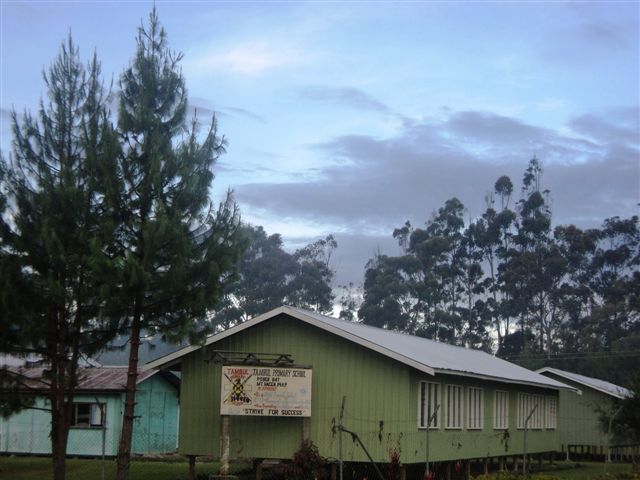 |
| The well-maintained Tambul primary school |
“We have law and order problems, however, these are minimal.
“Tribal fighting has reduced greatly.
“Alcohol and drug problems are being addressed with the help of churches.
“That’s why we are pumping a lot of money into the churches.
“We try to keep peace and good order through conflict resolution.
“We encourage conflict resolution through Peace Foundation Melanesia.”
Rural electrification and water are other priority areas of the Tambul-Nebilyer JDPBPC, with plans in place to bring these to all villages.
Diplomat anger at wasted Papua New Guinea aid
The extraordinary remarks by PNG's High Commissioner Charles Lepani came as the Coalition called for an urgent investigation into apparent "systemic criminal behaviour" in foreign aid.
The Daily Telegraph yesterday revealed Australia's $4.5 billion foreign aid program was plagued by fraud, with 175 cases under investigation including 71 in PNG.
High levels of fraud were also reported in Indonesia, the Philippines and the Solomon Islands, raising concerns about how well the program was being policed.
AusAID director-general Peter Baxter denied the scheme was "riddled with fraud" as he defended the level of corruption during a string of media appearances.
But Mr Lepani - a respected diplomat in Canberra - lashed out at the exorbitant spending on Australian-based contractors and consultants.
"Fifty per cent of that has not worked. It has not built capacity in PNG and a lot of it has to do with Australian management companies getting a lot of money but not delivering on what they are supposed to do, in terms of building capacity in Papua New Guinea," Mr Lepani said.
Despite his criticism, Mr Lepani denied fraud was "out of control" in his homeland: "No, I wouldn't say that."
Opposition foreign affairs spokeswoman Julie Bishop said that "reports of corruption within Australia's foreign aid program appear to reveal a level of systemic criminal behaviour".
She called on the Government to investigate the claims.
Magical Tambul, Western Highlands
Last time I visited magical Tambul, Western Highlands, was in September 2009 when I travelled there for the opening of 12 new potato screen houses belonging to the Fresh Produce Development Agency.
 |
| Magical sunrise in Tambul |
The cold, fresh, Mt Hagen air hit my face as I stepped off the plane to be met by NARI staffer, Kennufa Mou, who was to drive me to Tambul.
Memories of another day came running back as I had, during my stint with the Coffee Industry Corporation from 1998-2002, driven so many times around the highlands.
Mou, during our drive up to Tambul, briefed me on developments there, including the sealing of a 17km stretch of the Tomba-Tambul road by Dekenai Construction Ltd, which is expected to be completed by July and open up a whole new world of opportunities for Tambul people.
 |
| Project signboard along the Tomba-Tambul road |
These streams join rivers such as the Lai in Enga which flows on to the mighty Sepik River, while others join the Kaguel, which flows down south to join the Purari in Gulf province,
As we round another bend, the panorama of the Kaguel valley, Tambul and majestic Mt Giluwe towering in the distance, unfolds.
 |
| Mt Giluwe towers over Tambul |
Tambul, situated to the west of Mt Hagen and bordering Enga and Southern Highlands provinces, is famous for its fresh vegetables.
In fact, it is the single biggest producer of fresh vegetables in the country such as potatoes, broccoli, cabbages and cauliflower.
 |
| Brocolli farm belonging to the PNG Bible Church |
Its people are some of the hardest working who still value their subsistent way of living.
Tambul station is about 2,224 m above sea level at the foot of Mt Giluwe, and was established as a government patrol post in the 1950s, with the first highlands highway passing through it in the 1960s to Mendi in Southern Highlands.
Believe it or not, ice and snow are regular occurrences here, and the place is freezing cold.
Tambul is already contributing in a big way towards development of agriculture in this country, with the research station.
It also has some of the best services found in a rural area such as good roads, health, education, mobile phone, district treasury and internet to enable local people and NARI scientists to be in touch with the world.
Take your laptop with you, plug in your modem, and you’re in touch with the world from this rural part of PNG!
Tribal fighting and law and order issues have been kept to a bare minimum, and local people respect government facilities at the station.
I spent an enjoyable Friday afternoon with NARI staff including programme manager Johannes Pakatul, as well as my former Aiyura National High School mate, scientist Kud Sitango, who showed me around beneath the towering presence of Mt Giluwe.
 |
| NARI agriculture station manager Johanes Pakutul in a wheat field |
You could be forgiven for thinking that you were in America as the PNG Bible Church mission station has well-kept old style missionary houses in picture-perfect settings.
 |
| Picture-perfect missionary house at Tambul |
“I enjoy doing this very much,” Pastor Rambal Poponawa of the PNGBC tells me.
 |
| Pastor Rambai Poponawa at the guest house at Tambul |
“I want to see beauty.
“We want to create an atmosphere in which people can feel the presence of God.”
The amazing thing is that the school is entirely self-funding, mainly from the sale of fresh vegetables to established buyers in Port Moresby.
“Our church is financially independent,” Poponawa adds.
“The main funding for the school comes from the sale of vegetables.”
That night, even under three blankets, the freezing cold seeps right through to my bones!
Early last Saturday morning, NARI staffer James Laraki and I take a walk around the station, absorbing the sights and sounds of this mountain paradise, before the field day.
 |
| Another Tambul sunrise |
An icy-cold typical Tambul downpour also cut short the event and had visitors running for cover.
With the theme ‘Enhancing sustainable farming for rural farmers’, the event provided an opportunity for the people of Tambul and visitors alike to learn about activities undertaken, meet scientific and technical staff, tour the grounds and facilities, and gather information on other activities NARI undertakes throughout the country.
This event provided the chance to people to find out more about the research and development activities undertaken by NARI in the high altitude highlands region of PNG and how they can source and adopt them.
After the field day, I venture to the immaculate residence of local MP and Civil Aviation Minister, Benjamin Poponawa, where he is talking to local villagers.
.JPG) |
| Tambul-Nebilyer MP and Civil Aviation Minister Benjamin Poponawa. |
“But there is no incentive for people to work in their gardens.
“My people of Tambul-Nebilyer are running PMVs in Port Moresby and Lae.
“We have to bring them back.
“We need funding assistance to support our programmes.”
Poponawa says that in 2009, while opening the district treasury, Prime Minister Sir Michael Somare made a commitment of K5 million to the district but this had not been forthcoming because of “bureaucratic red tape”.
“A lot of programmes will go ahead if there is no bureaucratic red tape,” he adds.
“We have to make rural communities all over PNG attractive,
“One way is through assistance to agriculture programmes.
“Our district has gone out of its way to get agriculture experts from Israel, who will be arriving soon.
“Our major objective in the district is road infrastructure.
“Once that is in place, all services will follow through.”
Apart from the national government-funded Tomba-Tambul road sealing, Poponawa’s joint district planning and budget priorities committee has allocated K7.5 million funding for the 22km Tambul-Piambil upgrading, 10km Tambul-Upper Mendi, 7km Tambul ring road, 7km Pokerapul-Sisinpi, 10km Highlands Highway-Porabruk, and 12km West Kambia.
He is mindful of the new opportunities the liquefied natural gas project in neighbouring Southern Highlands will bring to his people.
“Tourism, especially through Mt Giluwe, and vegetables are a pot of gold that the people of Tambul are sitting on,” Poponawa says.
“NARI, however, is concentrating on research and development, and this is where extension services need to come in.
“We need to put up a cool room here for vegetables, as the LNG project is just around the corner, in Southern Highlands.
“The majority of people have land which they can utilise to grow vegetables, however, we need to look for markets for these people.
 |
| Potato field at NARI's high altitude research station |
“Guest house operators need to be trained.”
Driving out of Tambul on a cold Saturday afternoon, after talking with Poponawa, I thought long and hard about the example Tambul has set for the rest of PNG.
Civilisation is here, in rural areas such as Tambul, not in the towns and cities.
Prime minister: Henimbha, it’s OK
SIR Michael Somare appeared a contented man as he left courtroom one at the Waigani courthouse about 4.15pm yesterday, The National reports.
Asked at the doorway to comment on the tribunal’s decision, he smiled and said henimbha (it’s okay) in the Sausa language, spoken commonly in the Yangoru-Saussia district, the Boiken area of Wewak’s west coast and along the Sepik highway.
Sir Michael was met with a loud applaud from the waiting crowd on the foyer of the courthouse.
He also told photographers surround his car to capture his mood: “I deserve a break, I will take a holiday now.”
Sir Michael then got inside his car to be driven to parliament, accompanied by Deputy Prime Minister Sam Abal.
At the parliament poolside, he and his cabinet ministers gathered for refreshment before calling it a day.
Sir Michael was heard later whispering to Petroleum and Energy Minister William Duma: “Now that I am going on leave without pay, I might as well rely on my horses to take me through.”
It is understood that the PM was referring to one of his other pastime of punting.
As the PM’s entourage left the courthouse, outside in the car park, there was a subdued silence among those who had that filled the court house courtyard and car park.
Following the tribunal decision, Sir Michael released a media statement that he “respects the rule of law and, therefore, accepts the penalties” handed down by the tribunal.
Sir Michael apologised to the people, saying: “As a leader, I take full responsibility for failing to fulfil certain administrative aspects of my duties and responsibilities of leadership by submitting several late and incomplete returns to the Ombudsman Commission.
“For this, I apologise to the people of Papua New Guinea for this administrative oversight.
“It is very important to emphasise, however, that the tribunal has found me innocent of any corrupt practices that fall in breach of the substantive provision of the Organic Laws on Leadership.
“Further, I was found innocent of any false or misleading statements.
“Rather, the tribunal found that my breach of the Leadership Code was simply an administrative offence involving later and incomplete statements.”
Sir Michael said for this reasons, “I welcomed and supported the earlier decision by the tribunal not to suspend me from office pending its deliberations”.
He said the establishment and operations of the tribunal clearly demonstrated that no one was above the law but should be treated equally.
The prime minister said these were both important principles that he had worked to protect during his 42 years in public office.
“I must make it clear that I have never sought to avoid dealing with the substance of the Ombudsman’s case,” he said.
“Rather, I was exercising my constitutional right to have my substantive matter heard that has been before the Supreme Court for the last three years.”
Sir Michael said while on suspension, he would visit his East Sepik electorate and spend quality time with wife Lady Veronica, children and grandchildren.
Deputy Prime Minister Sam Abal will be acting prime minister for the next two weeks.
“Abal is a bright and strong leader of the younger generation and he has my full confidence during this time and in the future,” the prime minister said.
“In accepting full responsibility and the suspension, I am pleased that this chapter of my long political career is now closed.
“I look forward to, with the help of my government, completing this term of parliament before retiring.
“I seek to carry my responsibilities to the people of PNG and fulfil our collective vision of a bright and secure future for present and future generations.”
Thursday, March 24, 2011
Millions lost in AusAID foreign aid scam
AusAID has 175 cases of fraud under investigation - stretching across 27 countries and totalling millions of dollars.
Documents released under Freedom of Information expose a criminal trail in some of the world's poorest countries, with widespread theft of money and forging of receipts.
They also show how food and other supplies are being diverted from dirt-poor communities and sold on the black market at inflated prices.
While AusAID insists it is improving fraud control, the documents also reveal police are often reluctant to intervene and charge local criminals - frustrating the agency's attempts to recover missing aid money.
In one extraordinary case, the Eritrean Government in 2006 seized food and other supplies from the UN's World Food Program, saddling Australian taxpayers with a probable loss of $1.25 million.
The revelations will do little to boost public confidence in a foreign aid program that is forecast to nearly double to $8 billion a year by 2015.
PNG emerged as corruption central with 71 cases of identified fraud - 40 per cent of the AusAID total - involving millions in missing funds.
Indonesia, which will receive $458 million in Australian assistance in 2010/11, recorded 31 fraud cases, followed by the Philippines at 20 and Solomon Islands with 19.
AusAID director-general Peter Baxter said fraud levels in foreign aid compared "very favourably" with domestic agencies like Centrelink.
"The level of fraud in our program from 2004/05 until December 2010 was 0.017 of 1 per cent of the $20 billion that had been appropriated to AusAID during that period," Mr Baxter said. And he denied fraud was on the increase, despite 16 cases being reported last November alone.
But FOI documents reveal how taxpayers' money is being squandered, with corrupt local officials and agencies profiting at the expense of the poor. Australia is one of the biggest aid donors in the world, focusing on the Asia-Pacific although the Government wants to expand its aid funding into Africa over the coming years.
The FOI documents reveal the difficulties of trying to manage a $4.5 billion budget while dealing with some of the most corrupt nations in the world. One investigation in Fiji, involving fraud of $37,670, has been closed with AusAID declining to report the matter to police "due to the highly sensitive political environment" in the Pacific island nation.
Other times, AusAID has struggled to establish fraud "because of the lack of a paper trail" while on other occasions businesses were paid money but then closed their offices.
An unknown amount of AusAID funds were caught up in a major scandal involving the African country of Mali with health workers allegedly embezzling hundreds of thousands of dollars.
The fraud involved "managing contractors" paid hundreds of millions to manage aid projects - including Cardno Limited, involved in 40-odd cases of fraud.
Asked bluntly whether fraud was out of control, Mr Buckley said "I wouldn’t say that".
Equally he conceded that "any lost dollars are not good".
"We are trying to deal with it," he said, of Cardno’s efforts to combat fraud.
"We reckon that we do a pretty good job."
He said Cardno – one of the biggest managing contractors to AusAID - have to report any suspected areas of fraud within 24 hours of hearing about it.
He said Cardno had "good processes" in place to detect fraud.
Tribunal suspends Somare for 14 days
A three-man leadership tribunal in Port Moresby handed down the decision this afternoon to a packed courtroom that for two weeks has heard the case regarding Sir Michael’s failure to lodge financial returns dating as far back as 20 years ago.
The tribunal chair Roger Gyles says the prime minister is suspended from office from and including April the 4 for 14 days.
 |
| Crowd outside the court room. |
 |
| Smiles from Somare supporters |
S
 |
| Somare and his deputy Sam Abal leave the court room |
 |
| Subdued crowd leaves the court house |
 |
| Somare's daughter Betha leaves the court house |
 |
| National Alliance 'big boys' Simon Kaiwi and Steven Pokawin (obscured) talk to journalists outside court. |
Verdict on prime minister slated for 4pm
penalty has been imposed on him by the leadership tribunal which has
found him guilty of 13 of 25 charges of breaching the leadership code,
The National reports.
Whether he remains prime minister is one of the penalties being considered.
The charges related to lateness and incomplete annual financial
returns statements between 1994 and 1997.
Yesterday afternoon, the tribunal sent out a public notice saying it
would hand down its decision beginning at 4pm today.
On Tuesday, the prosecution had submitted to the tribunal to impose
the maximum penalty of dismissal.
However, the prime minister's defence team of Posman Kua Aisi Lawyers
principal Kerenga Kua and Justin Wohuinangu, led by overseas lawyer
Ian Molloy, argued that the charges did not warrant dismissal,
submitting that he should be fined K500 for each of the 13 charges.
Molloy argued that Sir Michael had attempted to lodge all his annual
returns in his busy schedule that also included changing offices from
Port Moresby to Wewak and on some of these occasions, not being a PM.
He argued that late lodgment or incomplete annual return forms Sir
Michael had lodged was not as severe as that committed by other MPs
over the years since PNG's independence, for which they had only being
penalised fines of between K500 and K1,000 per charge.
Molloy had argued that some of these leaders had totally failed to
lodge their annual returns or had been charged with non-accountability
of public funds and that their penalty were monetary fines.
Wednesday, March 23, 2011
A thought for Hula

We love and miss you so much...Malum and our children Malum Jr, Gedi, Moasing and Keith.
Tuesday, March 22, 2011
Prosecutor calls for Somare to be sacked
Papua New Guinea's public prosecutor has called for the prime minister to be dismissed from office after he was found guilty of official misconduct.
A leadership tribunal yesterday found Sir Michael Somare guilty of 13 counts of filing late and incomplete financial returns to PNG's Ombudsman Commission.
In his sentencing submission, prosecutor Pondros Kaluwin said politicians found guilty of similar offences in the past had not been punished with dismissal.
But he said this case is more serious because Sir Michael is the prime minister and "the higher the office, the higher the responsibility".
Sir Michael's lawyer, Ian Molloy, argued against dismissal, saying there was no dishonesty involved and his client had "an extraordinary and unblemished public record".
The tribunal said it hoped to make a decision on the 74-year-old leader's penalty this week.
Who is Hudson Ramatlap protecting?
Bulolo MP
I refer to the comments by the first legislative counsel, Mr Hudson
Ramatlap, and note with great concern that a person who is supposed to
protect the independence of Parliament legislative process is now
making outlandish comments in support of the contemptuous behaviour of
the Prime Minister.
His statement is not only misleading, but calculated to undermine the
seriousness of this matter.
This is not just another political scoring issue here it is an issue
of national importance.
The first misleading statement is his reference that Belden Namah and
Dr PukaTemu whose names are also on the Gazettal Notice.
Their names are not there.
I can pass a copy to him if he so pleases.
I know he has a copy of the notice but deliberately wanted to mention
their names.
This is contemptuous in itself as he is trying to water down the
seriousness of this case and the implications it has on the judiciary.
Secondly, Mr.Ramatlap as a lawyer knows that an appointment does not
take effect until it is gazetted.
It is trite law that a purported performance of duty by a minister
without having his appointment gazetted is null and void.
It can also be noted on the gazettal notice that Mr Pruaitch's
gazettal does not mention him as Finance and Treasury Minister to show
that he is a finance minister suspended on full pay, or to confirm
that this is just a republishing of the original Gazettal dated 13th
September 2007 as claimed by Mr Ramatlap.
Instead it is a new portfolio (State Minister assisting PM) and that
portfolio takes effect upon gazettal.
This is also deliberately stated by Mr Ramatlap to further confuse the
public of the serious nature of the matter.
Mr Pruaitch and Mr Ramatlap are alleging that the decision of the
Supreme Court does not stop the Prime Minister from appointing a
Minister.
In other words, they are claiming that the Prime Minister had
unfettered powers to appoint a Minister, even in contempt of the
Supreme Court Order.
How sensible is that?
I have sought opinion on the Supreme Court decision and whilst the
decision does not state the details of being suspended on pay, which
is left to be an administrative matter, the decision in no uncertain
terms declares Mr Pruaitch automatically suspended as a leader.
Mr Pruaitch is not attending Parliament sitting or attending NEC
decisions which is the effect of him being suspended as a "leader".
It follows that Mr Pruaitch's justification of his new portfolio can
be said that he wants to be a minister without the name "leader"
because under the name leader, he is suspended.
Can the Judiciary see how important it is to protect its independence
or continue to subject itself from political interference?
I am concerned because we are setting double standards and weakening
the institutions that we look up to as our beacon of hope.
Where is the rule of law?
The Prime Minister is in clear contempt and should be cited for
contempt of court.
I reiterate that this is not the first time that the Prime Minister did this.
He is known for interfering and scandalising the judiciary.
We cannot allow that to happen.
I do not need to influence the judiciary as they are learned people
who know the legal implications of this issue.
What I am saying here is my concern as a national leader to protect
the independence of the judiciary.
Tribunal finds prime minister guilty of 13 counts
 |
| Prime Minister Sir Michael Somare leaving the Waigani court premises with his deputy Sam Abal after yesterday's leadership tribunal found the prime minister guilty of 13 counts.-Nationalpic by EKAR KEAPU |
Prime Minister Sir Michael Somare sat expressionless as the judgment was read by tribunal chairman Roger Gyles, in summary.
It took no more than five minutes as he summarised the tribunal’s main findings.
The tribunal also said they would be making recommendations, relating to this proceeding, to the head of state, the governor-general.
However, prior to making any recommendations to Government House, pursuant to section 27(5) of the Organic Law on leadership, it would “provide an opportunity for further submissions and/or evidence”.
These, it will hear today at 9.30am through submissions on penalty from both parties.
Sir Michael is the first prime minister to be tried by the leadership tribunal in relation to his annual returns from 1994 to 1997.
The not guilty and dismissed charges related to his returns between May 1997 and May 2004.
The latter years were regarded as “unnecessary” and not pressed by the prosecution because they were outside the 1994-97 period which the Ombudsman Commission had initially investigated and brought charges against in 2006.
Of the 13 guilty charges, eight were allegations relating to incomplete statements while five counts were related to delay in providing such statements to the ombudsman.
In the 44-page judgment, the judges explained that there were no other allegations of corrupt practices or breach of any substantive provisions of the Organic Law on leadership by Sir Michael except the allegations on delay and incomplete statements.
In respect of Sir Michael’s duty under section 4 of the Organic Law on leadership, to provide to the Ombudsman Commission timely and complete annual financial statements, the tribunal:
* Found him not guilty of all three of the effective allegations against him of misconduct in office by failure to provide such statements, namely allegations 2, 3 and 4, and had summarily dismissed two others, namely allegations 1 and 5, as unnecessary;
* Found him guilty of all five of the effective allegations against him of misconduct in office by delay in providing such statements to the Ombudsman Commission, namely allegations 7, 8, 9, 10 and 12, and had summarily dismissed three others, namely allegations 6 and 13 as unnecessary and allegation 11 as it was not pressed by the public prosecutor; and
* Found him guilty of the eight effective allegations against him of misconduct in office by providing to the Ombudsman Commission incomplete statements, namely allegations, 15, 16, 18, 19, 20, 21, 23 and 24, and had summarily dismissed four others, namely allegations 14 and 25 as unnecessary and allegations 17 and 22 as they were not pressed by the public prosecutor.